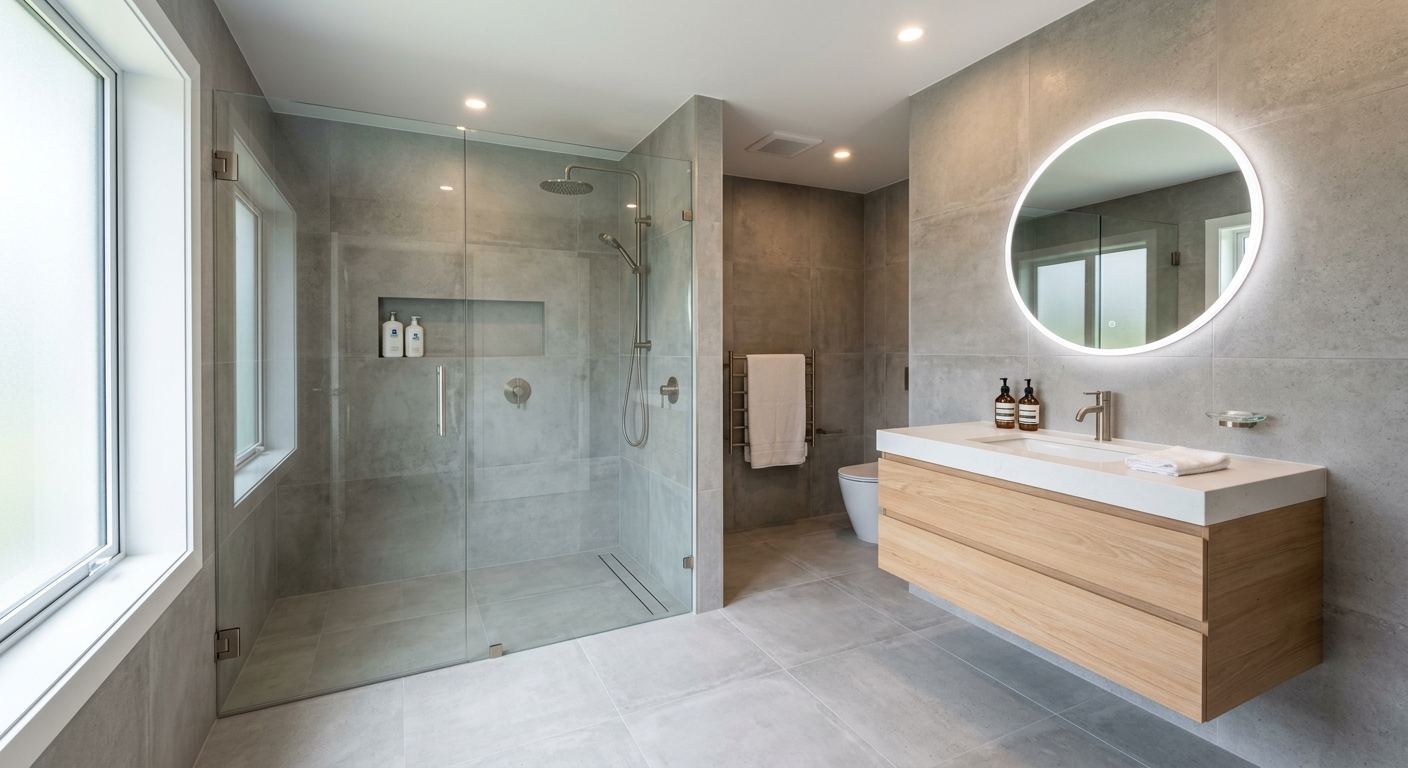
Bathroom renovation options and costs in Country Hills Village
Bathroom renovation options in Country Hills Village tend to follow the same pattern: the “start price” looks straightforward, but the final cost depends on what gets uncovered once the walls come off. In a community of about 2,480 residents (Statistics Canada, 2021 Census), many nearby homes were built long enough ago that older plumbing layouts and dated drainage details are common. That matters in Calgary-area basements and main-floor bathrooms, where contractors often see cast-iron or aging drain stacks and the kind of subfloor movement that can make tiles fail early. In older housing, there’s also a realistic chance of asbestos-containing materials in floor tile or older drywall compounds, which can trigger added testing and abatement steps.
In the Calgary economic region, pricing is driven more by local labour rates and the condition of the housing stock than by weather extremes. Alberta’s freeze–thaw cycles and indoor humidity cycles don’t usually change labour pricing, but they do raise the importance of proper waterproofing and ventilation—meaning skilled trades and specific membrane systems aren’t optional. Contractor availability in the Calgary metro can also influence timelines and costs, especially when multiple trades are needed concurrently for rough-in, electrical, and tile.
In Country Hills Village, I’m most often asked to renovate bathrooms around the Country Hills Boulevard and along the transit corridor where older homes meet more owner-occupied turnover—those are busy spots for carpentry, plumbing, and tile crews. With that in mind, here’s a practical comparison of renovation scopes so you can budget confidently before the “hidden-scope” conversation begins.
| Renovation Scope |
What's Included |
Typical Duration |
Price Range |
| Cosmetic refresh (paint, fixtures, accessories only) |
New vanity or faucet, toilet swap, updated lighting, paint, caulking refresh, accessories (towel bars, mirrors), deep-clean/seal where needed |
3–7 days |
$3,500–$7,500 |
| Mid-range full renovation (new tile, vanity, tub/shower, electrical) |
Demo and disposal, new vanity and mirror, tub/shower or surround rework, new tile floor and walls (standard sizes), exhaust fan + GFCI circuit (as needed), upgraded plumbing fixtures, waterproofing and grout sealing |
2–4 weeks |
$15,000–$24,000 |
| High-end full renovation (custom tile, steam shower, heated floors) |
Higher-spec tile (custom layouts), heated floor wiring/cabling, steam shower package, upgraded ventilation, possible layout refinishing, premium fixtures, enhanced waterproofing and niche/bench work |
4–7 weeks |
$24,000–$35,000 |
| Shower-only installation (convert tub to walk-in shower) |
Tub removal, new walk-in shower pan, tile surround, grab-ready framing as applicable, plumbing changes for new drain/supply locations, waterproofing, exhaust ventilation review |
1.5–3 weeks |
$8,500–$16,000 |
| Bathtub replacement or tub-liner install |
Option A: replace tub and re-set surround with new caulking and trim; Option B: tub-liner install (surface prep, liner, sealing) depending on existing condition |
1–2 weeks |
$1,200–$3,000 |
| Tile-only installation (floor + surround, existing layout kept) |
Tile floor and wall re-tiling, underlayment prep, waterproofing to required areas, grout and sealing, basic finish trim, assumes plumbing remains in current locations |
1.5–3 weeks |
$6,000–$14,000 |
Prices are estimates only and vary by project scope, site access and material selection.
What affects the price of bathroom renovation in Country Hills Village
In Country Hills Village and across the Calgary region, you can see the same bathroom renovation quoted 30–50% apart. The reason is usually not “tile shopping” or personal preference—it’s the starting condition of the home and how many hidden-scope items the contractor must address to make the finish last. Labour rates in Calgary-area metros are a primary driver, and older housing stock often requires extra plumbing and ventilation upgrades once walls are opened. That’s why even a job that looks like a mid-range renovation can move toward the higher end of the $15,000–$30,000 full-reno band when rough-in work and backer/waterproofing details are upgraded.
Age also matters because older bathrooms may have drain assemblies that are worn, undersized, or corroded. In some homes, supply lines are galvanized and need re-routing to meet proper pressure and reliability. Ventilation upgrades are another cost influencer: a bathroom with inadequate exhaust can trap moisture, increasing the risk of grout breakdown and mouldy caulking—so contractors often include fan upsizing or duct routing. In pre-1985 homes, asbestos-containing materials can be present in vinyl floor tile or certain drywall compounds; discovery can add $1,500–$5,000+ for testing and abatement coordination, moving your budget quickly.
Concrete examples I see locally: (1) If you change the vanity location even by a couple of feet, you’ll likely pay more for drain and supply rough-in, which can add rough carpentry and patching time. (2) Upgrading from standard ceramic to larger-format porcelain often costs more in materials and labour because of setting-bed prep and layout planning to reduce lippage. (3) If the bathroom subfloor is uneven, the “tile-only” plan stops being purely tile and turns into self-levelling/repair work—pushing costs toward the tile band and sometimes into a full remodel.
| Price Factor |
Why It Matters |
Cost Impact |
| Layout change — moving drain or supply lines requires rough-in work |
New locations mean opening walls/floors, rerouting piping, and patching for a waterproof finish |
Often adds $2,000–$8,000 depending on distance and access |
| Tile selection — large-format porcelain vs. mosaic vs. ceramic |
Format affects setting technique, lippage control, and how much waste you generate |
Can shift your tile budget by $1,500–$6,000 |
| Fixture tier — builder-grade vs. mid-range vs. designer brands |
Higher tiers cost more per unit and may require additional trim/valve compatibility |
Typically adds $500–$4,000 |
| Subfloor condition — rot or unlevel concrete adds scope |
Repairing structure and achieving flatness is critical for tile longevity |
Often adds $1,000–$5,000 for prep and reinforcement |
| Electrical — adding GFCI outlets, exhaust fan, heated floor circuit |
Bathroom electrics must be safely installed; heated floors require proper circuit planning |
Can add $600–$3,500 |
| Waterproofing method — membrane type and extent |
Full-area coverage and correct system build-up prevents moisture issues |
Usually adds $800–$4,000 versus basic approaches |
| Older-home surprises — asbestos tile, cast-iron drains, galvanized pipes |
Testing/abatement and plumbing replacement expand scope after demo |
Commonly adds $1,500–$10,000+ when discovered |
| Bathroom size — sq ft drives tile and labour time directly |
Tile area, waterproofing coverage, and labour hours scale with square footage |
Can add $2,000–$8,000 between small and larger layouts |
Permits & regulations in Alberta
In Alberta, cosmetic upgrades usually don’t require permits. That typically includes swapping fixtures in the same locations—like replacing a vanity top, toilet, faucet, mirror, or repainting, as well as retiling where plumbing points remain unchanged. However, permits are commonly required when you relocate plumbing. That means moving a drain or supply line, changing the location of the toilet, rerouting water lines for a new vanity position, or any rough-in work that alters how water waste is carried through the home.
Electrical also changes the permit picture. If you’re adding or modifying circuits—such as installing or upgrading an exhaust fan, adding a heated floor circuit, or introducing additional GFCI-protected bathroom outlets—work must meet provincial electrical code standards and be performed by (or signed off by) a licensed electrician. Structural or framing changes (like moving a wall or opening up framing for venting) can also trigger permit/inspection requirements depending on the scope.
For a homeowner in Country Hills Village, verify licensing and coverage before signing:
- Ask for the contractor’s Alberta trade licence number (or their registration details) and confirm it on the appropriate online registry used for that trade.
- Request a current certificate of insurance (general liability) showing the effective dates and contractor name.
- Confirm clearance/coverage for work by reviewing evidence of WCB/WSIB-type coverage (commonly requested in Alberta as WCB clearance or account proof).
- Have the contractor provide a written statement of what permits they will pull (and whether permit fees are included in the quote).
Step-by-step: (1) shortlist 2–3 contractors, (2) request licence/insurance documents in advance, (3) compare what’s included for permits and inspections, and (4) only then lock a start date.
Choosing tile, waterproofing and fixtures for your Country Hills Village bathroom
In a Country Hills Village bathroom renovation, three material decisions usually decide your total budget: tile choice, waterproofing system, and fixture tier. First, tile: entry-level ceramic is often the most affordable per square foot, but it can be less forgiving in high-traffic showers if the installation isn’t precise. Mid-range porcelain gives better water resistance and durability for floors and wet areas. Natural stone (marble, travertine, slate) can look luxurious, but it often costs more in materials and labour, and it may require sealing and careful selection for slip resistance.
Second, waterproofing: Alberta bathrooms experience repeated humidity cycles, and the risk isn’t just visible mould—it’s hidden water migration behind finishes. Paint-on membranes can work for limited scenarios, but in full shower builds most homeowners choose a bonded sheet membrane or a proven system that includes proper bonding, seams, and a complete build-up to the curb/transition areas. The right approach prevents slow failures that show up as loose grout, musty odours, or deteriorating substrates.
Third, fixture tier: builder-grade fixtures save on upfront costs, while mid-range and designer brands can reduce maintenance annoyance and improve consistency (valves, finishes, trims). The cost can be justified if you plan to stay in the home and want long-term resale appeal.
Where does the money actually make sense? For example, a mid-range full renovation may land around the $15,000–$24,000 range with standard tile and reliable waterproofing. Upgrading to heated floors and a higher-tier tile layout can push you toward the high-end band, but switching from ceramic to porcelain floors is usually a better value than upgrading everything else at once—especially if your goal is durability in a Calgary winter-to-summer moisture cycle.
| Material / Option |
Pros |
Cons |
Price Range |
| Ceramic tile (floor + walls) |
Lower material cost, wide colour options, good for budgets when installed correctly |
Can be less durable than porcelain in wet or heavy-use zones; requires careful slip selection |
$3,000–$7,500 |
| Porcelain tile (floor + walls) |
Higher water resistance, strong durability, better choice for shower surrounds and floors |
Costs more and may require more precise layout/cutting |
$5,000–$12,000 |
| Natural stone (marble, travertine, slate) |
High-end look and unique veining; premium feel for feature walls or niches |
Higher material and labour; sealing and maintenance; must be selected for slip resistance |
$8,000–$18,000 |
| Frameless glass shower enclosure |
Modern look, visual openness, easy wipe-down |
More expensive hardware; requires accurate framing and waterproofed base |
$2,000–$6,000 |
| Prefab tub surround (acrylic) |
Fast install, consistent finish, typically lower labour risk than tile |
Limited style options; edges and joints still need good sealing |
$500–$2,500 |
| Custom shower pan (tile or linear drain) |
Best drainage and slope control; supports linear drain aesthetics and durability |
More labour and waterproofing detail; design choices affect cost significantly |
$1,800–$7,500 |
How to choose a bathroom renovation contractor in Country Hills Village
Choosing the right contractor is less about ads and more about proof. Start with Alberta licensing and coverage. Ask your contractor for: (1) their Alberta trade licence details for the trades they lead, (2) their general liability insurance certificate (with the correct contractor name and active dates), and (3) WCB/WCB clearance-type evidence so you know workers’ coverage is in place. If a contractor can’t provide documents or seems annoyed by verification, that’s usually a sign the scope and risk management aren’t handled carefully.
Next, get 2–3 itemised written quotes. You want a breakdown that separates labour and materials, not just a single total. Look for line items covering demo/disposal, waterproofing, electrical scope, tile setting, substrate repair, and any permit fees. Confirm exclusions clearly—especially what happens if the contractor discovers issues like failing subfloor, cast-iron drains, or asbestos-containing materials. A professional quote will either include a contingency allowance or explain an approach for discovery and how costs are approved.
Review warranty terms: confirm the workmanship warranty length, what it covers (for example, tile cracking vs. membrane failure), whether it’s transferable to future owners, and how manufacturer warranties work for fixtures and tile systems. Payment schedules should be conservative—never more than about 10–15% upfront. Hold back part of the balance until key milestones are complete (panelling, waterproofing sign-off, and final finish).
- Request proof of Alberta trade licence for the relevant trade roles.
- Verify general liability insurance certificate and effective dates.
- Ask for WCB/clearance evidence for workers.
- Use itemised quotes with labour vs. materials separated.
- Confirm whether demolition and disposal are included.
- Clarify what waterproofing system is being installed (and where).
- Check if permits are included and who pulls them.
- Look for a detailed schedule: start date and completion estimate.
- Verify fixture allowance amounts (and what happens if you exceed them).
- Confirm the warranty covers workmanship and how to make a claim.
- Keep a holdback until waterproofing and tile are fully finished.
- Ask how the contractor handles hidden-scope discoveries and approvals.
Red flags I see in Country Hills Village: contractors who won’t share licence/insurance details, quotes that ignore disposal and permit scope, vague waterproofing descriptions, heavy reliance on “allowance” pricing with no numbers, and payment requests that front-load too much money before demo and rough-in milestones.
Frequently asked questions — bathroom renovation in Country Hills Village
How do I compare bathroom renovation quotes?
Start by comparing apples to apples: ask each contractor to provide itemised quotes that separate labour and materials, including demo/disposal, waterproofing, tile setting, electrical scope, and whether plumbing is staying in place. In Country Hills Village, hidden-scope is common in older homes—so look for language about how cast-iron/copper drainage, galvanized supply lines, or possible asbestos discoveries will be handled (testing/abatement and approval steps). Also compare product allowances: a “mid-range” vanity or fan can vary widely in cost and quality. Finally, ensure price is tied to scope—if one quote is in the full-renovation range (for example, the $15,000–$24,000 band) but another is much lower, ask what they’re excluding (permits, disposal, waterproofing system, or electrical upgrades).
Can I live at home during a bathroom renovation in Country Hills Village?
Often, yes—especially during cosmetic refreshes or when you can keep a functional half-bath. For a full bathroom renovation, living at home is possible but typically requires a plan for water shutoffs and bathroom downtime. Many projects start with demo, then rough-in and waterproofing, and finally tile and finishes. In Calgary-area basements and older main floors, plumbing changes may require short periods without shower access. If you’re converting a tub to a shower or moving drains, expect more disruption than a tile-only refresh. A reputable contractor will provide a staged schedule in writing and protect your home with dust control. If there’s a second bathroom, you’ll usually be more comfortable; if not, it’s smart to budget for temporary access (work schedule, family arrangements, or a short break).
What's the best bathtub material for a Country Hills Village home?
For most Country Hills Village homeowners, the “best” bathtub material is the one that matches how your bathroom is used and how your plumbing is set up. Acrylic tubs are common because they’re lighter and install relatively quickly; they can be a good choice if you want to keep costs down and avoid structural complexity. Enamel steel is durable but can feel colder and may require careful leveling. If you’re dealing with an older base where the tub surround is worn, a tub-liner can be budget-friendly, but it depends on the substrate condition and surface prep—poor prep can lead to adhesion failure. In practical terms, for a bathtub replacement or tub-liner plan, many renovations land in the $1,200–$3,000 range, but the “best” option depends on whether you need waterproofing changes and whether electrical/ventilation is being updated as part of a broader remodel.
Is it worth renovating a bathroom before selling in Country Hills Village?
It can be worth it, but only if you focus on high-impact upgrades that buyers notice and that protect the home for the next few years. In a community like Country Hills Village with older housing stock in the wider Calgary area, bathrooms often have wear-and-tear issues—failing caulking, dated fixtures, or poor ventilation—so addressing those can prevent objections at the inspection stage. However, overspending on high-end finishes without matching the rest of the home can reduce your return. A sensible approach is to budget for the scope that fixes the biggest risks: proper waterproofing, ventilation, and durable tile, then modern but practical fixtures. If you’re considering a full renovation, remember the range commonly sits around $15,000–$30,000 for Calgary-area projects, while a shower-only conversion can fall around $8,000–$15,000. The “worth it” decision usually comes down to how broken the current bathroom is and whether repairs are needed behind the walls.
How do I plan a bathroom renovation on a tight budget in Country Hills Village?
Plan for priorities rather than perfection. If your budget is tight, start with the parts that prevent costly failures: waterproofing and ventilation, then fix any subfloor issues before you tile. You can often reduce cost by keeping the layout—avoid moving drains/supplies unless necessary—because layout changes typically add rough-in work and patching time. A cosmetic refresh can be a smart first step (paint, fixtures, accessories) if the tile and waterproofing are already in good shape. If you’re aiming for a “full but focused” upgrade, consider a mid-range renovation rather than chasing luxury materials; for many projects the mid-range band lands around $15,000–$24,000 depending on tile and electrical needs. Also build contingency into your plan. In Calgary-area older homes, hidden-scope—like asbestos testing/abatement, drain upgrades, or subfloor repairs—can expand scope after demolition.
What's the difference between a cosmetic and a full bathroom renovation?
A cosmetic bathroom renovation is mainly surface and fixture updates without major demolition. It usually includes paint, replacing fixtures (like vanity top, faucet, toilet), updating lighting, and refresh work around existing tile and plumbing connections. A full renovation is what you do when you’re changing finishes and typically opening walls/floors: new tile floor/walls, new tub or shower build (including a proper pan and waterproofing), vanity replacement, ventilation upgrades, and often electrical and plumbing rough-in updates. In Country Hills Village, the difference matters because once walls are opened, contractors may find subfloor repairs, cast-iron drainage issues, galvanized supply line problems, or asbestos-containing materials in older finishes—items that can raise your budget quickly. That’s why cosmetic projects can start in the low-thousands, while full renovations commonly fall into the $15,000–$30,000 range in the Calgary economic region.