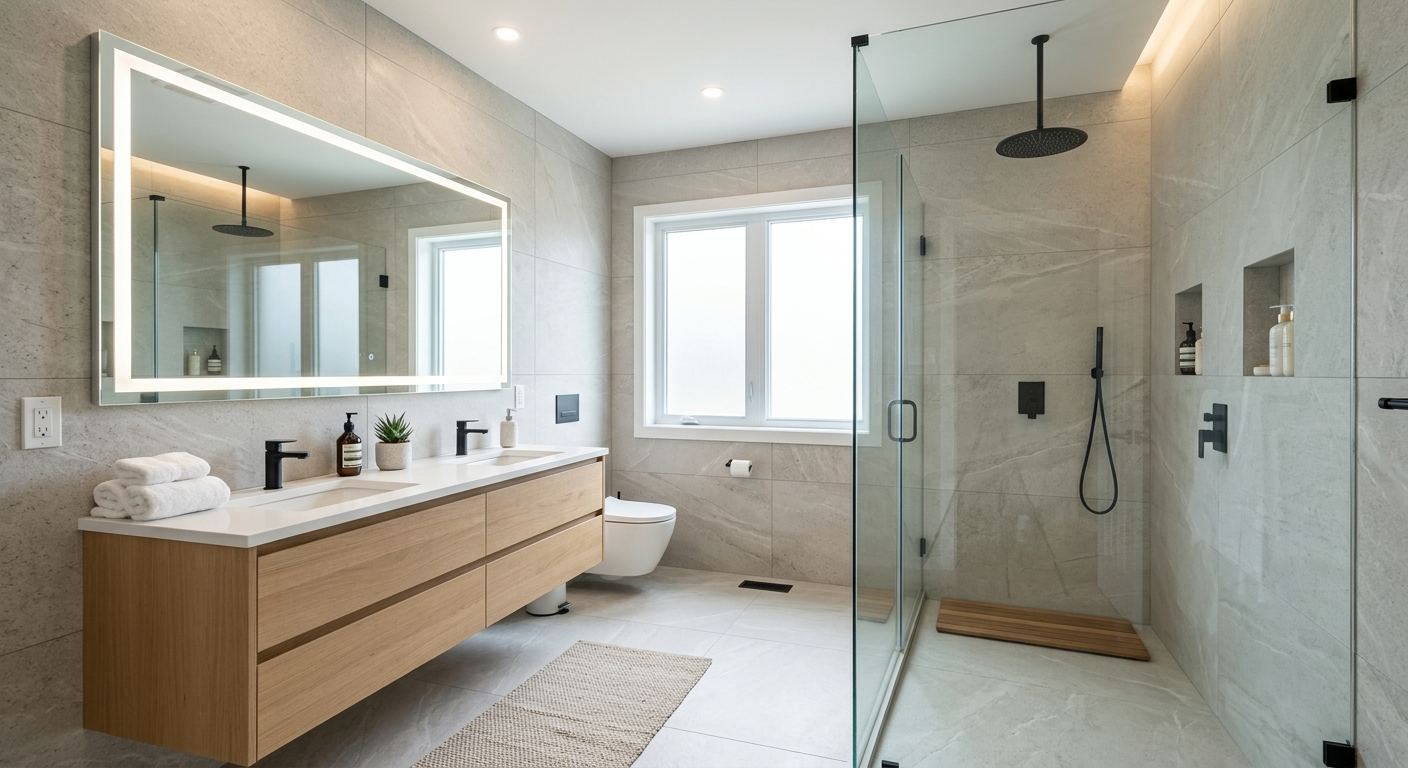
Bathroom renovation options and costs in Devon
Devon homeowners typically choose from a few proven bathroom renovation paths—because the “baseline” in this part of the Edmonton economic region is driven more by labour and code-upgrades than by climate. That matters in a practical way: nearly half of Devon’s housing stock was built before 1981, and older layouts often hide dated drain and supply piping, legacy venting, and electrical that may not meet today’s bathroom requirements. In fact, Statistics Canada reports 46.6% of homes are built before 1981, and 77.2% of households are owner-occupied—so many renos start as “make it nicer,” then expand to “make it safe and code-compliant.”
In Edmonton-area markets, skilled trades availability and oil-and-gas competition keep labour rates strong, so opening walls is expensive even before you buy tile. Many contractors also plan for contingency when they anticipate issues like galvanized supply lines, undersized exhaust ventilation, or cast-iron drain stacks that need upgrading. If pre-1985 materials are disturbed, asbestos-containing products (such as some vinyl flooring or related floor materials) can trigger abatement and specialized handling, which adds time and budget.
In Devon, trade demand is especially high around downtown Devon and the central neighbourhoods near local retail corridors, where occupied homes still need careful scheduling and dust control. If you’re budgeting, it’s smart to compare options by scope first—then decide on materials and finishes. Below is a clear comparison of the common renovation scopes and realistic price bands for this region.
| Renovation Scope |
What's Included |
Typical Duration |
Price Range |
| Cosmetic refresh (paint, fixtures, accessories only) |
New vanity top or vanity-only replacement, toilet/trim swap, paint, accessory hardware, caulking refresh; no wall opening |
3–7 days |
$2,500–$6,500 |
| Mid-range full renovation (new tile, vanity, tub/shower, electrical) |
Remove and replace floor and wall tile, new vanity and mirror, tub/shower refresh or replacement, updated exhaust fan, key electrical upgrades (GFCI), plumbing tie-ins as needed, new trims/fixtures |
2–4 weeks |
$12,000–$22,000 |
| High-end full renovation (custom tile, steam shower, heated floors) |
Custom layout, premium tile (larger formats, accent details), heated floor system, high-end fixtures, frameless or luxury shower elements, steam-ready plumbing/mechanical coordination, enhanced waterproofing details, multiple electrical circuits as required |
4–7 weeks |
$23,000–$35,000 |
| Shower-only installation (convert tub to walk-in shower) |
Remove tub, install walk-in shower base/pan, tile surround, new valve trim, plumbing rough-in and re-venting checks, exhaust fan tie-in if required |
1.5–3 weeks |
$7,000–$15,000 |
| Bathtub replacement or tub-liner install |
Replace tub and re-seal/tile transition OR install tub liner (where suitable); includes plumbing disconnect/reconnect as required, new trim and caulking |
5–12 days |
$3,000–$12,000 |
| Tile-only installation (floor + surround, existing layout kept) |
Remove existing tile, prep and waterproofing upgrades, install new floor and shower/tub surround tile, grout/seal, transitions; limited plumbing/electrical unless discovered issues |
1.5–3 weeks |
$5,000–$9,500 |
Prices are estimates only and vary by project scope, site access and material selection.
What affects the price of bathroom renovation in Devon
In Devon and the broader Edmonton economic region, you can see the same “bathroom refresh” quoted 30–50% apart because contractors price risk differently—especially once walls come open. Labour rates are a primary driver here; oil-and-gas competition keeps skilled trades wages higher, so installation time (demo, rough-in, tile, setting, curing) becomes a large share of the total. Second, the area’s housing age matters more than weather: Statistics Canada shows 46.6% of homes were built before 1981, and older bathroom build-outs often conceal cast-iron drain sections, galvanized or undersized supply piping, and exhaust ventilation that doesn’t meet modern expectations.
Older homes also tend to increase “hidden scope.” A simple floor plan change can require rough-in modifications, while missing or failing waterproofing behind existing tile can demand a full membrane rebuild. Asbestos discovery is another cost swing: if asbestos-containing materials are present in vinyl floor tile or related older floor finishes (common in some pre-1985 builds), abatement adds time and specialized labour, often pushing budgets up by $1,500–$5,000+ depending on extent.
For example, in a typical mid-range full renovation around $12,000–$22,000, the tile and fixture choices are only part of the equation; electrical and ventilation tie-ins are often what expand scope after demolition. Conversely, a shower-only conversion can land closer to $7,000–$15,000 when plumbing stays close to the existing valve location and the exhaust fan strategy is simple. Your final total in Devon usually comes down to what the contractor must “fix” to get the bathroom safely to code—not just what you want to see.
| Price Factor |
Why It Matters |
Cost Impact |
| Layout change — moving drain or supply lines requires rough-in work |
Relocating plumbing triggers demolition, new rough-in lines, pressure testing, and possible permit inspections |
Often increases project cost by 10–25% |
| Tile selection — large-format porcelain vs. mosaic vs. ceramic |
Larger tile needs flatter substrates and precise setting; mosaics add labour for small pieces and layout |
Typically shifts costs by $1,000–$4,000 |
| Fixture tier — builder-grade vs. mid-range vs. designer brands |
Premium trims and valves may require more detailed install and sometimes different rough-in spec |
Commonly adds $500–$3,500 |
| Subfloor condition — rot or unlevel concrete adds scope |
We may need subfloor replacement, flattening, and extra waterproofing prep |
Often adds $800–$2,500 |
| Electrical — adding GFCI outlets, exhaust fan, heated floor circuit |
Bath circuits must be correctly protected; heated floors require dedicated planning and wiring |
Frequently adds $600–$3,500 |
| Waterproofing method — membrane type and extent |
Better membranes and detailing (corners, seams, transitions) reduce failure risk |
Typically adds $500–$2,000 |
| Older-home surprises — asbestos tile, cast-iron drains, galvanized pipes |
Discovery can trigger abatement, drain replacement, or supply line upgrades |
Can add $1,500–$8,000+ |
| Bathroom size — sq ft drives tile and labour time directly |
More square footage means more setting time, grout lines, membrane coverage, and curing |
Usually scales by $100–$300 per sq ft of tile scope |
Permits & regulations in Alberta
In Alberta, the permit picture depends on how much you change. Cosmetic updates—like swapping fixtures, replacing a vanity, retiling within the same footprint, or refreshing paint and accessories—often do not require a permit. However, in Devon bathrooms, the work that typically does require permitting includes: moving plumbing (relocating a drain or supply line), adding or replacing an exhaust fan that involves a new circuit, making structural wall changes, and doing electrical changes that extend beyond simple like-for-like replacements. Any bathroom electrical work must meet the provincial code and be performed or signed off by a licensed electrician.
Step-by-step, verify your contractor properly before demo day. First, ask for the contractor’s Alberta trade licence information (and confirm it matches the scope—plumbing/electrical/waterproofing trades where applicable). Second, request a certificate of insurance (liability) and check that it’s current and covers renovation activities in your home. Third, confirm workers’ compensation coverage—commonly addressed through WSIB/WCB—so you’re not left holding the risk if a worker is injured on site. Where needed, ask for documentation such as a clearance letter or proof of coverage. Finally, ensure the contractor explains who pulls permits and schedules inspections, especially if plumbing rough-in or electrical upgrades are involved.
Choosing tile, waterproofing and fixtures for your Devon bathroom
In Devon, the three material decisions that most influence both budget and bathroom longevity are tile choice, waterproofing strategy, and fixture tier. Start with tile: entry-level ceramic can be cost-effective for a smaller surface and basic layouts, but it’s less durable than porcelain and often looks best when you keep patterns simple. Porcelain is a mid-range sweet spot—denser, more water-resistant, and typically better for floors and wet areas—while natural stone (marble, travertine, slate) is a luxury option that demands sealing and extra attention to installation flatness.
Next is waterproofing. Alberta bathrooms may feel “dry” compared to coastal regions, but they’re still wet environments with steam from showers and cold sub-surfaces in winter. A good system matters. Paint-on membranes are often suitable for limited areas and smaller scopes, but for shower walls and pans, bonded sheet membranes or a robust system (often including a cement board/Schluter-type approach depending on the system your contractor uses) usually provide better risk reduction when installed correctly—especially at corners, niches, and seams.
Third is fixture tier. Builder-grade fixtures are easiest to hit a budget target, while mid-range and designer brands often improve durability, valve performance, and finish consistency—helpful for resale in owner-occupied Devon homes (77.2% of households own). For a concrete example: you might spend roughly an extra $1,500–$3,500 on higher-end porcelain, a better valve trim, and a more comprehensive waterproofing detail, but you’re paying for failure prevention and a finish that won’t feel “dated” quickly. If your priority is value and minimal surprises, match mid-range porcelain + proven waterproofing to your mid-range full renovation budget around $12,000–$22,000 rather than over-upgrading only one item.
| Material / Option |
Pros |
Cons |
Price Range |
| Ceramic tile (floor + walls) |
Lower material cost, good variety of colours and finishes, acceptable for many typical bathrooms |
Can be less durable than porcelain; may chip more easily; can show wear sooner in high-traffic households |
$2,000–$5,500 |
| Porcelain tile (floor + walls) |
Denser and more water-resistant, better for floors, often more consistent colour and durability |
Higher material cost; installation quality needs flatter substrate for best results |
$4,000–$8,000 |
| Natural stone (marble, travertine, slate) |
Distinct look and luxury feel; great for feature walls and premium floors |
Requires sealing/maintenance; can be more variable and labour-intensive to install |
$7,500–$15,000 |
| Frameless glass shower enclosure |
Modern appearance, easier to clean than bulky surrounds, can make a small bath feel larger |
Costly hardware; requires precise tile edges and strong waterproofing details |
$2,500–$6,500 |
| Prefab tub surround (acrylic) |
Fast install, good water management when fitted correctly, lower labour than full custom tile surrounds |
Less “designer” look; limited patterns and sizing choices |
$1,200–$3,500 |
| Custom shower pan (tile or linear drain) |
Can create a seamless, premium wet zone; linear drains manage water neatly and look clean |
More labour and critical slope/drying details; higher waterproofing and inspection demands |
$3,500–$12,000 |
How to choose a bathroom renovation contractor in Devon
Choosing a contractor in Devon starts with proof, not promises. Verify Alberta licensing for the trade(s) they’ll be performing (and that the right licence type matches the work). Ask for a certificate of liability insurance and confirm it covers renovation activities at residential locations. Also confirm workers’ compensation coverage (WSIB/WCB). Then, request documentation—certificate details and coverage dates—before you sign. A reputable contractor can provide these quickly and will explain how they handle permits, inspections, and subcontractors.
Next, get 2–3 itemised written quotes. You want labour and materials broken out by line item (demo, plumbing tie-ins, electrical, waterproofing, tile setting, disposal, and any allowance items), not one lump sum. Compare scope carefully: what’s excluded (moving fixtures not mentioned, subfloor repairs, niche framing), is permit pulling included, and is waste disposal included? Warranty matters—ask for workmanship warranty length and whether it’s transferable to future homeowners if you sell. Also confirm product/manufacturer warranties for tile, membranes, shower systems and fixtures.
For payments, never pay more than 10–15% upfront. Use a holdback until key milestones are complete (especially after waterproofing and before final close-in). Timeline is critical too: insist on a documented start date and completion estimate in writing so you can plan around occupied home schedules.
- Provide Alberta trade licence details that match the work being quoted.
- Show current certificate of liability insurance (with your address listed when possible).
- Confirm WSIB/WCB coverage and provide proof/clearance letter if requested.
- Include a permit plan: who pulls permits and who schedules inspections.
- Use itemised quoting with labour + materials allowances, not just totals.
- Clarify exclusions in writing (subfloor repair, venting upgrades, membrane upgrades).
- Ask which waterproofing system is used and how corners/seams are detailed.
- Request a written warranty for workmanship and the product warranty documentation.
- Confirm whether warranties apply to the full wet area and shower assemblies.
- Set payment milestones: limit upfront deposit to 10–15% and hold back until completion.
- Require a detailed schedule: demo date, rough-in date, waterproofing date, tile date.
- Ask about dust control, bathroom access plan, and daily cleanup procedures.
Red flags in Devon include: (1) quotes that only say “retile and update fixtures” with no waterproofing or electrical/ventilation scope, (2) refusing to provide insurance/licence proof, (3) pushing for large upfront payments or no holdback, (4) vague timelines without a start/completion estimate, and (5) no written warranty details (or a warranty that doesn’t cover wet-area labour).
Frequently asked questions — bathroom renovation in Devon
What adds the most resale value in a bathroom reno?
In Devon and across the Edmonton region, bathrooms tend to sell better when they look modern and function reliably—especially in homes where 46.6% were built before 1981 and may have older ventilation or dated finishes. The biggest value add is typically a complete, code-minded upgrade: a quality exhaust fan strategy, correct waterproofing in the wet zone, updated fixtures (toilets, taps, shower valve trim), and durable tile that won’t show wear quickly. A mid-range full renovation (often around $12,000–$22,000) usually provides the best “value-per-dollar” because it refreshes the high-impact surfaces without going fully luxury on every line item. Heated floors and frameless glass can add appeal, but they matter most when the base build is done correctly (waterproofing, slope, and safe electrical).
Can I keep my existing plumbing layout to save money?
Yes—keeping the plumbing layout is one of the most reliable ways to control costs in Devon. When you avoid moving the drain and supply lines, you reduce demolition and rough-in work, and you often reduce permit complexity and inspection coordination. This is especially important in older homes where cast-iron drains or legacy piping can increase scope once walls are opened. If your valve location and toilet position are acceptable, a shower conversion can sometimes be priced like a “shower-only” scope (commonly $7,000–$15,000) rather than a full relocation. The key is to confirm the existing lines are sized correctly and are in serviceable condition—your contractor should camera-check or assess where possible before you commit.
How much does a walk-in shower cost in Devon?
A walk-in shower cost in Devon depends on whether you’re converting a tub, changing the layout, and how premium the finishes are. For many homeowners keeping plumbing close to the existing footprint, walk-in conversions usually fall in the regional shower installation band of $4,000–$15,000, with many projects landing more fully in the $7,000–$15,000 range when there’s tile work, waterproofing, and electrical/ventilation updates. Steam-ready or luxury linear drains push costs toward the higher end. In older Devon homes (46.6% pre-1981), the cost can climb if exhaust ventilation is weak or if older drain piping needs upgrading after demo.
What's the ROI on a bathroom renovation?
ROI varies based on home value, neighbourhood buyer preferences, and how much of the reno is “visible” versus structural or hidden. In the Devon/Edmonton area, bathrooms sell well when buyers see clean, water-safe workmanship: modern tile, updated fixtures, and a properly detailed wet zone. If your bathroom is dated or has ventilation issues, a renovation that corrects those problems typically performs better than cosmetic-only changes. As a rough budget reality check, a full renovation in this region often starts above cosmetic-only guidance, with typical totals in the $12,000–$35,000 bands depending on finishes and scope. The best ROI usually comes from prioritizing waterproofing, ventilation, and durable materials rather than over-upgrading accessories while leaving the wet-area build as-is.
Do I need waterproofing behind the tile?
Yes—if you want a bathroom that stays healthy long-term, waterproofing behind tile in the shower and wet areas is essential. In Devon, the driving issue isn’t “coastal humidity”; it’s repeated wetting from showers, temperature swings in winters, and the consequences of any membrane failure. Proper waterproofing reduces the risk of mould, grout/caulk deterioration, and hidden leaks that can damage subfloor and framing. When contractors rework a shower, the expectation is a correct waterproofing system (membrane type plus detailed seams and corners) and a pan/wet-zone approach with proper slope and drain integration. Your quote should specify what waterproofing method is being used and what areas are included—don’t assume “tile installation” automatically includes full wet-area waterproofing.
How do I compare bathroom renovation quotes?
Compare quotes like-for-like. Start by checking whether each quote includes the same scope: demo, disposal, waterproofing method, tile prep, electrical updates (like GFCI where required), exhaust fan upgrades, and whether permit pulling is included. Look for itemised line items rather than only totals—especially for allowances and alternates (tile brands, shower systems, fixture tiers). A quote that’s much lower may omit waterproofing details, ventilation upgrades, or disposal, or it may under-estimate older-home surprises common in pre-1981 houses (46.6% in Devon). Also confirm warranty length (workmanship and products) and the payment schedule. If you’re choosing between a mid-range full renovation (often $12,000–$22,000) and a higher-end scope, confirm which features differ—heated floors, custom glass, and custom pans—so you’re comparing decisions, not hidden exclusions.