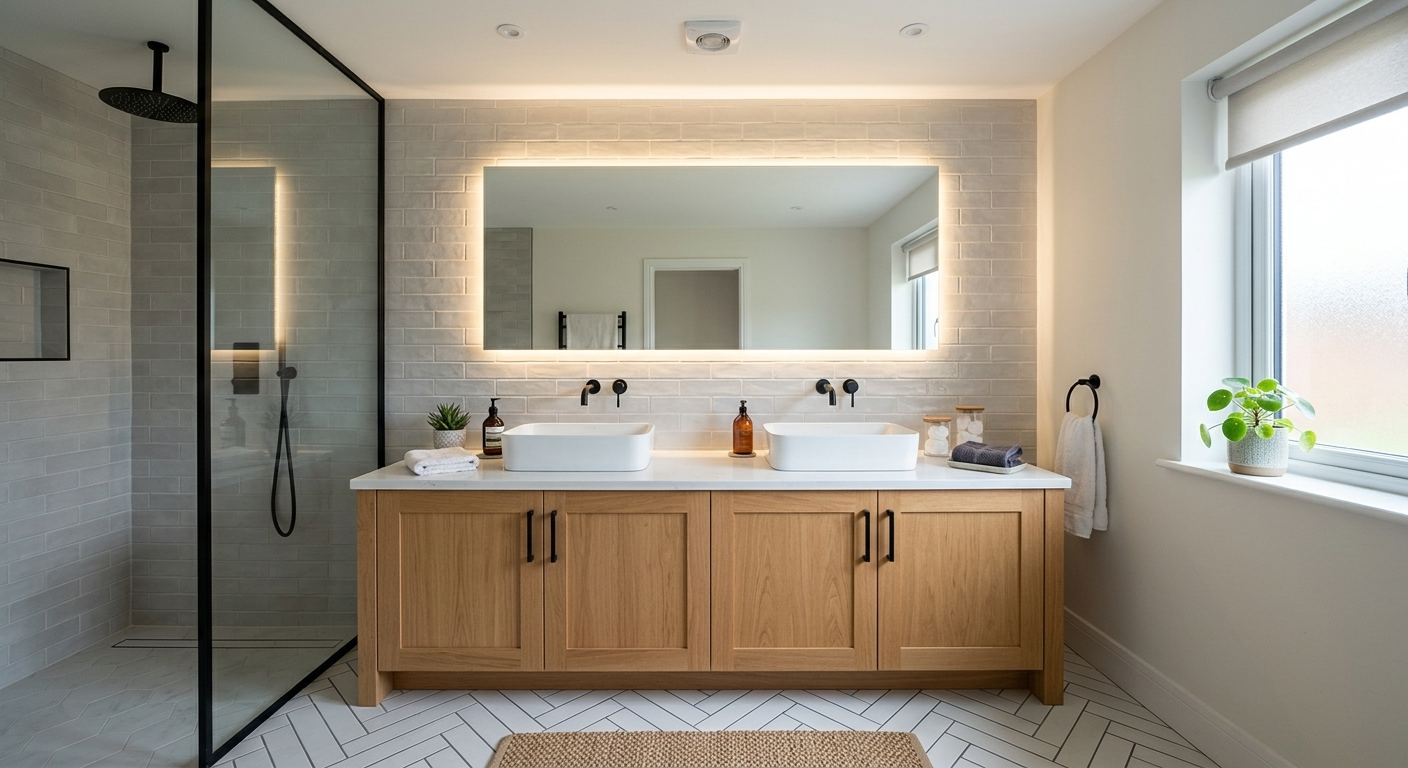
Bathroom renovation options and costs in Canora
Bathroom renovations in Canora usually start with a simple decision: refresh what you have, or open the walls and upgrade everything properly. Because Canora’s population is small (3,309 residents as of the 2021 Census), there are fewer local crews on-call, so availability and scheduling can affect pricing when multiple trades are coordinated back-to-back. Just as importantly, many nearby homes were built long before modern drain/waterproofing standards—older plumbing layouts can mean dated venting, cast-iron or copper drain stacks, and sometimes asbestos-containing materials in older floor tile or related finishes. (Statistics Canada, 2021 Census.)
In the Calgary economic region, renovation costs are shaped more by local labour rates and housing-condition realities than by weather alone. Calgary-area contractors commonly report that what looks like a “straight swap” on paper becomes a bigger scope once the walls are open: rough-in upgrades, subfloor repairs, venting corrections, and waterproofing that ties into how your shower/tub is actually built. If asbestos is discovered during demo in a pre-1985 bathroom, the project can expand quickly due to abatement protocols. That’s why many homeowners in areas like Ghost Pine/Orchards-style mature residential pockets prioritize proper waterproofing and ventilation early, even if it means stepping up from a cosmetic refresh to a mid-range remodel.
Below are realistic budget bands homeowners in Canora typically use to compare options. Use them as a planning baseline before you get itemised quotes from local contractors.
| Renovation Scope |
What's Included |
Typical Duration |
Price Range |
| Cosmetic refresh (paint, fixtures, accessories only) |
New paint, replace vanity or faucet only, mirror/accessories, re-caulk/touch-up grout, trim and hardware refresh |
2–5 days |
$3,000–$7,500 |
| Mid-range full renovation (new tile, vanity, tub/shower, electrical) |
Demo to stable surfaces, waterproofing, wall/floor tile, new vanity + toilet, tub or surround, exhaust fan, basic electrical updates, disposal |
2–3 weeks |
$15,000–$22,500 |
| High-end full renovation (custom tile, steam shower, heated floors) |
Full demo and rebuild, premium tile, custom shower/steam components, heated floors, upgraded plumbing rough-in, higher-tier electrical and ventilation |
3–6 weeks |
$22,500–$35,000 |
| Shower-only installation (convert tub to walk-in shower) |
Remove tub, new shower framing, waterproofing, walk-in shower base, glass door, plumbing adjustments as needed |
1.5–3 weeks |
$10,000–$18,000 |
| Bathtub replacement or tub-liner install |
Swap tub and re-seal/re-caulk, or install a tub liner where permitted and sub-surfaces are sound; includes basic tile/surround touch-ups |
3–7 days |
$500–$3,000 |
| Tile-only installation (floor + surround, existing layout kept) |
Remove existing finishes (as needed), prep for tile, install floor and shower/tub surround tile, waterproofing as required for wet areas |
1–3 weeks |
$4,000–$12,000 |
Prices are estimates only and vary by project scope, site access and material selection.
What affects the price of bathroom renovation in Canora
If you get two quotes for the “same” bathroom reno in the Calgary economic region, it’s not unusual to see a 30–50% difference. In practice, that gap comes from two drivers: regional labour rates and how old the home is. Climate matters less here than homeowners think because the cost swings are usually tied to hidden-condition fixes—ventilation that doesn’t meet modern performance, outdated venting that forces steam/damp air, or drain stacks that aren’t sized the way today’s plumbing expects. In other words, it’s often not Calgary weather that changes the bill; it’s what’s behind the drywall.
Older homes frequently hide cast-iron or copper drain sections that require upgrading, plus galvanized supply lines that need replacement for consistent water pressure and leak prevention. Venting shortfalls and insufficient exhaust fan performance can also create a higher mould risk, which pushes contractors to include stronger ventilation and better waterproofing. Discovery of asbestos in vinyl floor tile or older drywall compound in pre-1985 homes can trigger abatement—commonly adding roughly $1,500–$5,000+ depending on extent and testing results.
Here are a few common Canora scenarios that move pricing up or down:
- If you keep the existing tub location and plumbing, a tile-only package can stay closer to the $3,000–$12,000 band for tile installation.
- If you change the shower location or toilet offset, you’re more likely into a mid-range full renovation budget like $15,000–$22,500 because rough-in work and coordination increase.
- If subfloor is unlevel or has rot, tile costs rise because prep and waterproofing layers must be corrected first—otherwise the finish fails.
Even within Canora, the age of the housing stock tends to be the biggest cost multiplier because it determines how much “unknown” work shows up after demo.
| Price Factor |
Why It Matters |
Cost Impact |
| Layout change — moving drain or supply lines |
Requires plumbing rough-in, patching, and sometimes venting revisions |
Often pushes a project upward by $3,000–$10,000+ |
| Tile selection — large-format porcelain vs. mosaic vs. ceramic |
Different cutting complexity, substrate requirements, and labour time |
Typically $1,000–$6,000 difference |
| Fixture tier — builder-grade vs. mid-range vs. designer brands |
Hardware quality, installation features, and serviceability |
Often $500–$4,500 swing |
| Subfloor condition — rot or unlevel concrete adds scope |
Needs repair/rebuild before tile and waterproofing can perform |
Commonly $1,000–$7,000+ |
| Electrical — adding GFCI outlets, exhaust fan, heated floor circuit |
Permitted work and licensed execution; heavier loads for heated floors |
Often $600–$3,500+ |
| Waterproofing method — membrane type and extent |
Coverage, seams, and detail work are what prevent moisture failure |
Can add $800–$4,000 depending on system |
| Older-home surprises — asbestos tile, cast-iron drains, galvanized pipes |
Testing/abatement and replacement work expand scope after demolition |
Can add $1,500–$5,000+ (or more) depending on findings |
| Bathroom size — sq ft drives tile and labour time directly |
More surface area means more waterproofing, tile setting, and cleanup time |
Roughly scales project by $500–$2,000+ per size tier |
Permits & regulations in Alberta
In Alberta, many bathroom cosmetic updates do not require permits. For example, swapping out fixtures like a vanity top, faucet, toilet (if no plumbing rough-in changes are needed), mirrors, lighting trim, and replacing a like-for-like bathtub with the same drain position usually falls under renovation work that typically doesn’t require a permit. Similarly, retiling with no changes to plumbing locations and no structural wall changes often does not trigger permitting by itself—though waterproofing still must be done correctly for wet areas.
Permits are commonly required when you change the plumbing or electrical scope. Relocating drain or supply lines (moving the shower head, converting tub-to-shower with a new drain location, changing toilet rough-in), adding or replacing an exhaust fan with new ducting or adding new electrical circuit work, and any structural wall adjustments are the types of work that typically require permits and inspections. Electrical work must meet Alberta electrical code and be performed by, or at minimum signed off by, a licensed electrician.
How to verify a contractor in Canora step-by-step:
- Confirm the trade licence category/number that applies to their work (request it directly, then verify it through the appropriate Alberta online registry).
- Ask for a certificate of insurance: ensure it covers renovations/liability and ask for the expiry date.
- Request proof of WCB/WSIB coverage (coverage terms vary by employer and trade; you should receive documented proof or clearance).
- Get written confirmation of who pulls permits (or that permits are not needed) and what inspections are included.
Always verify before demo. It’s much easier to fix contractor compliance issues early than after the drywall is opened.
Choosing tile, waterproofing and fixtures for your Canora bathroom
In Canora, the fastest way to control bathroom renovation cost is to make the three big material decisions early: tile choice, waterproofing system, and fixture tier. These choices directly affect labour complexity, total materials, and the probability of future call-backs—especially in Alberta where bathrooms see heavy seasonal moisture swings.
1) Tile choice. Ceramic tile is usually the entry-level route and can be cost-effective when you want a straightforward install. Porcelain is typically tougher, better for floors, and often costs a bit more but reduces risk of chipping or uneven wear. Natural stone (marble, travertine, slate) looks high-end but can require specialized sealing and more skilled installation for flatness and consistent finish.
2) Waterproofing method. A paint-on membrane can work for some simple systems, but in wet areas you’ll often see better durability with a bonded sheet membrane or a compatible membrane system that’s detailed correctly at corners, niches, and transitions. When ventilation isn’t perfect, robust waterproofing is what protects framing and subfloor from long-term moisture.
3) Fixture tier. Builder-grade fixtures keep budgets lower, while mid-range and designer lines often add smoother valves, better finishes, and resale-friendly styling.
One example that clarifies “value”: upgrading from entry-level ceramic to porcelain can add around $500–$2,500 in materials and selection, but if it avoids tile failures or enhances floor durability, that premium can be worth it—particularly when you’re already investing in mid-range waterproofing and a full wall/floor re-tile.
| Material / Option |
Pros |
Cons |
Price Range |
| Ceramic tile (floor + walls) |
Budget-friendly, wide style selection, straightforward install on stable surfaces |
More prone to wear on floors vs. porcelain; may chip if substrate shifts |
$3,000–$7,000 |
| Porcelain tile (floor + walls) |
Durable for floors, better water resistance, consistent finish options |
Higher material cost; large formats can be labour-intensive to cut perfectly |
$5,000–$12,000 |
| Natural stone (marble, travertine, slate) |
Luxury look, unique veining, strong curb appeal |
Requires sealing/maintenance; more variation means more careful layout and labour |
$8,000–$18,000 |
| Frameless glass shower enclosure |
Modern look, makes smaller bathrooms feel larger, easier cleaning |
Higher hardware cost; needs precise plumb/level for a clean fit |
$2,000–$6,500 |
| Prefab tub surround (acrylic) |
Fast install, less tile cutting, great value for tight timelines |
Limited design customization vs. full tile; attention needed at waterproofing edges |
$500–$3,000 |
| Custom shower pan (tile or linear drain) |
Premium finish, linear drain performance, designed slope for proper drainage |
More detailed waterproofing and framing; higher labour |
$4,000–$12,000 |
How to choose a bathroom renovation contractor in Canora
When you’re hiring a bathroom renovator in Canora, start with proof that the contractor can legally and safely perform the work in Alberta. Ask for their Alberta trade licence number (and request the category that matches what they’ll do), then obtain a current certificate of insurance showing liability coverage for renovations. For workers, confirm WCB/WCB clearance documentation so you’re not left holding the risk if someone is injured on your site.
Next, get 2–3 written, itemised quotes. The most helpful quotes break labour and materials separately (tile setting, waterproofing system, framing, electrical tie-ins, plumbing rough-in allowance, disposal). Avoid “all-in” lump sums where major components are not named—bathrooms commonly change scope once demo starts.
Read the scope line-by-line: what’s excluded? Disposal included? Permit pull included (if required)? Who supplies tile backer/wet-area materials and what exact waterproofing system is being used? Also confirm warranty terms: workmanship warranty length, product/manufacturer warranty, and whether warranties transfer if you sell the home.
Payment schedule matters too. Don’t pay more than about 10–15% upfront. For larger projects, hold back a portion until key milestones are finished—waterproofing inspection-ready stages and substantial completion. Finally, get a start date and a completion estimate in writing so you’re not stuck waiting while trades are rescheduled.
- Verify Alberta trade licence and that the right licence covers their scope.
- Confirm liability insurance, expiry date, and renovation-specific coverage wording.
- Request WCB/WCB clearance documentation for the contractor and subcontractors.
- Require 2–3 itemised quotes (labour vs materials) rather than one lump sum.
- Make exclusions explicit: disposal, patching, drywall repairs, glass enclosure, and niche framing.
- Ask if permits are included and who is responsible for inspections.
- Confirm the exact waterproofing system (membrane type and who applies it).
- Ask how they handle older-home surprises (asbestos testing/abatement process).
- Ensure they provide a written timeline with trade coordination dates.
- Check workmanship warranty length and whether it’s in writing.
- Review payment schedule: keep upfront to 10–15% and hold back at milestones.
- Confirm disposal details (haul-away included and dumpster arrangements if needed).
Red flags: (1) quotes that don’t mention waterproofing method, (2) reluctance to provide licensing/insurance proof, (3) payment demands beyond 15% upfront, (4) vague scopes that omit disposal/permits and rely on “we’ll figure it out,” and (5) no written warranty terms or timeline.
Frequently asked questions — bathroom renovation in Canora
Should I do a tub-to-shower conversion?
In Canora and across Alberta, a tub-to-shower conversion is worth considering if you want easier daily use, fewer slip risks, and a more modern layout. A key factor is your plumbing condition: if your existing drain/supply arrangement is sound, the conversion can stay closer to a shower install budget of $8,000–$15,000. If the conversion requires moving the drain, upgrading venting, or correcting older rough-in problems behind the wall, expect a wider scope and a higher total—often aligning with mid-range full renovation budgets. For older homes, the biggest “gotcha” is discovering hidden issues during demolition, so plan contingency and ask your contractor how they handle surprises like subfloor repairs or potential asbestos testing.
How do I prevent mold in a Canora bathroom?
Mold prevention is mostly about controlling moisture after showers—especially through correct waterproofing and ventilation. Start with a proper exhaust fan sized for your bathroom and ducted correctly; in Alberta winters, moisture can linger if ventilation is weak. Next, ensure wet areas use an appropriate waterproofing system with correct details at corners, seams, niches, and transitions—membrane type matters. Finally, keep grout/seams sealed where appropriate and don’t trap water behind finishes during installation. In older Canora homes, you may also find that subfloor or framing has absorbed moisture in the past; that’s why contractors should address rot or unlevel surfaces before tiling. When scope is done right, you reduce the risk that moisture turns into long-term mould growth.
What adds the most resale value in a bathroom reno?
For buyers in Canora and the broader Calgary area, the biggest resale impact usually comes from improvements that feel “complete” and durable: a modern, well-finished shower or tub, new vanities and fixtures, reliable ventilation, and flooring/wall finishes that won’t degrade. Heated floors and premium glass enclosures can add appeal, but the foundational items often matter most. If you’re comparing budgets, homeowners choosing a mid-range full renovation—commonly within $15,000–$22,500—tend to get better perceived value because the bathroom looks rebuilt rather than patched. The best strategy is to invest where performance shows: waterproofing, leak-proof detailing, good exhaust, and clean tiling lines, rather than only upgrading fixtures.
Can I keep my existing plumbing layout to save money?
Yes—keeping your existing plumbing layout is one of the most reliable ways to control costs in an older home in Canora. When you don’t move drain or supply lines, you avoid a lot of rough-in work and hidden wall repairs, which often drives big cost swings in the Calgary economic region. In that scenario, you can often focus the budget on finishes and waterproofing. For example, if your layout is staying put and the subfloor is sound, a tile installation package can land in the $3,000–$12,000 range. If your contractor discovers galvanized supply lines, cast-iron drains, or venting issues once the walls open, you may still need upgrades—but starting with a “keep layout” plan generally reduces the chances of major scope expansion.
How much does a walk-in shower cost in Canora?
The cost of a walk-in shower in Canora typically depends on whether you convert from a tub and whether your drain position changes. If it’s a straightforward conversion with manageable plumbing adjustments, many homeowners budget within the shower installation band of $8,000–$15,000. When the bathroom requires additional subfloor repair, stronger waterproofing detailing, a premium glass enclosure, or more extensive plumbing changes, pricing can move higher and may start to resemble a mid-range full renovation. For older homes, hidden issues are common after demolition—so ask your contractor what their demolition-to-install process looks like and how they handle ventilation updates and any older plumbing replacement needs.
What's the ROI on a bathroom renovation?
ROI varies because it depends on the condition of your home, the quality of the workmanship, and the buyer segment in your local market—not just the dollar amount you spend. In Canora and the Calgary economic region, buyers pay close attention to bathrooms that look modern and feel maintenance-friendly: good tile work, dependable waterproofing, and reliable ventilation. A renovation that stays aligned with performance-focused mid-range decisions (often around $15,000–$22,500) usually makes more sense than over-upgrading while ignoring core issues like subfloor stability or exhaust performance. If you’re doing a high-end upgrade, the ROI may be less consistent, but it can still pay off if your finishes and layout are timeless and the renovation is executed to a high standard. The best ROI comes from combining durable materials with correct installation details.