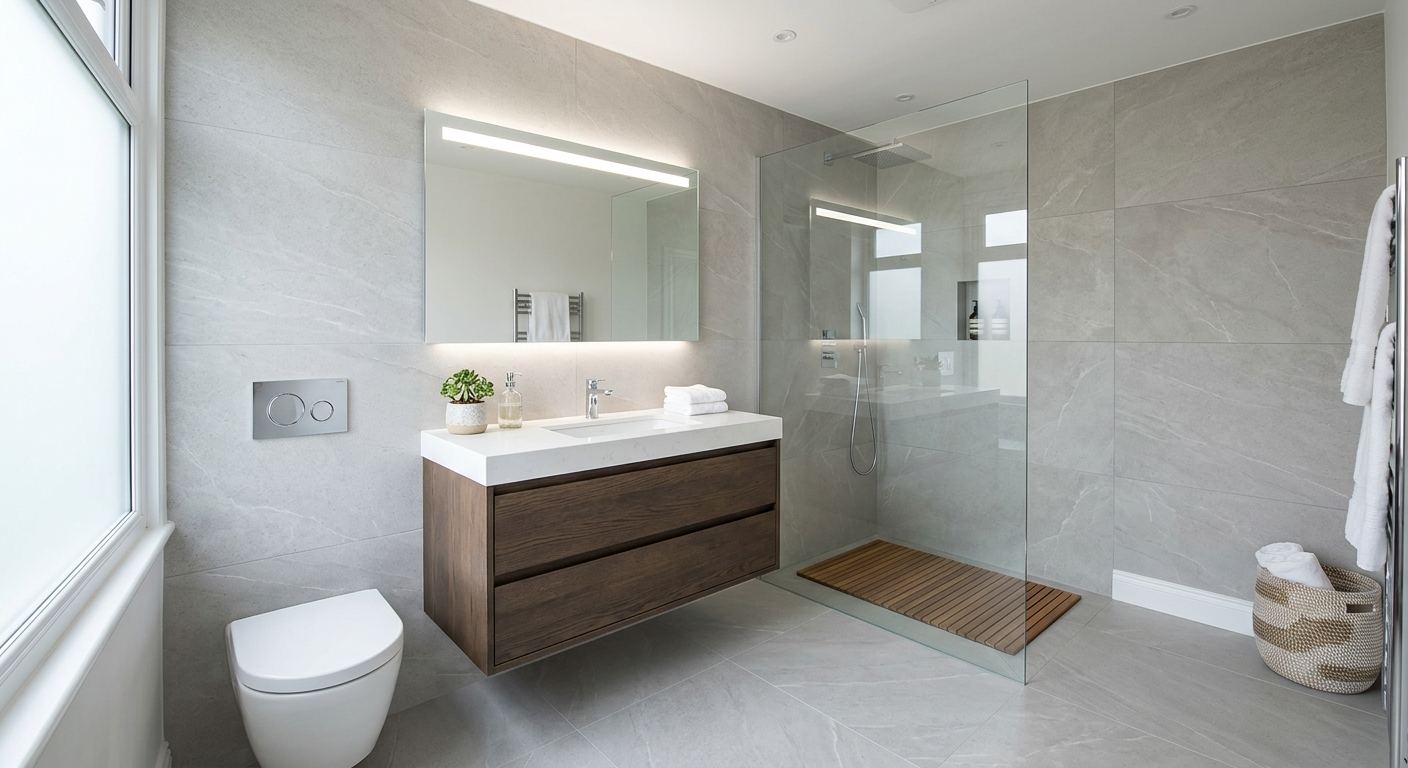
Bathroom renovation options and costs in Chaparral
Bathroom renovation in Chaparral is typically less about “weather” and more about the realities of Calgary-area pricing—labour availability, callout schedules, and what the existing bathroom hides once walls come off. With a population of about 12,500 residents (Statistics Canada, 2021 Census), Chaparral is small enough that contractors often plan schedules around a handful of active projects, which can affect turnaround time. Most bathrooms you’ll see in older homes around the Calgary economic region are not new-build clean-slate installs; many have dated drain layouts and finishes that can escalate cost. Depending on your home’s age, contractors sometimes discover cast-iron or older plumbing components that need upgrading for proper slope and safe connections, and in some pre-1985 properties asbestos may be present in vinyl floor tile or older drywall materials.
In this market, Calgary’s labour rates and hidden-scope risks often drive project swings more than Alberta’s climate. Even though Alberta is cold, the bathroom cost drivers are usually interior: ventilation performance (and code compliance), moisture control layers, and the coordination between plumber, electrician, and tile setter. For example, a “quick refresh” can stay near the low five figures when no plumbing moves; once you add rough-ins, improve exhaust ventilation, or change the shower footprint, budgets commonly move into the mid-range full renovation band. Trade demand is especially consistent in newer infill pockets and established communities around Okotoks and nearby areas that share crews—so Chaparral homeowners should book early to protect start dates.
Use the table below to align your goals (and your risk tolerance for concealed repairs) before you request itemised quotes.
| Renovation Scope |
What's Included |
Typical Duration |
Price Range |
| Cosmetic refresh (paint, fixtures, accessories only) |
Replace vanity or faucet, swap toilet/lighting, paint, re-caulk, update accessories; no tile removal beyond minor touch-ups |
3–7 days |
$4,500 – $9,000 |
| Mid-range full renovation (new tile, vanity, tub/shower, electrical) |
Demo and disposal, subfloor/behind-wall repairs as needed, new waterproofing, tile floor + surround, vanity, tub or shower conversion, exhaust fan upgrade, electrical updates, trim/finishing |
2–4 weeks |
$15,000 – $22,000 |
| High-end full renovation (custom tile, steam shower, heated floors) |
Full remodel with upgraded waterproofing, custom shower details, heated floor circuit, premium fixtures, premium tile work (often larger formats), enhanced ventilation, finer finishes |
4–6 weeks |
$22,000 – $30,000 |
| Shower-only installation (convert tub to walk-in shower) |
Tub removal, new shower pan system, wall tile, glass enclosure allowance, updated plumbing rough-in, new/updated exhaust fan |
1–3 weeks |
$8,000 – $15,000 |
| Bathtub replacement or tub-liner install |
Remove existing tub (or prep for liner), set new tub/tub liner, sealing, re-tile limited areas, re-establish caulking and trims |
2–7 days |
$500 – $3,000 |
| Tile-only installation (floor + surround, existing layout kept) |
Tile demolition (as required), tile removal/installation, waterproofing on tiled areas, grout/caulking, transition trims; fixtures often reused |
1–2 weeks |
$3,000 – $12,000 |
Prices are estimates only and vary by project scope, site access and material selection.
What affects the price of bathroom renovation in Chaparral
In Chaparral, you can see the same “type” of bathroom renovation quote differ by 30–50% across Calgary and Alberta when crews price labour risk and hidden work differently. The big reason is that many bathrooms sit in older homes—so contractors aren’t just pricing new tile and fixtures; they’re pricing the chance that the subfloor is soft, ventilation ducting is inadequate, or plumbing needs correction. Calgary-area labour rates and trade availability are the most consistent cost drivers, while climate plays a secondary role through moisture management details (drying time, ventilation performance, and waterproofing quality).
Even if your scope looks straightforward, Calgary economic region homes often include older plumbing stacks and supply lines that don’t meet modern expectations for connection methods, pressure balance, and proper venting. That can push a “refresh” upward toward mid-range full renovation costs (often aligning with the $15,000 – $22,000 band) once rough-in changes and coordination add time. Conversely, if you keep the existing drain locations and only replace fixtures, the project can remain near the lower end of the cosmetic refresh range.
Here are a few concrete Chaparral scenarios that change budgets quickly: (1) relocating a shower drain requires cutting and reworking the rough-in, which adds labour and may affect tile layout; (2) swapping to large-format porcelain can raise the tile package cost but may reduce labour time if walls are true; (3) finding asbestos-containing materials in older vinyl floor tile or drywall compound triggers abatement steps—commonly adding about $1,500–$5,000+ depending on extent and access. In older homes, cast-iron or older copper sections can also require partial removal and replacement, and that’s where cost can jump even if your finishes stay “mid-range.”
| Price Factor |
Why It Matters |
Cost Impact |
| Layout change — moving drain or supply lines requires rough-in work |
Triggers demolition, plumbing rough-in, pressure testing, and re-setting fixtures to match falls/slope |
Often adds $3,000 – $8,000 |
| Tile selection — large-format porcelain vs. mosaic vs. ceramic |
Material unit price and installation complexity (cuts, substrate prep, and pattern alignment) |
Can swing $2,000 – $7,000 |
| Fixture tier — builder-grade vs. mid-range vs. designer brands |
Higher-end fixtures cost more and sometimes require compatible valves/rough-in parts |
Typically $800 – $4,500 |
| Subfloor condition — rot or unlevel concrete adds scope |
Requires rebuild/leveling under tile and can affect waterproofing continuity |
Commonly $1,000 – $6,000 |
| Electrical — adding GFCI outlets, exhaust fan, heated floor circuit |
Licensed electrical work, load calculation, circuit extensions, and safe bathroom compliance |
Often adds $900 – $4,500 |
| Waterproofing method — membrane type and extent |
Proper coverage and system compatibility prevents mould and failed grout in wet zones |
Usually adds $800 – $3,500 |
| Older-home surprises — asbestos tile, cast-iron drains, galvanized pipes |
May require abatement, partial demolition, pipe replacement, and extra disposal/work staging |
$1,500 – $10,000+ |
| Bathroom size — sq ft drives tile and labour time directly |
More surface area increases tile, thinset, grout, waterproofing coverage, and set time |
Varies widely, often $1,500 – $6,000+ |
Permits & regulations in Alberta
In Alberta, many straightforward cosmetic updates—like swapping a vanity, replacing a faucet, changing lighting fixtures, re-caulking, and repainting—typically do not require a permit. Likewise, installing a prefab tub surround on the same footprint and without changing plumbing usually falls into “refresh” territory. Where things change is when you add or relocate plumbing, modify electrical circuits, or make structural wall changes.
Work that typically DOES require a permit/inspection: relocating plumbing (moving a drain or supply line), new plumbing rough-ins, adding or moving a toilet connection, replacing shower plumbing components when the rough-in changes, and any electrical work that involves new circuits or panel/circuit modifications (for example, adding a heated floor circuit). If you’re adding a new exhaust fan with a new electrical run, that’s also typically part of permitting/inspection expectations for safety and code compliance.
Work that typically does NOT require a permit: like-for-like fixture swaps where the plumbing/electrical locations stay the same (e.g., replacing a vanity top and faucet at existing stops, or updating a light fixture on an existing circuit), and retiling where you’re not changing structure or services.
Step-by-step in Chaparral: (1) Ask for the contractor’s Alberta trade licence details and business information; (2) Request a certificate of insurance (liability) and confirm dates; (3) Verify WSIB/WCB coverage documentation—don’t accept verbal confirmation; ask for the clearance/coverage letter; (4) Make sure permits are pulled when plumbing/electrical scope changes, and confirm the contractor responsibilities in writing; (5) Keep copies of all certificates and clearance documents with your contract file.
Choosing tile, waterproofing and fixtures for your Chaparral bathroom
In Chaparral, your budget usually “locks in” on three material decisions: tile choice, waterproofing system, and fixture tier. First, tile: ceramic is the entry-level option and can be cost-effective if you’re keeping a simple pattern and your walls are reasonably straight. Porcelain costs more but is denser, more consistent for floors, and often performs better for high-traffic bathrooms. Natural stone (marble, travertine, slate) looks upscale, but it needs careful selection, sealing, and skilled layout—especially if you’re doing a large shower surround.
Second, waterproofing: Alberta bathrooms benefit most from a system designed to remain continuous through corners, penetrations and transitions. A paint-on membrane can work in limited scenarios, but bonded sheet membranes or a modern tile-system approach (including proper compatible boards/membranes and sealants) generally offer better reliability where owners expect long-term performance. In a cold climate, bathrooms also see temperature swings; when ventilation isn’t ideal, good waterproofing helps prevent moisture migration and the mould issues that appear after repeated steam cycles.
Third, fixtures: builder-grade gets you the layout and function, while mid-range and designer brands can improve feel (valves, shower heads, pressure balance) and can support stronger resale appeal. Here’s a practical dollar example: if moving to porcelain adds about $2,000 – $4,000 over ceramic across a typical tub/shower surround, that upgrade can be justified when you’re also improving waterproofing and keeping the layout—because you’re paying for longevity, not just appearance. If you’re on a tight budget, you can keep fixtures mid-range and allocate savings toward a waterproofing upgrade, which is often the smartest place to spend.
| Material / Option |
Pros |
Cons |
Price Range |
| Ceramic tile (floor + walls) |
Lower material cost, wide design variety, good for basic layouts |
More variation in tile hardness; can be less forgiving on floors if quality varies |
$3,000 – $7,000 |
| Porcelain tile (floor + walls) |
Durable, consistent for floors, better moisture performance, modern large-format options |
Higher material cost; requires skilled prep for best results |
$6,000 – $12,000 |
| Natural stone (marble, travertine, slate) |
Premium look, unique veining/texture, strong spa-style appeal |
Sealing and maintenance; more cutting/layout complexity; higher labour |
$10,000 – $20,000 |
| Frameless glass shower enclosure |
Clean sightlines, easy to keep looking modern, good resale appeal |
More costly; needs accurate measurements and strong waterproofing detailing |
$2,000 – $6,000 |
| Prefab tub surround (acrylic) |
Faster install, fewer grout lines, consistent finish, good for budget remodels |
Less custom aesthetic; limited design variety; seams must be installed precisely |
$500 – $2,500 |
| Custom shower pan (tile or linear drain) |
Lux feel, better drainage options, seamless look when detailed correctly |
Higher complexity; depends heavily on correct slope, waterproofing, and drain fit |
$2,500 – $8,000 |
How to choose a bathroom renovation contractor in Chaparral
Start by verifying Alberta licensing and coverage. Ask the contractor for their Alberta trade licence documentation (or licence number/registry reference), and request a current certificate of liability insurance with your project address listed or applicable coverage noted. Then verify workers’ compensation coverage: in Alberta this is the WSIB/WCB coverage proof your contractor must maintain. Don’t rely on “we’re covered” statements—ask for the clearance/coverage letter or documentation they can provide on request.
Next, get 2–3 itemised written quotes. A reliable bathroom quote breaks labour and materials so you can see whether differences are coming from tile quality, waterproofing system, glass enclosure allowance, or hidden-scope allowances. Read the scope carefully: is permit pulling included when plumbing/electrical changes apply? Is demolition and disposal included? Are subfloor repairs and waterproofing tie-ins included, or treated as “extras” once walls open?
Warranty matters. Confirm the workmanship warranty length in writing, whether it covers labour to redo failed areas, and whether it’s transferable if you sell your home. Also check the product/manufacturer warranty for fixtures and tile-related systems. Payment schedules should protect you: never pay more than about 10–15% upfront, and hold back a portion until key milestones are complete and the walkthrough confirms standards.
Finally, request a start date and a realistic completion estimate, and insist the schedule assumptions are noted (lead times for tile, glass, and specialty valves). Then check the details before signing.
- Ask for Alberta licence/registration details and verify them before work begins.
- Request certificate of liability insurance and confirm coverage is current.
- Confirm WSIB/WCB coverage with documentation/clearance letter, not verbal proof.
- Use itemised quotes (labour + materials) instead of a single lump sum.
- Confirm whether demolition, hauling, and disposal are included.
- Clarify waterproofing scope (membrane type, coverage extent, seam/penetration detailing).
- Ask what happens if asbestos or older concealed issues are discovered after demo.
- Ensure permits are included where plumbing/electrical locations change.
- Check who provides the exhaust fan and whether ducting/venting is upgraded as needed.
- Get warranty terms in writing (workmanship and product warranties) and confirm transferability.
- Confirm payment milestones (no more than 10–15% upfront; holdback until final review).
- Get a written schedule with start date, key milestones, and expected completion date.
Red flags in Chaparral: contractors who won’t provide licence/insurance proof, quotes that exclude waterproofing details, vague “allowances” that change without a written change order, payment terms demanding more than 15% upfront, or crews who can’t explain how they handle older-home surprises (like cast-iron drains or asbestos-containing materials) once walls are opened.
Frequently asked questions — bathroom renovation in Chaparral
How do I compare bathroom renovation quotes?
In Chaparral and the Calgary area, comparing bathroom renovation quotes comes down to apples-to-apples scope. Ask each contractor for an itemised breakdown of labour and materials (tile package, waterproofing system, glass enclosure allowance, electrical and plumbing allowances, and disposal). Confirm what’s included versus excluded: permits (when plumbing/electrical locations change), demolition, subfloor repairs, and any allowance for older-home surprises like cast-iron drain sections. Also compare the timeline—if one quote includes dependable lead times for tile and fixtures and the others don’t, the cheaper bid can become expensive later. As a budget anchor, a “refresh” might start around the low five figures, but a mid-range full renovation frequently lands in the $15,000 – $22,000 range when tile and electrical upgrades are included (and hidden-scope is allowed for).
Can I live at home during a bathroom renovation in Chaparral?
Often you can, but it depends on how much of the bathroom you’re demoing and whether there’s a second washroom in the home. For cosmetic updates—painting, fixture swaps, minor accessory changes—many homeowners stay in the home with minimal disruption. For mid-range full renovations, expect staged work: demo, rough-ins, waterproofing, tile, then finish carpentry. During the “wet trade” phases, you may not be able to use the shower/tub reliably until waterproofing and tile cure. If you’re doing a shower-only conversion (like changing a tub to a walk-in), plan for at least a week or more of limited use. In older Chaparral homes, concealed plumbing corrections can add days. If you only have one bathroom, discuss temporary access and schedule sequencing with your contractor before signing.
What's the best bathtub material for a Chaparral home?
The “best” bathtub material in Alberta usually means the best fit for your comfort needs and installation conditions. Acrylic tubs are lightweight, commonly available, and easier to set in many renovations; they’re a practical choice when you’re keeping the existing footprint. Cast iron is extremely durable but heavy and can be more disruptive to replace (and labour time can rise). If you’re not replacing the tub and you’re considering a tub-liner approach, confirm the surface prep and bonding method—poor prep is where failures happen. For many Chaparral homeowners, the best value is choosing a tub material that matches your renovation scope: if your budget sits near a $500 – $3,000 bathtub replacement/tub-liner band, ensure waterproofing and sealing are still treated as a critical step, not an afterthought. If you’re moving beyond that to a full remodel, you’ll often get better long-term results by upgrading shower/tub waterproofing and ventilation, not just the tub surface.
Is it worth renovating a bathroom before selling in Chaparral?
Usually, yes—if you’re upgrading the bathroom to a buyer-credible standard and not over-improving beyond what comparable buyers expect in the Calgary region. In Chaparral, buyers tend to value clean tilework, updated fixtures, and bathrooms that show correct moisture handling: good exhaust fan performance, properly detailed waterproofing, and fresh caulking/sealants. A cosmetic refresh can help if your layout is already functional; it may keep you closer to the low five figures and still create a “new” feel. But if your bathroom has outdated plumbing, poor ventilation, or cracked tile, a mid-range full renovation can be more worthwhile because it reduces buyer inspection red flags and hidden repair risk. Use your budget to focus on systems and durability—people don’t just buy finishes, they buy confidence.
How do I plan a bathroom renovation on a tight budget in Chaparral?
Plan by separating “must change” from “nice to change.” If plumbing locations are staying put, you can target a cosmetic refresh or a tile-focused upgrade while keeping labour exposure under control. For a tight budget, consider keeping your existing tub/shower footprint and prioritising waterproofing continuity in tiled zones—this is where moisture problems start and it’s often cheaper to do right once. Choose mid-range fixtures instead of designer upgrades, and pick tile that balances durability with complexity (porcelain over very soft/fragile options; simpler layouts reduce waste). Also carry contingency: in older Calgary-area housing stock, concealed issues can appear after demo, and that’s why quotes can move upward quickly. If you’re aiming for a realistic full-reno expectation, many projects end up in the $15,000 – $22,000 zone when tile and electrical/ventilation improvements are included. Avoid changing scope repeatedly mid-project—every design shift adds scheduling and labour coordination costs.
What's the difference between a cosmetic and a full bathroom renovation?
A cosmetic bathroom renovation typically swaps visible surfaces and fixtures without changing the plumbing or the bathroom’s core layout. Think paint, vanity/faucet replacement, lighting updates, re-caulking, and limited accessory changes. A full renovation is a demolition-to-finish project: it often includes new tile floors and surrounds, new waterproofing layers, possible subfloor repairs, updated electrical (like GFCI outlets and exhaust fan improvements), and sometimes plumbing rough-in changes. In Chaparral, the biggest practical difference is risk: full renovations are more likely to uncover hidden issues common to older homes in the Calgary region, such as ventilation shortcomings, deteriorated subfloor, or older drain/supply components. That’s why “simple refresh” budgets can start in the low five figures, while mid-range full renovations commonly land much higher—often in the $15,000 – $22,000 range depending on tile, fixtures, and whether rough-in work is required.