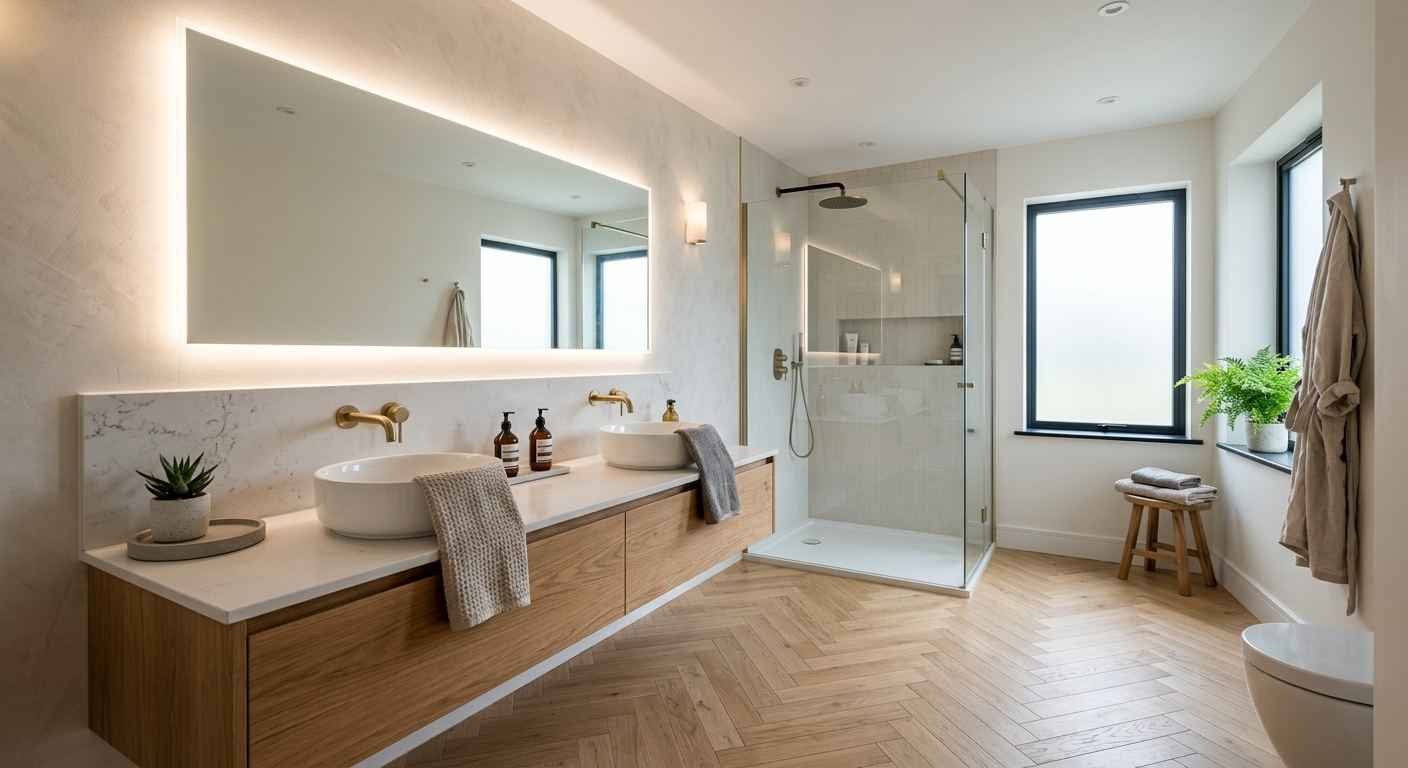
Bathroom renovation options and costs in 100 Mile House
Bathroom renovations in 100 Mile House typically start with choosing how much you want to change—because in this part of the Cariboo, labour and what we uncover behind walls can outweigh material trends. With a population of 1,980 (Statistics Canada, 2021 Census), the local contractor pool is smaller than in larger centres, so scheduling can be tighter when multiple trades are needed at once. Just as important, a lot of homes here date back to the 1950s–1980s era, which means dated plumbing layouts, older drain piping, and in some cases asbestos-containing floor tile or drywall compound may be present. When we open up bathrooms in older houses across the region, we’re often checking for undersized venting, cast-iron or deteriorating drain components, and supply lines that no longer match current expectations.
Cariboo climate does affect bathrooms, mainly through moisture management: we plan for strong exhaust capacity, good insulation around exterior walls, and waterproofing details that can handle winter humidity swings. However, pricing in 100 Mile House is still driven more by the age of the housing stock and local labour rates than by temperature itself. Trades commonly feel especially in demand around the downtown/core area and along the main corridor where older homes are concentrated and projects cluster. With that in mind, here are realistic renovation tiers you can use to compare quotes from different contractors.
| Renovation Scope |
What's Included |
Typical Duration |
Price Range |
| Cosmetic refresh (paint, fixtures, accessories only) |
New vanity/lighting (no plumbing relocation), paint, mirror, towel bars, re-caulking, deep clean; existing fan kept if functional |
3–7 days |
$9,000 – $14,000 |
| Mid-range full renovation (new tile, vanity, tub/shower, electrical) |
Demo and rebuild, tub/shower surround or shower conversion as specified, tile floor + walls, vanity and toilet, new exhaust fan wiring, updated GFCI, basic waterproofing upgrades |
3–5 weeks |
$14,000 – $22,000 |
| High-end full renovation (custom tile, steam shower, heated floors) |
Designer tile layouts, custom shower/tile pan or steam-ready system, heated floor circuit, upgraded ventilation, premium fixtures, niche, improved insulation and sealing |
5–8 weeks |
$22,000 – $32,000 |
| Shower-only installation (convert tub to walk-in shower) |
Remove tub, install walk-in shower (tile or prefab as chosen), new curb/drain arrangement where required, waterproofing, new controls/trim, updated fan if tied in |
2–4 weeks |
$5,000 – $15,000 |
| Bathtub replacement or tub-liner install |
Remove and install new tub or liner system, re-seal at plumbing interface, surface prep and finishing; limited plumbing changes if layout stays |
1–2 weeks |
$1,500 – $8,000 |
| Tile-only installation (floor + surround, existing layout kept) |
Tile removal and re-install, waterproofing system for tile area, grout/seal, new matching trim; fixtures may be re-used or lightly replaced |
1–3 weeks |
$2,000 – $9,000 |
Prices are estimates only and vary by project scope, site access and material selection.
What affects the price of bathroom renovation in 100 Mile House
Two homeowners in 100 Mile House can receive quotes that differ by 30–50% for what looks like the “same” bathroom because the real drivers are usually regional labour rates and the age of the housing stock, not climate branding. In the Cariboo, trades often bill somewhat lower than big-metro British Columbia, but you still need multiple licensed scopes—plumbing, electrical, tile setting, drywall/paint—and those add up quickly once we open walls. If discovery work turns into required upgrades, the scope expands fast.
Older homes in the Cariboo region often hide cast-iron or undersized drain stacks that need replacement, galvanized supply lines that don’t perform reliably, or venting and fan setups that don’t move moisture adequately. Ventilation upgrades matter because bathrooms in British Columbia can trap humidity during shoulder seasons and winter, and that’s when mould prevention becomes a workmanship priority, not an optional extra. Pre-1985 flooring and older textured finishes also raise the asbestos possibility—if asbestos-containing materials are found in vinyl floor tile or drywall compound, abatement and inspection protocols can add roughly $1,500–$5,000+ to the budget.
Concrete examples we see in 100 Mile House: (1) keeping your existing tub footprint often keeps rough-in stable—quotes may land closer to the $14,000–$22,000 mid-range band; (2) moving the drain or swapping a basic fan for a higher-CFM unit typically pushes electrical and drywall time, nudging you toward the $22,000–$32,000 full-reno band; (3) adding heated floors increases labour for circuit work and careful prep, but it can be justified if you’re already renovating the floor.
| Price Factor |
Why It Matters |
Cost Impact |
| Layout change — moving drain or supply lines requires rough-in work |
New pipe runs and proper slope/venting mean demo, rough-in plumbing, and often subfloor/framing adjustments |
Commonly increases the project by several thousand dollars depending on distance and wall access |
| Tile selection — large-format porcelain vs. mosaic vs. ceramic |
Large-format demands flatter substrates; mosaics are labour-intensive to align and grout |
Can shift labour and material lines by roughly $1,000–$4,000+ overall |
| Fixture tier — builder-grade vs. mid-range vs. designer brands |
Higher tiers cost more for vanity, toilet, shower trim, and matching hardware |
Usually adds $500–$4,000+ depending on what you choose |
| Subfloor condition — rot or unlevel concrete adds scope |
Damaged framing or uneven prep can require rebuilds before tile can be safely installed |
Often adds $1,000–$6,000 when structural repair is needed |
| Electrical — adding GFCI outlets, exhaust fan, heated floor circuit |
Bathroom code expectations and fan capacity drive additional labour and materials |
Can add $500–$5,000+ depending on circuit complexity and finishes |
| Waterproofing method — membrane type and extent |
Different systems require different prep, cure times, and attention at corners/penetrations |
Material/labour differences often run $300–$2,500+ within the same scope |
| Older-home surprises — asbestos tile, cast-iron drains, galvanized pipes |
Discovery triggers remediation and replacement work that must meet current standards |
Frequently adds $1,500–$5,000+ (and more if multiple hidden systems fail) |
| Bathroom size — sq ft drives tile and labour time directly |
More floor area increases tile, waterproofing, mortar, and setting time |
Small bathrooms can be closer to the lower bands; larger ones push the upper end |
Permits & regulations in British Columbia
In British Columbia, cosmetic updates like swapping a vanity, replacing fixtures, painting, and re-caulking around existing tubs usually do not require a permit because you’re not changing plumbing locations or altering the building structure. Likewise, replacing a like-for-like exhaust fan without new circuits is often straightforward, but it still must be completed to code by qualified professionals where electrical is involved. In contrast, permits commonly are required when you relocate plumbing (moving a drain or supply lines), add an exhaust fan (especially with new wiring), or make structural wall changes. If you’re changing where the shower valve sits, rerouting drain locations, or altering the wet wall layout, assume you’ll need a permit and inspection for the plumbing rough-in and/or associated trades.
Here’s a practical step-by-step approach for a homeowner in 100 Mile House to verify a contractor’s British Columbia compliance:
- Ask for the contractor’s BC trade licence information relevant to the scope (plumbing/electrical/tile or general contracting as applicable).
- Confirm liability insurance with an active certificate of insurance showing the project name/address (where possible).
- Request proof of WSIB/WCB coverage for workers (the coverage should align with the trades employed or subcontracted).
- Verify any asbestos handling work is done by certified specialists if suspect materials are found during demo.
- Ask for a written allowance on permits/inspections (who pulls them and whether they’re included).
For licensing, start with the appropriate provincial registry the contractor points you to, and always cross-check their certificate dates. A legitimate team should hand you documents quickly—if they hesitate, that’s a warning sign.
Choosing tile, waterproofing and fixtures for your 100 Mile House bathroom
In 100 Mile House, your bathroom budget usually gets decided by three material choices: tile type, waterproofing system, and fixture tier. Because Cariboo homes often have older substrates and more variability behind the walls, the “right” combination is the one that fits your existing conditions and still delivers long-term moisture resistance in British Columbia’s humid winter periods.
1) Tile choice: ceramic tile is an entry-level option and can be cost-effective if your floor is already flat. Porcelain is tougher, typically better for wet areas and longevity, and it handles daily cleaning well—though it’s a bit heavier to install and needs careful prep. Natural stone (marble, travertine, slate) looks premium, but it demands more labour and attention to sealing and surface stability, especially where substrate conditions are inconsistent.
2) Waterproofing method: paint-on membranes can work, but the surface prep and proper thickness are critical. Bonded sheet membranes are more forgiving in some scenarios and are chosen often when walls show movement risk. A full shower-system approach (including correct overlaps, sealing at corners and penetrations) is what prevents mould-inducing moisture from migrating behind tile.
3) Fixture tier: builder-grade fixtures keep upfront costs down; mid-range strikes a balance for better valves and finishes; designer brands often raise costs but can improve perceived quality and resale appeal.
A real-world example: if you’re budgeting around a mid-range full renovation (for instance, staying within the $14,000–$22,000 band), shifting from ceramic to porcelain might be justified for durability, but “jumping” to natural stone when your bathroom is small and your layout needs plumbing corrections may not deliver proportional value. If you’re already investing in waterproofing upgrades for a high-use shower, upgrading tile above ceramic can be the better spend—otherwise, match materials to the conditions we’re actually correcting.
| Material / Option |
Pros |
Cons |
Price Range |
| Ceramic tile (floor + walls) |
Entry-level cost, good style variety, solid performance with proper sealing and grout selection |
More movement/imperfection tolerance is limited; may chip if substrate prep is rushed |
$2,000 – $5,500 |
| Porcelain tile (floor + walls) |
More durable and water-resistant, better long-term wear, typically ideal for wet areas |
Requires a flatter substrate; labour can be higher for larger-format pieces |
$3,000 – $7,500 |
| Natural stone (marble, travertine, slate) |
High-end look, unique veining and finishes that elevate resale appeal |
More maintenance (sealing), higher material cost, labour-intensive cutting and finishing |
$6,000 – $12,000 |
| Frameless glass shower enclosure |
Modern appearance, helps visually open the space, durable if installed correctly |
Higher cost than standard enclosures; needs accurate plumbing and waterproofing line-up |
$1,200 – $4,500 |
| Prefab tub surround (acrylic) |
Fast install, consistent finish, often reduces tile labour and schedule risk |
Less custom look; seams and edge details must be sealed carefully |
$800 – $2,800 |
| Custom shower pan (tile or linear drain) |
Best-in-class water control, tailored slope and drainage, integrates with your tile design |
More build time; requires meticulous waterproofing and correct framing/prep |
$2,500 – $9,000 |
How to choose a bathroom renovation contractor in 100 Mile House
Choosing the right contractor matters even more in 100 Mile House because project gaps can stall multiple trades. Start by verifying British Columbia licensing and insurance properly, then pressure-test quotes with itemised scope—not just a lump-sum number. For licensing, ask which parts of the work each trade is responsible for and request proof they’re authorized for their scope. Next, confirm liability insurance with a current certificate of insurance; you want coverage to match the size of the project and the timing of the work. Finally, ask for proof of WSIB/WCB coverage for their workers—insist on seeing it in writing.
Then get 2–3 itemised written quotes that show labour and materials separately, including tile setting, waterproofing method, drywall/paint, disposal, and any permit-related items. Read the scope line by line for exclusions: is demolition included? Are tile underlay and backer boards included? Is permit pulling included, or is it an extra charge? Ask who disposes of waste and whether dump fees are covered.
Warranty should be specific: a workmanship warranty (commonly covering installation defects for a defined period), plus manufacturer warranties for products. Confirm whether warranties are transferable if you sell your home. On payment schedule, never pay more than 10–15% upfront and use holdback until key completion milestones. Finally, get a signed timeline with a start date and completion estimate in writing.
- Licences: ask which trade licences apply to plumbing/electrical scopes in your job.
- Insurance: request liability coverage documents with effective dates.
- WSIB/WCB: confirm coverage for workers who are actually on the site.
- Itemised quote: labour and materials broken out, not only a single total.
- Permit responsibility: specify who pulls permits and what inspections are included.
- Disposal: confirm whether dump fees and removal are included.
- Demo scope: ask what is removed (subfloor, wallboard, finishes) and what is protected.
- Waterproofing details: name the membrane system and coverage area (shower only vs full wet wall).
- Tile build-up: confirm underlay/backer board, mortar type, and grout selection.
- Electrical specifics: include exhaust fan wiring, GFCI outlets, and heated floor circuit if chosen.
- Schedule: get a start date plus completion estimate and confirm coordination with trades.
- Warranty: workmanship warranty length and what it covers, plus product warranty paperwork.
Red flags in 100 Mile House include: (1) refusing to provide insurance/licensing proof; (2) giving only a lump-sum number without scope detail; (3) dismissing older-home concerns (asbestos/cast-iron drains/venting) with no plan; (4) demanding large upfront deposits (over 15%); and (5) promising “no permits needed” even when plumbing is being moved or electrical circuits are added.
Frequently asked questions — bathroom renovation in 100 Mile House
Should I do a tub-to-shower conversion?
In 100 Mile House and across British Columbia, tub-to-shower conversions are popular because they can improve day-to-day usability and reduce the chance of slips around higher tub edges. If your current tub surround is aging or the layout feels tight, converting can also simplify future maintenance. Cost-wise, the work often lands in the shower-only range of $5,000–$15,000, but the final number depends on whether the drain location stays the same. In older homes (common in the Cariboo), conversions sometimes uncover undersized venting, older drain components, or plumbing that needs upgrading, which can push the project upward. If you want a truly accessible upgrade, ask for a walkthrough shower design with strong slope control and a waterproofing system that matches the shower pan build.
How do I prevent mold in a 100 Mile House bathroom?
Preventing mould in 100 Mile House comes down to three things: controlling moisture, sealing properly, and using ventilation that matches real shower use. First, choose a waterproofing system rated for wet-area tile installs and ensure corners and penetrations are treated—not just “painted over.” Second, use a bathroom fan with enough capacity and ducting that exhausts outside (not into attic spaces). Third, make sure insulation and air-sealing details around exterior walls are adequate, because condensation forms where surfaces get cold in BC winters. Even with excellent materials, poor drying times can cause mould—so we set up bathrooms with reliable exhaust and recommend timers or humidity-sensing controls. Finally, in older homes where older finishes may be present, test/remediate suspect materials if discovered before closing walls.
What adds the most resale value in a bathroom reno?
Resale value in British Columbia tends to track improvements buyers can quickly see and trust: modern waterproofing, clean tile work, updated fixtures, and a ventilation upgrade that reduces future moisture problems. Functionally, walk-in showers and better storage (a vanity with real drawer space, not just a pedestal) often feel like “must-haves” to buyers. From a budget perspective, mid-range full renovations commonly sit in the $14,000–$22,000 range and can deliver the best balance of cost to visible outcomes. If you go higher, like $22,000–$32,000, value often improves when upgrades are practical—heated floors, a higher-end shower system, and premium finishes—rather than purely cosmetic add-ons. In 100 Mile House, buyers also notice whether the contractor handled older-home surprises properly (venting, electrical safety, and any necessary remediation).
Can I keep my existing plumbing layout to save money?
Yes—keeping the existing plumbing layout is one of the most reliable ways to control cost in 100 Mile House. When you don’t move the drain and supply lines, you typically reduce rough-in plumbing work, minimize wall and floor demolition, and avoid additional electrical and inspection steps that often come with relocated fixtures. That’s why many projects can remain closer to the mid-range full renovation band of $14,000–$22,000 rather than expanding toward the upper end. The catch is that “keeping the layout” only saves money if the existing plumbing and venting are in good enough condition. Older homes in the Cariboo can have undersized or deteriorating drains, galvanized supply lines, or ventilation that doesn’t meet modern expectations, and those must be corrected once discovered.
How much does a walk-in shower cost in 100 Mile House?
A walk-in shower’s cost depends on whether you’re converting from a tub, replacing an existing shower, and what tile/waterproofing approach you choose. In typical Cariboo pricing, shower-only installation commonly falls in the $5,000–$15,000 range. If you choose higher-end custom tile builds, a linear drain, glass enclosure, or you discover older wet-wall issues that require repairs, the job can move toward the upper end. Conversions are usually more variable because opening walls can reveal ventilation or drain issues that must be brought up to current standards. For a realistic estimate, you want your contractor to quote waterproofing scope, subfloor/prep expectations, and whether the electrical work includes the exhaust fan wiring and appropriate GFCI protection.
What's the ROI on a bathroom renovation?
ROI in British Columbia isn’t a fixed percentage because it depends on the condition of the existing bathroom, the quality of waterproofing, and what you spend relative to the home’s value. That said, renovations that reduce risk—proper waterproofing, ventilation, safe electrical, and durable finishes—tend to hold value better than purely cosmetic changes that don’t address moisture control. In 100 Mile House, many homeowners see the strongest “return” when the project improves daily function (storage, accessibility, layout flow) and when the workmanship is done to prevent mould. Price-wise, staying within a sensible band like $14,000–$22,000 often aligns with buyers’ expectations for a well-executed update in smaller communities, especially when older-home surprises are handled correctly.