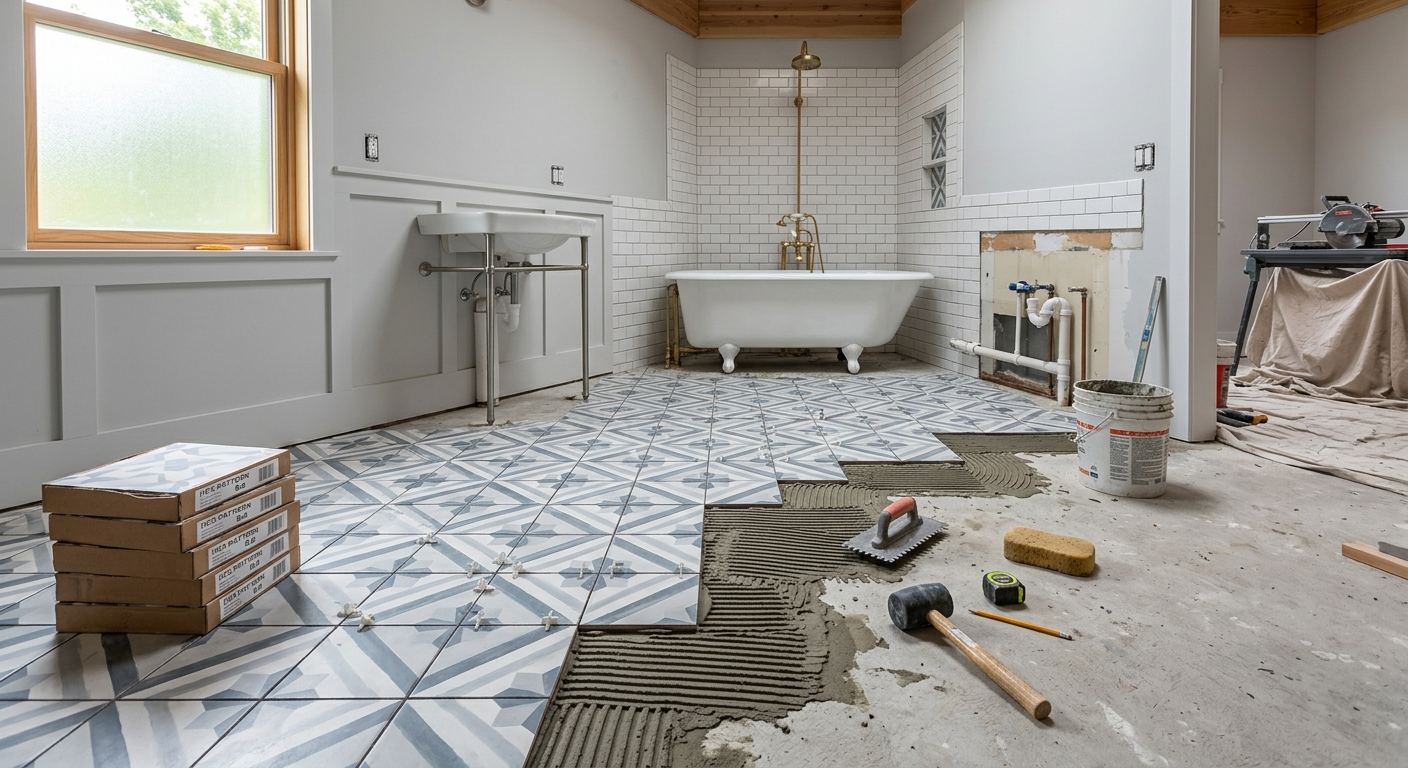
Bathroom renovation options and costs in Carey
In Carey, British Columbia, the right bathroom renovation option depends on how much you want to change—and on what’s hidden behind the walls. Carey’s population was 18,405 in the 2021 Census (Statistics Canada, 2021 Census), and like much of the Lower Mainland–Southwest, a lot of local housing stock is mid-century. That matters because older layouts often mean dated plumbing runs, and in many pre-1980 homes you may encounter cast-iron or galvanized supply lines plus the potential for asbestos-containing materials tucked in older flooring, drywall compound, or insulation. Even when the room looks “fine,” opening walls can quickly expand the scope.
Lower Mainland–Southwest bathroom pricing is shaped less by the weather than by labour availability and local trade rates. Metro Vancouver-area demand keeps plumbers, tilers, and electricians busy, so same-bathroom schedule changes can move timelines and budgets. In neighbourhoods like the older residential pockets around Carey’s established streets, we often see high trade interest because homeowners are both upgrading aging systems and refreshing finishes. If your bathroom is in a pre-reno building, common discoveries—insufficient ventilation, worn drains, or subfloor irregularities—can push a “mid” project into a higher scope.
Below are realistic price bands for common pathways in Carey, which you can use to compare contractor quotes before you lock in materials and scope.
| Renovation Scope |
What's Included |
Typical Duration |
Price Range |
| Cosmetic refresh (paint, fixtures, accessories only) |
New paint, swap vanity or taps, replace toilet/lighting where plumbing/electrical stays in place, add accessories; no wall/floor removal |
3–7 days |
$5,000–$12,000 |
| Mid-range full renovation (new tile, vanity, tub/shower, electrical) |
Demo and disposal, tub/shower or alcove surround, tile floor + walls, vanity, mirror/lighting, exhaust fan upgrade, new GFCI receptacle (if needed), standard waterproofing, basic plumbing refresh as required |
2–3 weeks |
$18,000–$32,000 |
| High-end full renovation (custom tile, steam shower, heated floors) |
Custom shower/tile package, steam unit, heated floors, upgraded ventilation, designer lighting, premium waterproofing system, higher-end finishes and fixtures, more extensive rough-in and detailing |
3–6 weeks |
$32,000–$45,000 |
| Shower-only installation (convert tub to walk-in shower) |
Remove tub, build new shower base/pan, tile walls and floor, new glass enclosure allowance, update drains and waterproofing, exhaust fan checks and adjustments if needed |
1.5–3 weeks |
$10,000–$25,000 |
| Bathtub replacement or tub-liner install |
Swap alcove tub and finish trim (or liner where suitable), confirm drain compatibility, basic reseal, new fixtures/caulking, targeted wall protection |
4–10 days |
$1,500–$6,000 |
| Tile-only installation (floor + surround, existing layout kept) |
Tile demo of tile-only areas, install new tile floor and wall surround, waterproofing coverage appropriate to wet areas, new trim/caulking |
1–2 weeks |
$2,000–$8,000 |
Prices are estimates only and vary by project scope, site access and material selection.
What affects the price of bathroom renovation in Carey
In Carey and across the Lower Mainland–Southwest, two quotes for what looks like the “same” bathroom can differ by 30–50% because the real drivers are behind-the-wall labour decisions and unforeseen material remediation—not just finishes. Compared with other parts of British Columbia or more rural markets, Metro Vancouver-area labour rates and trade availability strongly affect timelines and day rates, and the region’s housing stock tends to be older enough that opening walls triggers system upgrades. That’s why a project that starts as a “tile + vanity refresh” can quickly become a plumbing and venting scope update to meet current code and performance expectations.
Older homes in the Lower Mainland–Southwest region often hide cast-iron or galvanized drain stacks, outdated copper supply lines, and bathrooms with ventilation that doesn’t actually move enough moisture. When we replace drains or adjust venting, labour rises and additional inspections may be needed. Also, discoveries of asbestos-containing materials (commonly in pre-1985 vinyl tile, some drywall compound, or insulation) can force abatement and containment protocols—typically adding roughly $1,500–$5,000+ depending on extent and how the materials are packaged. If the bathroom subfloor is uneven, you may see extra prep time for leveling and new waterproofing details, which is common in older mid-century builds.
Two practical Carey examples: (1) If you keep the drain location and just re-tile, tile-only work often lands closer to the $2,000–$8,000 band; (2) if you move the vanity, relocate plumbing, and upgrade the exhaust fan with a new electrical circuit, a full mid-range renovation can shift into the $18,000–$32,000 range and beyond. The “humidity” angle is real, but it’s the ventilation and waterproofing system choices—made in a labour-intensive environment with older substrates—that usually decide the final number.
| Price Factor |
Why It Matters |
Cost Impact |
| Layout change — moving drain or supply lines requires rough-in work |
Re-routing pipes means demolition, new framing, patching, inspections, and longer labour time |
Often adds $3,000–$10,000+ |
| Tile selection — large-format porcelain vs. mosaic vs. ceramic |
Harder materials demand more precise substrate prep, specialized cuts, and more careful installation |
Typically adds $1,500–$6,000 |
| Fixture tier — builder-grade vs. mid-range vs. designer brands |
Higher-end fixtures can require more detail work, plus increased material cost |
Often adds $500–$5,000 |
| Subfloor condition — rot or unlevel concrete adds scope |
Rot removal, joist repair, underlayment replacement, or new leveling adds time and materials |
Commonly adds $1,000–$4,500 |
| Electrical — adding GFCI outlets, exhaust fan, heated floor circuit |
More circuits mean licensed electrical work, wiring changes, and inspection requirements |
Often adds $800–$3,500 |
| Waterproofing method — membrane type and extent |
Better systems cost more and require careful installation, but reduce long-term moisture risk |
Typically adds $600–$2,500 |
| Older-home surprises — asbestos tile, cast-iron drains, galvanized pipes |
Remediation, disposal handling, and plumbing upgrades add trades and compliance steps |
Can add $1,500–$8,000+ |
| Bathroom size — sq ft drives tile and labour time directly |
More floor/wall area increases material quantities and hours for prep and install |
Varies widely; often $2,000–$12,000+ |
Permits & regulations in British Columbia
In British Columbia, cosmetic updates in a bathroom—like swapping fixtures, repainting, replacing a vanity, or retiling without moving plumbing—typically don’t require a permit. However, if you’re changing the “functional” parts of the room, permits and inspections usually come into play. For example, relocating plumbing (moving a drain or supply line), adding or upgrading an exhaust fan that requires new wiring or a new circuit, and making structural wall changes are the kinds of work that typically require permits and inspections. Electrical work must meet the provincial electrical safety requirements and be performed by or signed off through licensed electrical work.
A homeowner in Carey can verify a contractor step-by-step before signing: first, confirm the contractor’s British Columbia trade licence (as applicable to their scope) using the appropriate provincial online licence registry for their trade category. Second, ask for a certificate of insurance showing liability coverage and confirm it’s current; if the contractor is using subcontractors, ensure those parties are also insured. Third, request proof of coverage appropriate to the work (Workers’ Compensation coverage for the employer/contractor performing the work). When you receive paperwork, don’t just accept screenshots—match the name on the insurance to the legal entity on the quote and invoice.
Finally, ask whether the permit pull/inspection coordination is included in the quote for any work that triggers it—then keep a copy of permit numbers and inspection sign-offs for your records.
Choosing tile, waterproofing and fixtures for your Carey bathroom
Your Carey bathroom budget is usually decided by three material decisions: tile choice, waterproofing method, and fixture tier. Tile sets the tone, but in the Lower Mainland–Southwest it also determines labour complexity because older subfloors may need more prep. For tile, ceramic is often the entry point (more forgiving and typically lower material cost), porcelain is denser and more water-resistant for wet areas, and natural stone (marble, travertine, slate) adds premium material cost plus stricter installation and sealing expectations.
Next is waterproofing. In coastal BC, moisture management is critical; the right waterproofing system helps prevent mould and failure at the tile edges, but it also must match your shower design and substrate. Paint-on membranes can work for certain wall applications, but full wet-area performance typically requires a bonded sheet membrane or a properly installed system with compatible boards and details around niches, corners, and drains. For many remodels where we open walls, a schluter-style approach (system boards plus membranes and matching components) is often the most predictable way to protect against moisture intrusion over time.
Finally, fixture tier impacts not only price but also what you can do aesthetically and functionally at resale. Builder-grade fixtures can keep you closer to the $18,000–$32,000 full renovation band when paired with good waterproofing. If you choose heated floors or a steam shower, you may move toward the $32,000–$45,000 high-end range—where the extra cost is justified by comfort and long-term usability, not just appearance. As a dollar example, upgrading the shower package from standard tub/shower to a walk-in with proper waterproofing and glass typically moves you into the shower installation band of $10,000–$25,000, even if the layout stays similar.
| Material / Option |
Pros |
Cons |
Price Range |
| Ceramic tile (floor + walls) |
Good value, wide colour/design selection, often simpler to cut and install |
Can be less durable than porcelain in some formats; may require careful selection for slip resistance |
$2,000–$6,000 |
| Porcelain tile (floor + walls) |
Denser and more water-resistant, excellent for wet areas, more consistent sizing and performance |
Higher material cost; more precise substrate requirements for large-format tiles |
$3,000–$8,000 |
| Natural stone (marble, travertine, slate) |
Premium look, unique veining and character, strong resale appeal |
Requires more labour, sealing/maintenance considerations, can be more expensive to source and manage |
$5,000–$12,000 |
| Frameless glass shower enclosure |
Cleaner visual line, durable modern look, helps brighten smaller bathrooms |
Higher hardware cost; measurements must be exact; installation needs careful alignment |
$2,000–$6,000 |
| Prefab tub surround (acrylic) |
Fast install, good water resistance when properly fitted, less tile labour |
Fewer design options; can look less “custom” than tile; repairs are more limited |
$1,500–$4,000 |
| Custom shower pan (tile or linear drain) |
Creates a high-end look with integrated drainage, strong performance when waterproofed correctly |
More detailed framing and waterproofing; requires experienced installation and correct slope |
$4,000–$12,000 |
How to choose a bathroom renovation contractor in Carey
Choosing the right contractor in Carey is mostly about verifying capacity and protecting yourself from scope creep. Start with licensing and coverage. Ask for proof of the contractor’s British Columbia trade licence that matches their work, plus liability insurance (certificate of insurance) showing the coverage is active and the named insured matches their business. For job protection, confirm Workers’ Compensation coverage through the employer/contractor’s Workers’ Compensation account (you should be provided documentation/clearances where applicable).
Then get 2–3 itemised written quotes, not lump sums. A strong quote breaks labour and materials down (demo, framing/patching, waterproofing labour, tile installation labour, fixture allowances, disposal fees, and any subcontracted electrical/plumbing). Read the scope line-by-line: what’s excluded (for example, moving plumbing, asbestos testing, or subfloor reconstruction)? Is the permit pull included if required? Is disposal included for drywall, tile, and packaging? Also clarify whether the quote assumes “typical” subfloor and access, so you can identify what triggers change orders.
Warranty matters. Ask how long the workmanship warranty lasts and whether it’s backed in writing by the installer—not just by “good faith.” Confirm the product/manufacturer warranties for tile, waterproofing membrane components, glass, and fixtures, and whether those warranties are transferable to subsequent owners (relevant for resale).
Payment schedule should be controlled: never pay more than about 10–15% upfront, and hold back a portion until key milestones are complete. Get a start date and completion estimate in writing, with a realistic allowance for lead times on glass and specialty fixtures.
- Request licence proof and confirm it matches the quote name and address.
- Ask for liability insurance and read the effective dates.
- Confirm Workers’ Compensation coverage documentation for the contractor.
- Get 2–3 itemised quotes (labour + materials + allowances).
- Check the scope for permits, inspections, and who pays those fees.
- Verify disposal is included (tile, drywall, demo material removal).
- Confirm waterproofing scope and which system is being used.
- Ask how they handle older-home surprises (subfloor, drains, wiring).
- Clarify lead times for tile, glass, and vanities before scheduling.
- Confirm warranty length for workmanship and how claims are handled.
- Review the payment schedule; limit upfront deposit to 10–15%.
- Ensure the timeline includes buffer days for inspection and cure times.
Red flags I see in Carey include: (1) a quote with no breakdown (no allowances, no disposal line, no waterproofing details), (2) promises of “no issues” despite older plumbing and mid-century walls, (3) asking for large upfront payments, (4) vague warranty language (“we’ll fix it”), and (5) refusing to put the timeline, scope, and change-order process in writing.
Frequently asked questions — bathroom renovation in Carey
How do I plan a bathroom renovation on a tight budget in Carey?
If you’re working with a tight budget in Carey, the best strategy is to protect the “expensive surprises” first: keep the plumbing layout and avoid moving drains or supply lines. That alone can prevent the scope jump that often sends a job toward the higher end of the full renovation range. Use the price bands to set expectations: a cosmetic refresh is usually far cheaper than a full bathroom, while a properly scoped mid-range full renovation typically sits in the $18,000–$32,000 band depending on tile and electrical. For materials, choose porcelain where it matters (wet zones and floors) but balance against cost—avoid natural stone if you’re trying to stay lean. Also budget for moisture control: good waterproofing details cost more upfront but reduce future repairs from failed edges and grout. In older homes, plan a small contingency for subfloor corrections and possible venting upgrades, since Lower Mainland–Southwest labour rates make delays costly.
What's the difference between a cosmetic and a full bathroom renovation?
A cosmetic renovation focuses on surfaces and fixtures while leaving the plumbing and major layout alone—think painting, swapping a vanity, replacing taps and lighting, and adding accessories. A full bathroom renovation usually involves demo, new tile (floor and wet-wall areas), updated waterproofing, and often electrical upgrades like a compliant exhaust fan and GFCI receptacle. If your project includes changing a tub/shower to a walk-in, adjusting venting, or relocating any drain/supply lines, it’s no longer “cosmetic” in practical terms because you’re adding rough-in work and inspections. In Carey, many homeowners start with the idea of retiling and end up addressing hidden issues like older drains or insufficient ventilation once walls open. That shift is one reason a full renovation commonly lands in the $18,000–$45,000 range versus a simpler refresh that’s typically much lower.
How do I choose the right contractor for my bathroom in Carey?
Choose a contractor by verifying three things: licensing for their trade scope in British Columbia, current liability insurance, and Workers’ Compensation coverage for the employer performing the work. Then demand itemised quotes with clear scopes—labour, materials, allowances, disposal, and whether permits are included for tasks that require them (like plumbing relocation or new exhaust fan wiring). In Carey’s Lower Mainland–Southwest market, experienced plumbers and tilers can schedule quickly, but only if the scope is clear; vague quotes often lead to change orders. Ask how they handle older-home surprises such as cast-iron drain sections, galvanized supply lines, and potential asbestos-containing materials in pre-1985 elements. Finally, confirm warranty terms in writing: workmanship coverage for waterproofing and tile installation should be specific, and product warranties should be documented. A credible contractor will also give you a realistic timeline with cure and inspection windows.
What's the most common mistake homeowners make in bathroom renovations?
The most common mistake I see in the Carey area is under-scoping the “behind-the-wall” requirements and then trying to force a low budget onto a larger need. Homeowners often assume a bathroom can be renovated like a paint job, but tile and shower work depend on a sound substrate, correct waterproofing, and ventilation performance. In older Lower Mainland–Southwest homes, opening the wall may reveal aging drain assemblies, inadequate venting, or outdated supply lines. If you only budget for finishes, a discovery that triggers remediation—sometimes even asbestos-related abatement in pre-1985 materials—can quickly blow up the plan. Another frequent issue is choosing a waterproofing approach based on price alone instead of compatibility with the shower design. The fix is simple: get an inspection/investigation plan up front, request an itemised quote, and set a reasonable contingency so you’re not surprised when the job needs plumbing rough-in upgrades.
How long does tile installation take in a Carey bathroom?
Tile timelines in Carey typically depend on bathroom size, tile type, and whether the job requires extra prep (leveling, board replacement, or more detailed waterproofing work). For many standard renovations where plumbing layout doesn’t move, tile work often takes about 5–10 working days, with extra time for waterproofing cure and careful corner detailing. If you’re doing a full shower surround with multiple niches, linear drains, or large-format porcelain, expect more layout accuracy work and longer install time. In practice, total project duration is longer than “tile days” because demo, substrate prep, inspections, and drying/cure schedules come between stages. That’s why contractors often show tile-only as a smaller window in the $2,000–$8,000 band, while full renovations that include electrical and plumbing upgrades generally land in the $18,000–$45,000 range and take weeks, not days.
How much does a bathroom renovation cost in Carey?
In Carey, the cost depends on scope, but realistic budgeting usually starts with the region’s full bathroom bands. Full bathroom renovations typically run $18,000–$45,000 in the Lower Mainland–Southwest, with labour and older housing conditions driving much of the variation. A shower-only conversion often fits in the $8,000–$25,000 range when proper waterproofing and drainage adjustments are included. If you’re keeping the layout and only replacing fixtures or refreshing surfaces, you can often control costs more tightly than with a full rebuild. Tile-only projects can fall around the $2,000–$8,000 band, but only if the substrate is in good condition and waterproofing requirements are straightforward. The biggest reason final numbers move is what’s discovered behind walls—aging drains, supply line condition, subfloor issues, and ventilation. Planning for that possibility with an itemised quote and a small contingency helps keep your budget predictable.