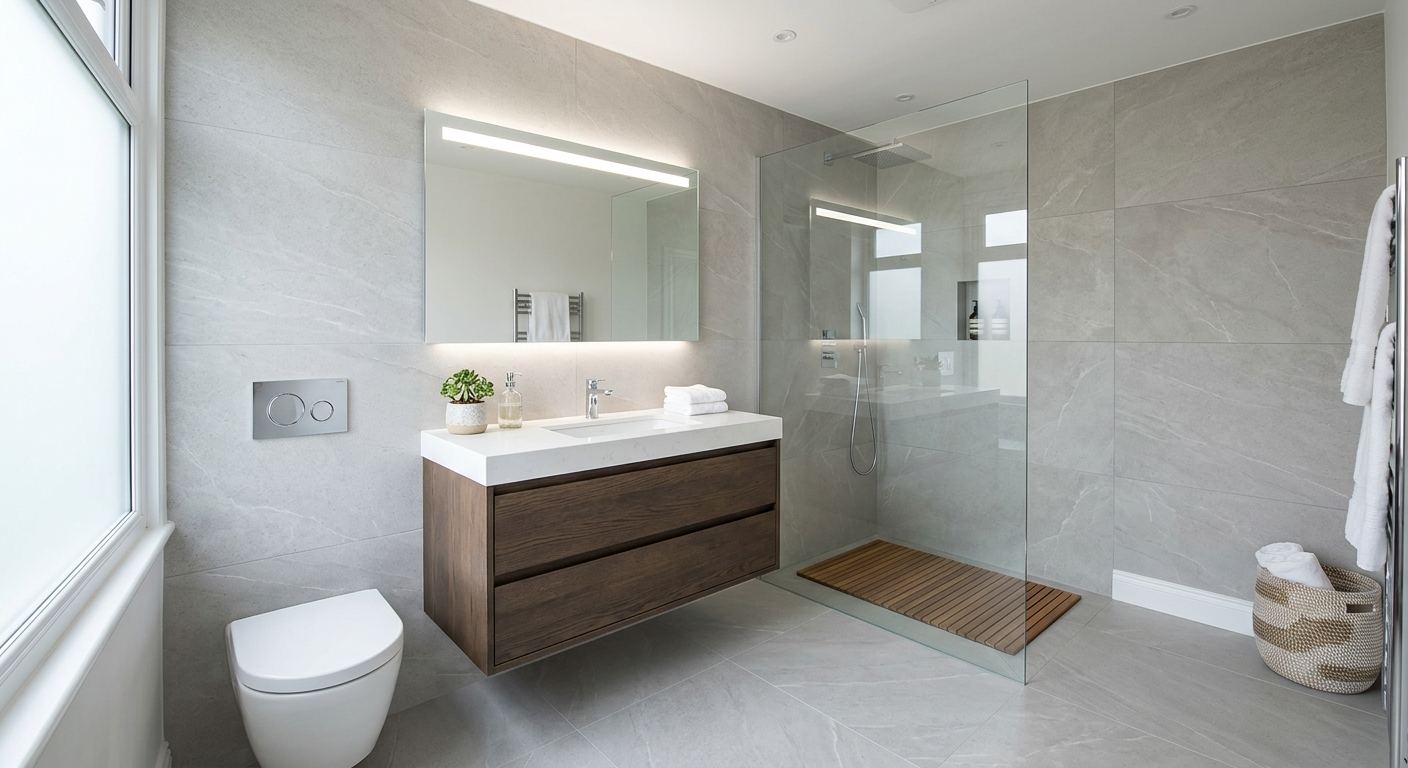
Bathroom renovation options and costs in Haney
Haney homeowners typically choose between a cosmetic refresh, a mid-range full renovation, or a higher-end transformation—each with very different timelines and risk. The first budget question is often driven by the housing stock: with a large share of older homes (many predating 1980) in the Lower Mainland–Southwest, you’re more likely to uncover dated plumbing layouts and older drain materials once walls and floors come off. That same age profile also increases the odds of finding asbestos-containing materials in floor tile, drywall compound, or insulation during demo in certain pre-1985 builds. In a city of 21,041 residents (Statistics Canada, 2021 Census), contractor demand is steady, and that matters when scheduling skilled tilers, plumbers, and electricians—especially in neighbourhood pockets with lots of mid-century remodel activity such as Haney’s older residential sections near the downtown core and surrounding residential streets.
In the Lower Mainland–Southwest, cost is shaped less by temperature and more by labour rates and the way bathrooms are built in older houses. Once opening up begins, projects commonly expand to include plumbing and venting upgrades to align with current British Columbia requirements. Even where the goal is “just new tile,” you may still end up adding electrical for a proper exhaust fan, fixing subfloor flatness, or replacing worn supply lines. That’s why comparing quotes needs the scope to match—not just the final dollar figure.
Use the table below to benchmark typical Haney price ranges, then we can talk about which option best fits your bathroom’s condition and your goals before you commit.
| Renovation Scope |
What's Included |
Typical Duration |
Price Range |
| Cosmetic refresh (paint, fixtures, accessories only) |
Paint, caulking replacement, swap vanity or faucets (no plumbing moves), toilet refresh, lighting/fixture swaps, re-grout/spot repair, new accessories |
3–7 days |
$5,000–$12,000 |
| Mid-range full renovation (new tile, vanity, tub/shower, electrical) |
Demo to drywall (as needed), new waterproofing and tile (floor + surround), new vanity/toilet, tub/shower replacement or refinishing with proper prep, vent fan upgrade (as required), updated lighting, electrical allowances, disposal |
2–4 weeks |
$18,000–$32,000 |
| High-end full renovation (custom tile, steam shower, heated floors) |
Architectural layout, premium waterproofing system, custom shower/tile detailing, heated floor prep and circuit (where required), steam or multi-function shower, designer fixtures, enhanced electrical plan, higher-end vanity and hardware |
4–7 weeks |
$32,000–$45,000 |
| Shower-only installation (convert tub to walk-in shower) |
Remove tub, install walk-in shower pan/base (tile or linear drain), new waterproofing and tile surround, new glass (if selected), updated plumbing rough-in as needed, exhaust fan refresh (as required) |
1–3 weeks |
$16,000–$25,000 |
| Bathtub replacement or tub-liner install |
Replace tub and reglaze/finish where applicable, new trim and seals, re-caulk, tile touch-up around tub edge, plumbing connections as required |
5–12 days |
$1,500–$6,000 |
| Tile-only installation (floor + surround, existing layout kept) |
Tile removal and re-install, underlayment prep, waterproofing upgrade (where required by system), re-grout, incorporate existing vanity/fixtures if protected, patch/level subfloor as needed |
1–2 weeks |
$2,000–$8,000 |
Prices are estimates only and vary by project scope, site access and material selection.
What affects the price of bathroom renovation in Haney
Homeowners in Haney often see quotes swing by 30–50% for what looks like the “same” bathroom on paper—primarily because the Lower Mainland–Southwest market has higher construction labour costs and because bathroom renovations are trade-intensive in a tight footprint. Labour and availability of plumbers, tilers, and electricians strongly influence pricing here, and that can outweigh differences you’d expect from climate alone. In British Columbia, many older homes also require additional work once walls are opened: venting updates, plumbing replacements, and corrected waterproofing details are common scope expansions rather than optional upgrades.
Age of housing stock is a key driver. In the Lower Mainland–Southwest, older homes frequently hide cast-iron or galvanized drain sections, outdated copper supply lines, or insufficient ventilation. When we find issues like this, the project can move from a “cosmetic refresh” into a mid-range full renovation fast. Another common budget surprise is asbestos in certain pre-1985 materials—if vinyl floor tile or drywall compound contains asbestos, remediation steps must be added. That typically adds about $1,500–$5,000+ depending on area and access.
Concrete Haney examples that raise costs include: (1) relocating plumbing to accommodate a walk-in shower or linear drain (rough-in work and patching add time); (2) unlevel subfloor or rot around wet areas (we have to rebuild or self-level); and (3) upgrading exhaust and adding GFCI protection when electrical is outdated. If you keep the footprint and stick to a standard tub or shower base, budgets can land closer to the full-renovation band (often $18,000–$45,000), while keeping layout changes minimal usually helps control tile-only portions (commonly within $2,000–$8,000 when demolition and waterproofing requirements are straightforward).
| Price Factor |
Why It Matters |
Cost Impact |
| Layout change — moving drain or supply lines requires rough-in work |
New locations mean breaking floors/walls, plumbing rough-in, testing, and patching to waterproofable surfaces |
Often +$3,000–$10,000 depending on extent |
| Tile selection — large-format porcelain vs. mosaic vs. ceramic |
Larger tiles need flatter substrates; mosaics increase labour and cutting time |
Often +$1,000–$6,000 |
| Fixture tier — builder-grade vs. mid-range vs. designer brands |
Higher tiers cost more and may need more precise installation tolerances |
Often +$500–$5,000 |
| Subfloor condition — rot or unlevel concrete adds scope |
Fixing softness, adding backer systems, and achieving flatness prevents cracked tile |
Often +$1,000–$7,000 |
| Electrical — adding GFCI outlets, exhaust fan, heated floor circuit |
Licensed electrical is required and wiring path can be limited in older walls |
Often +$800–$4,500 |
| Waterproofing method — membrane type and extent |
Better systems reduce failure risk but add material and labour for correct overlaps and detailing |
Often +$500–$3,500 |
| Older-home surprises — asbestos tile, cast-iron drains, galvanized pipes |
Unexpected remediation and replacement trades extend schedule and raise permit/scope demands |
Often +$1,500–$12,000+ |
| Bathroom size — sq ft drives tile and labour time directly |
More surface area increases tile, waterproofing, setting materials, and working time |
Often scales roughly +$2,000–$8,000 across sizes |
Permits & regulations in British Columbia
In British Columbia, cosmetic updates usually do not require a permit. That means straightforward work like swapping fixtures (faucets, toilet replacement where the plumbing connection is unchanged), repainting, accessory upgrades, and retiling that doesn’t move plumbing or change structure is typically treated as renovation rather than a permitting trigger. However, if you’re relocating plumbing (moving a drain or supply line), adding or changing an exhaust fan that involves new wiring/circuit work, or making structural wall changes, permits are commonly required.
Electrical work must meet provincial code and be performed by a licensed electrician. If heated floors are added, that also involves electrical scope that must be handled correctly and signed off. For plumbing rough-ins—new drain runs, venting adjustments, or any changes behind finished walls—permits and inspections are typically required because those are the points that affect safety and long-term performance.
Step-by-step for Haney homeowners: (1) Ask the contractor for their British Columbia trade licence details for the relevant trades (plumbing/electrical as applicable) and confirm the name matches their documents; (2) Request a current certificate of insurance (liability) showing active coverage; (3) Get proof of WCB/clearances or appropriate coverage for workers—this is often requested via a clearance letter; and (4) Keep copies in writing as part of your contract package. If a contractor can’t provide licences, insurance, and clearance documentation up front, treat it as a major red flag and pause the decision.
Choosing tile, waterproofing and fixtures for your Haney bathroom
In Haney, your budget is shaped most by three material decisions: tile, waterproofing, and fixture tier. Tile choice affects both material cost and labour complexity. Entry-level ceramic is usually simplest to install on properly prepared surfaces and can work well for a clean, classic look, but it may be less forgiving than porcelain in high-splash areas. Porcelain (floor and walls) is often a better value in British Columbia bathrooms because it’s denser, generally more stain-resistant, and it holds up well to cleaning routines—though large-format porcelain requires a flatter substrate.
Waterproofing is where “cheap” options can cost more later. Haney’s coastal moisture swings and frequent shower steam make bathrooms unforgiving—mould and failure often start where corners, niches, and transitions are detailed incorrectly. A paint-on membrane can be a budget option for some surfaces, but a bonded sheet membrane or a proven system (including compatible boards and seam detailing) is typically more robust for showers. The right choice helps prevent moisture migration and protects the surrounding drywall and framing.
Finally, fixture tier matters for both daily use and resale. Builder-grade fixtures keep material costs down, while mid-range brands offer smoother valves, more reliable finishes, and easier long-term maintenance. Designer fixtures can be justified when you’re doing a high-end full renovation and want upgrades that buyers notice immediately. For example, moving from a basic tub/shower trim package to a mid-range valve and trim set might add roughly $500–$2,000, but it’s often worth it because it improves function and finish longevity, especially in a primary bathroom.
| Material / Option |
Pros |
Cons |
Price Range |
| Ceramic tile (floor + walls) |
Budget-friendly, wide design selection, typically straightforward installation |
Can be less durable than porcelain; requires careful substrate prep to avoid cracking |
$2,000–$6,000 |
| Porcelain tile (floor + walls) |
More stain-resistant, better wear resistance, often ideal for wet-room cleaning routines |
Costlier material; large-format pieces need very flat substrates |
$4,000–$8,000 |
| Natural stone (marble, travertine, slate) |
Luxury look, unique variation, high-end resale appeal |
More maintenance (sealing), higher material and labour, substrate and waterproofing detailing is critical |
$7,000–$18,000 |
| Frameless glass shower enclosure |
Brightens the room, modern look, easier to clean than curtains |
Higher hardware cost; requires accurate layout and sturdy framing/waterproofing |
$1,800–$5,000 |
| Prefab tub surround (acrylic) |
Fast installation, water-tight when installed correctly, budget-friendly |
Limited style customization; can show seams/edges over time if not properly finished |
$1,500–$4,000 |
| Custom shower pan (tile or linear drain) |
Clean modern drainage lines, strong integration with waterproofing system |
More labour and detailing; requires precise slope and drain placement |
$8,000–$20,000 |
How to choose a bathroom renovation contractor in Haney
Choosing the right bathroom contractor in Haney starts with verifying British Columbia coverage and licensing in a way you can document. First, confirm the contractor provides current trade licence details for the work they claim to do (and that each subcontractor has the right credentials). Next, ask for a certificate of liability insurance showing active coverage for the renovation period. For workers, request evidence of WCB/WCB coverage or a clearance letter, because it protects you if something goes wrong on-site. If they can’t provide these details quickly and clearly, you’re taking unnecessary risk.
Then get 2–3 itemised written quotes—not a single lump sum—so you can compare labour hours, demolition, waterproofing, tile installation method, electrical allowance, permit handling, and disposal. A good quote will clearly state what’s excluded: for example, whether plumbing replacement is included if an inspector requires upgrades, and whether asbestos abatement is handled by a specialist if discovered in older floors. You should also see warranty terms: workmanship coverage (commonly 1 year or more depending on scope) and separate manufacturer/product warranties where applicable. Ask if the workmanship warranty is transferable if you sell your home.
For payments, avoid paying more than about 10–15% upfront. A holdback until substantial completion is a practical safeguard. Finally, lock in timeline details: start date and a realistic completion estimate in writing, including lead times for tile, glass, and vanities common in the Lower Mainland–Southwest market.
- Confirm relevant British Columbia trade licences match the scope (plumbing/electrical as applicable).
- Request certificate of insurance and verify coverage dates and job location.
- Ask for WCB/clearance documentation before work begins.
- Use itemised quotes (labour + materials + allowances), not only “total price.”
- Make sure permit responsibility is stated (pulling permit vs. homeowner obtains it).
- Clarify disposal and haul-away (demo debris, packaging, old fixtures).
- Ask the exact waterproofing method and system they use, including how corners and transitions are treated.
- Confirm substrate prep expectations (flatness, backer board, subfloor repairs).
- Verify tile installation includes proper movement joints and matching grout/caulk at transitions.
- Check electrical scope: exhaust fan, GFCI requirements, lighting location changes (if any).
- Get a written warranty summary for workmanship and understand product warranty handling.
- Agree on payment schedule with milestones and a holdback for final completion.
In Haney, common red flags include: contractors who provide only a lump sum without waterproofing and electrical/plumbing allowances; refusing to provide licence/insurance/clearance documentation; starting work without a clear demolition-to-tile schedule (often leading to rushed waterproofing); vague warranty language; and promises of “no surprises” when older homes often require plumbing venting or subfloor corrections once opened.
Frequently asked questions — bathroom renovation in Haney
What's the best tile for a bathroom in Haney?
In Haney and the Lower Mainland–Southwest, the “best” tile is usually the one that balances slip resistance, durability, and a waterproofing system that’s detailed correctly. For most bathrooms, porcelain tile is a strong choice because it handles moisture and cleaning better than basic ceramic, and it tends to stain less over time. If you want a traditional look, ceramic can still work well when your substrate is properly prepared and waterproofing is done for wet areas. Pay attention to texture: a slightly textured floor tile reduces slip risk when the floor is wet. Budget-wise, many homeowners fall into a tile installation range of about $2,000–$8,000 when the layout stays the same and the subfloor is sound. In older Haney homes, I strongly recommend assuming we’ll need to correct flatness before large-format tile goes down.
Should I do a tub-to-shower conversion?
A tub-to-shower conversion is a popular move in British Columbia because it modernizes the layout, reduces the “lip” you step over, and often makes daily use easier. In practical terms, it also tends to improve safety and accessibility, which can be attractive for resale. That said, conversions aren’t always “cheap surprises,” because plumbing rough-in may be needed for a new drain location, and we often update venting or supply lines once access is opened. The usual path is to remove the tub, install the shower pan/base with proper slope (and waterproofing at all seams), then finish with tile and a glass enclosure if desired. For Haney, you’ll often see shower-only conversion projects land in the broader bathroom range; as a guide, shower installation is commonly $8,000–$25,000 depending on tile complexity, glass choice, and whether electrical/exhaust work is required.
How do I prevent mold in a Haney bathroom?
Mould prevention in Haney is mostly about moisture control and correct waterproofing details—not just wiping surfaces. Start with a properly installed shower waterproofing system: corners, niches, and transitions are where failures begin if detailing is rushed. Pair that with good ventilation: an exhaust fan sized for the bathroom, correctly vented to the exterior, is essential in a region where bathroom humidity can linger after showers. If your current fan is weak or vented improperly, we typically upgrade during renovation so the new tile stays protected. Also, choose suitable grout and use the right caulk at movement joints around tub edges and where tile meets fixtures. In older Lower Mainland–Southwest homes, we also check for hidden water damage and subfloor softness before tiling. Addressing those issues early is what keeps moisture from turning into a long-term mould problem.
What adds the most resale value in a bathroom reno?
Resale value in British Columbia bathrooms usually comes from a combination of visible upgrades and “quality-of-life” improvements that buyers recognize quickly. High-impact items include modern tile work (especially a fresh shower/tub surround), updated vanity and lighting, and a clean, well-designed layout that feels bright and functional. Buyers also value reliability: a renovation that includes correct waterproofing, ventilation upgrades, and evidence of proper permits/inspections tends to outperform a purely cosmetic refresh. If you’re budgeting, a mid-range full renovation is often the sweet spot for value—many projects land within the full renovation band of about $18,000–$45,000 depending on scope. Premium features like heated floors or a steam shower can lift perceived value, but they’re best reserved for when you’re already doing a full high-end build with the supporting waterproofing and electrical plan.
Can I keep my existing plumbing layout to save money?
Yes—keeping your existing plumbing layout is one of the most reliable ways to control cost in Haney. When you don’t move the drain or supply lines, you avoid a lot of rough-in work: breaking floors/walls, rerouting piping, and then repairing and rebuilding to a waterproof-ready substrate. That usually reduces both labour time and the chance of encountering hidden issues. It also helps keep permits and inspections more straightforward when plumbing isn’t being relocated. Many homeowners can still get a major visual upgrade by focusing on tile, vanity, lighting, and a refreshed tub/shower surround while leaving the footprint intact. If you’re comparing options, a tile-only scope can often stay closer to a smaller band like $2,000–$8,000 when the layout and subfloor condition are favourable. The key is to confirm the condition behind the walls before you lock in the “keep it all” plan.
How much does a walk-in shower cost in Haney?
In Haney, the cost of a walk-in shower depends mainly on whether you’re converting from a tub, the tile format, and whether plumbing/electrical work is required. For a shower-only installation (for example, converting a tub to a walk-in), budgets commonly sit around $8,000–$25,000—with higher pricing when you add custom tile details, a linear drain, frameless glass, or heated-floor wiring. If your subfloor is unlevel or shows rot, it can push the cost upward because we must correct flatness and ensure the waterproofing system is installed properly. The Lower Mainland–Southwest labour market is also a factor: skilled tilers and plumbers are in demand and bathroom work is perennially busy, so schedule and labour rates influence final totals. For best accuracy, get an itemised quote after a walkthrough and, when possible, inspection of the area you’re opening.