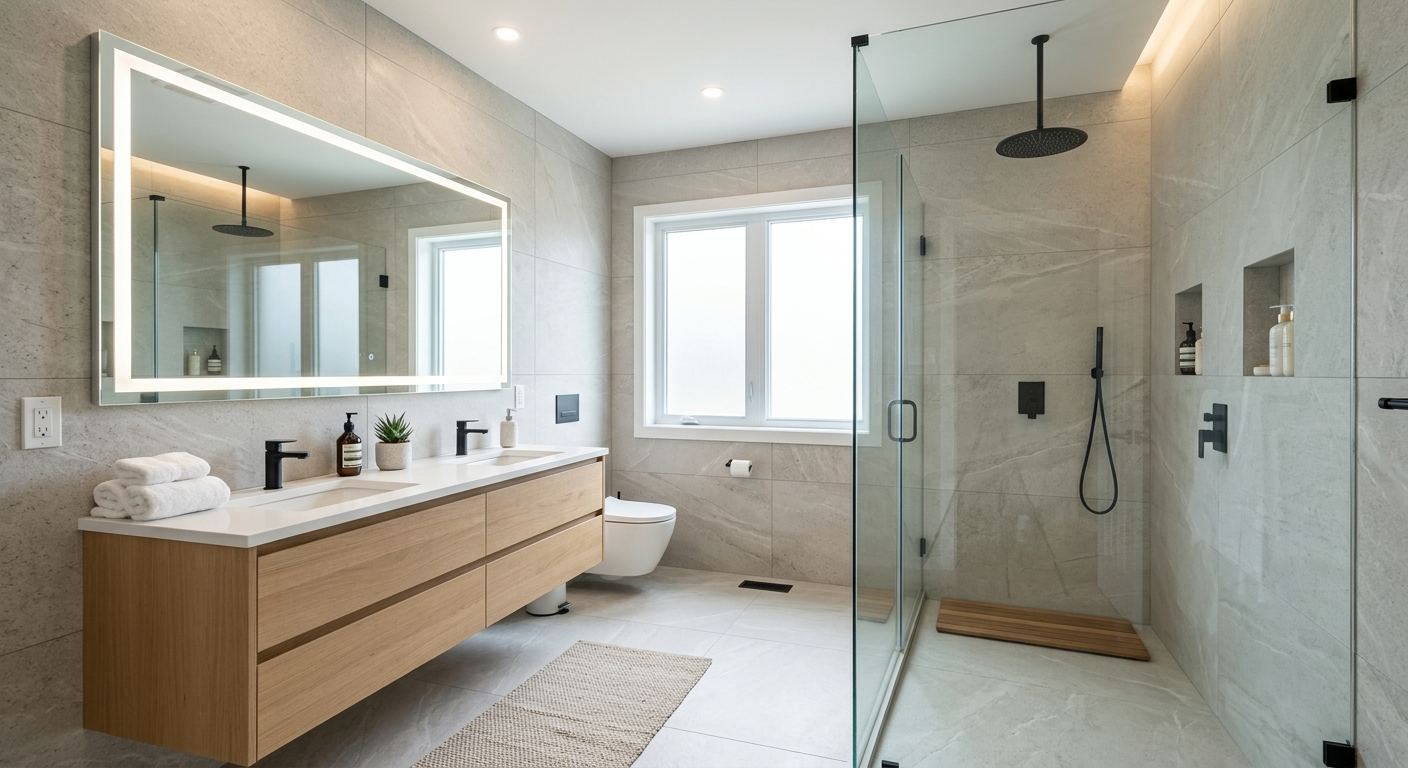
Bathroom renovation options and costs in Puntledge
Puntledge homeowners typically have a clear range of bathroom renovation options, from a quick cosmetic refresh to a full rip-and-rebuild. With a small population base of 1,387 people (Statistics Canada, 2021 Census), local trades can be booked up quickly when demand spikes, so scheduling often becomes part of your cost. Puntledge also has many older homes common across the Lower Mainland–Southwest, and in pre-1980 construction the original plumbing layouts and materials can be dated—meaning you may find cast-iron or galvanized components behind walls and floors, and sometimes asbestos-containing materials in older flooring or drywall compounds.
While Puntledge’s coastal climate brings steady humidity, bathroom costs here are driven more by labour rates and housing age than by weather alone. In the Lower Mainland–Southwest, skilled plumbers, tilers, and electricians are in high demand, and once walls are opened, projects frequently expand to include plumbing and venting upgrades to align with current British Columbia requirements. Areas around Comox Valley corridors and older residential pockets near Puntledge typically see higher trade traffic because of constant turnover in mid-century homes and the frequency of plumbing discovery work.
To help you budget, below are typical scopes and price bands for Puntledge. Use this table as a baseline, then expect the contractor’s assessment to narrow it based on your exact layout, finishes, and whether any “open-wall” repairs are uncovered.
| Renovation Scope |
What's Included |
Typical Duration |
Price Range |
| Cosmetic refresh (paint, fixtures, accessories only) |
New vanity or taps (like-for-like), mirror, lighting, paint, caulking, toilet or basic trim; existing tile left as-is |
2–5 days |
$2,500–$7,500 |
| Mid-range full renovation (new tile, vanity, tub/shower, electrical) |
Demo, waterproofing, floor + wall tile, new vanity and toilet, tub/shower or surround, exhaust fan upgrade, basic electrical updates, disposal |
2–3 weeks |
$22,000–$35,000 |
| High-end full renovation (custom tile, steam shower, heated floors) |
Custom shower/tub design, premium tile detailing, higher-end fixtures, heated floor circuit, upgraded ventilation, possibly venting changes, tailored storage |
3–5 weeks |
$35,000–$55,000 |
| Shower-only installation (convert tub to walk-in shower) |
Remove tub, replace with walk-in shower pan, membrane waterproofing, new tile surround, new valve trim, glass or curtain option, exhaust fan check |
1–2 weeks |
$12,000–$28,000 |
| Bathtub replacement or tub-liner install |
Remove and install new tub and trim, refit surround; or install an acrylic liner with sealing, limited plumbing access, reseal and finish |
3–7 days |
$1,500–$6,000 |
| Tile-only installation (floor + surround, existing layout kept) |
Tile removal and reinstallation on floor and walls, waterproofing where needed, grout/seal, new finish at edges; no major plumbing relocation |
5–10 days |
$5,000–$14,000 |
Prices are estimates only and vary by project scope, site access and material selection.
What affects the price of bathroom renovation in Puntledge
Even when two homeowners ask for “the same” bathroom reno, quotes in Puntledge can differ by 30–50% across the Lower Mainland–Southwest and other parts of British Columbia. The biggest reason isn’t the tile—it's labour and what happens after the walls come down. In the Lower Mainland–Southwest, demand for plumbers, tilers, and electricians tends to stay strong, and that pushes labour rates upward. In addition, the age of local housing stock means hidden scope is common once access is gained: plumbing and venting may need updating, and ventilation often falls short of modern expectations.
Older homes frequently show problems that inflate scope: cast-iron drain stacks, galvanized supply lines, and sometimes outdated wiring routes that complicate bathroom lighting and exhaust fan installs. A single discovery can cascade. For example, if asbestos-containing materials are found in vinyl floor tile or old drywall compound from pre-1985 construction, you can see abatement protocols add roughly $1,500–$5,000+ to the budget depending on containment and removal requirements. That’s one reason why a “mid-range” full reno budget like $22,000–$35,000 can shift toward the high end once remediation and additional trades appear.
Two practical Puntledge examples: (1) If you keep the existing toilet and vanity positions, you usually avoid extensive rough-in changes, protecting your timeline and costs—whereas moving a drain or supply can turn a “tile-only” plan into a full rough-in package. (2) If your subfloor is uneven or has rot around plumbing penetrations, floor flattening and waterproof detailing add labour time, which is why a full renovation band such as $18,000–$45,000 can widen in reality.
| Price Factor |
Why It Matters |
Cost Impact |
| Layout change — moving drain or supply lines requires rough-in work |
New pipe runs, access cutting, and pressure/venting checks |
Often adds $3,000–$12,000 depending on distance and wall/floor access |
| Tile selection — large-format porcelain vs. mosaic vs. ceramic |
Material cost plus labour complexity for cuts and substrate prep |
Typically shifts tile budgets by $1,500–$6,000 |
| Fixture tier — builder-grade vs. mid-range vs. designer brands |
Higher-end valves, finishes, and shower systems cost more and may require specialised trim |
Can move totals by $500–$5,500 |
| Subfloor condition — rot or unlevel concrete adds scope |
Extra framing/patching, flattening, and waterproofing adjustments |
Commonly adds $1,000–$4,000 |
| Electrical — adding GFCI outlets, exhaust fan, heated floor circuit |
Licensed work, permitting/inspection, and additional wiring/conduit |
Often adds $800–$4,500 |
| Waterproofing method — membrane type and extent |
Better systems cost more but reduce future mould and failure risk |
Generally adds $500–$2,500 but lowers call-backs |
| Older-home surprises — asbestos tile, cast-iron drains, galvanized pipes |
Remediation, pipe replacement, and additional disposal/trade coordination |
Can add $1,500–$10,000+ depending on extent |
| Bathroom size — sq ft drives tile and labour time directly |
More wall/floor area equals more waterproofing, mortar, and tiling hours |
Small rooms can stay near the low band; larger rooms shift toward $2,000–$12,000 more overall |
Permits & regulations in British Columbia
In British Columbia, the line between “cosmetic” and “regulated” work matters for both safety and inspection. In most Puntledge bathroom upgrades, swapping fixtures (like taps, vanity, toilet, mirror) and retiling with the same layout typically does not require a permit, provided you’re not moving plumbing lines or changing structural walls. That’s why simple refresh projects can move fast.
However, permits and inspections are commonly needed when you relocate plumbing (moving a drain or supply line), add or modify exhaust fans with new electrical circuits, or make structural changes that affect walls, floors, or supports. Electrical work must meet provincial electrical code standards and be completed or signed off by a licensed electrician. Likewise, plumbing rough-in changes generally trigger a permit and inspection so the work is pressure-tested and verified before walls close.
To verify your contractor in Puntledge, ask for:
- A copy of their British Columbia trade licence for the relevant category (and confirm it matches the scope: plumbing/electrical/tile general contractor coordination where applicable).
- Certificate of insurance showing liability coverage (and ask for updated dates).
- Coverage evidence for workers and jobsite compliance (Workers’ Compensation coverage where applicable for their workforce).
- Written proof of permits being pulled when required, or confirmation that their licensed trades will handle permits.
Step-by-step: (1) Check the licence validity online using the province’s trade registry resources; (2) request their insurance certificate and verify the named insured; (3) confirm coverage documentation is current; (4) verify the quote specifies which work requires permits and who pulls them; and (5) only sign when scope and inspection responsibilities are clear in writing.
Choosing tile, waterproofing and fixtures for your Puntledge bathroom
Your bathroom budget in Puntledge is mainly shaped by three material decisions: tile, waterproofing, and fixture tier. First, tile choice: ceramic is a solid entry option for straightforward floors and simpler layouts, while porcelain is typically denser and more durable for wet-room use, especially when you want bigger-format pieces. Natural stone (marble, travertine, slate) looks premium, but it often needs more careful selection, sealing, and premium labour for flatness and finishing details.
Second, waterproofing method: in British Columbia’s coastal humidity, the risk isn’t just visible leaks—it’s long-term moisture management. A paint-on membrane can work in certain scenarios, but many showers perform best with a bonded sheet membrane system or a proven tile-in waterproofing assembly designed for wet areas. Proper detailing at corners, niches, and the drain is what prevents mould and keeps grout lines from deteriorating.
Third, fixture tier: builder-grade fixtures keep the first cost down, but mid-range and designer options often provide better valves, smoother finishes, and longevity that matters when resale and maintenance are on your mind.
Match your budget by choosing the “right upgrade” for your situation. For example, spending more on waterproofing and shower pan detailing is usually justified; swapping tile grades without improving waterproofing is not. If you’re working within the mid-range band of $22,000–$35,000, you can often achieve a high-end look by using porcelain tile and allocating budget toward a robust waterproofing system. Conversely, natural stone in a small bathroom may be harder to justify unless you’re committed to the higher installation standards—stone can push totals toward the upper full renovation range like $35,000–$55,000.
| Material / Option |
Pros |
Cons |
Price Range |
| Ceramic tile (floor + walls) |
Entry-friendly cost, wide style selection, good for straightforward tiling |
Often less durable than porcelain in heavy-use showers; may chip if substrate isn’t prepared well |
$2,000–$6,000 |
| Porcelain tile (floor + walls) |
Durable, great for wet-room floors, handles larger formats with the right prep |
Higher material cost; requires correct substrate flatness for best results |
$3,500–$9,000 |
| Natural stone (marble, travertine, slate) |
Premium look, unique veining, elevated bathroom feel |
More demanding maintenance (sealing), selection and installation labour can be higher |
$6,000–$15,000 |
| Frameless glass shower enclosure |
Modern appearance, easier to keep clean than curtains, adds perceived value |
Glass and hardware cost; tight tolerances required |
$2,000–$6,500 |
| Prefab tub surround (acrylic) |
Faster install, fewer tile cuts, good for budget-conscious bath conversions |
Less custom look; transitions and sealing details must be done carefully |
$1,000–$3,500 |
| Custom shower pan (tile or linear drain) |
Best appearance control and drainage performance; linear drains feel luxury |
More labour and detailing; depends heavily on waterproofing correctness |
$3,000–$10,000 |
How to choose a bathroom renovation contractor in Puntledge
Choosing the right contractor is where you protect your budget. Start with British Columbia licensing and insurance checks that match the work. Ask for (1) their current BC trade licence (or, for a coordinated renovation, confirmation that each licensed trade will perform their portion); (2) a liability insurance certificate showing coverage and expiry; and (3) workers’ compensation coverage for their workforce where applicable. You should be able to see the certificate dates and verify coverage without pressure.
Next, get 2–3 itemised written quotes. You want labour and materials separated (demo, framing/repairs, waterproofing, tile setting, electrical/plumbing, glass enclosure, disposal). Avoid “lump sum only” offers unless the scope is extremely detailed—bathrooms are small spaces, and missing line items are where costs creep.
Then read the scope like a contract, not a brochure. Confirm what’s excluded: permit pulling, disposal, asbestos or hazardous material handling if discovered, subfloor repairs, venting upgrades, and whether fixtures are supplied by the contractor or you. Warranty matters too: workmanship warranty length, who provides it, and whether product warranties transfer to you after installation.
For payment, use a schedule that avoids cashing out early—never more than about 10–15% upfront, and keep a holdback until punch-list items are complete. Finally, lock in timeline expectations: start date, estimated duration, and milestones (demo, rough-in, waterproofing inspection, tile, trim, final clean) in writing.
- Verify the correct British Columbia licence category for the contractor and trades involved.
- Request a current certificate of insurance (liability) and check expiry dates.
- Confirm workers’ compensation coverage if they have employees/crew.
- Use itemised quotes with labour vs materials clearly broken out.
- Ensure permits are stated: which permits, who pulls them, and when inspections occur.
- Check disposal inclusion (dump fees, hazardous materials handling procedures).
- Confirm waterproofing scope (membrane type, coverage areas, and sealing details at drains).
- Ask who protects your floors/doorways during demo and tiling.
- Get fixture model numbers listed, not just “or equivalent.”
- Confirm electrical: exhaust fan specs, GFCI requirements, and heated floor circuit inclusion if desired.
- Request proof of warranty: workmanship term and manufacturer warranty handling.
- Agree on payment milestones: limit upfront, keep a holdback until completion/punch list.
Red flags I see often in Puntledge: vague scopes with no unit pricing, quotes that skip waterproofing details, “approved” work that isn’t actually licensed, payment schedules that demand large deposits, and no clear process for hidden-condition discoveries (plumbing, subfloor, or potential remediation).
Frequently asked questions — bathroom renovation in Puntledge
How much does a walk-in shower cost in Puntledge?
In Puntledge, a walk-in shower usually lands in the shower installation band of $8,000–$25,000, but your exact cost depends on whether you’re converting from a tub, how complex the waterproofing detailing is, and whether plumbing/venting upgrades are needed after demo. If you keep the drain location, costs often sit toward the lower half. If you move plumbing, add a linear drain, upgrade the exhaust fan circuitry, or discover older drainage issues behind the wall, budgets can move upward quickly. In the Lower Mainland–Southwest, labour demand is a major factor, so even “simple” shower conversions can be higher than you’d expect elsewhere in British Columbia.
What's the ROI on a bathroom renovation?
ROI varies by buyer demand, neighbourhood condition, and whether the reno addresses functional problems (ventilation, leaking, outdated electrical/plumbing) versus purely cosmetic upgrades. A well-executed bathroom renovation tends to protect buyer confidence—especially where moisture management and ventilation are improved. In British Columbia’s market, buyers often pay attention to shower condition, exhaust performance, and how current the finishes are. Even if you don’t recover every dollar, you can reduce “risk discounts” during resale. If your scope is mid-range (for example, targeting a full reno around $22,000–$35,000), your ROI is often better than for projects that over-upgrade for the home’s baseline. The biggest multiplier for resale is a renovation that looks clean, is properly waterproofed, and is done to modern practice.
Do I need waterproofing behind the tile?
In almost all shower and wet-area tile installations in British Columbia, waterproofing behind the tile is essential. Bathroom humidity is persistent, and grout alone is not a waterproof barrier. A correct waterproofing assembly (membrane system plus proper detailing around the drain, corners, and any transitions) is what prevents hidden moisture from reaching framing and subfloor. If you choose a paint-on membrane, it must be installed to the product specifications; many homeowners get best results with a bonded sheet membrane or a proven tile-in waterproofing system, especially for shower pans. When you’re planning a shower or full renovation, ask your contractor to name the exact waterproofing system, where it’s applied (walls, curb, floor tie-ins), and how they treat penetrations and edges.
How do I compare bathroom renovation quotes?
Compare quotes line-by-line, not just totals. Ask each contractor to provide itemised labour and materials (demo, rough-in coordination, waterproofing system, tile labour, grout/sealant, fixtures, glass enclosure, disposal). Confirm what’s included for permits and inspections—especially if plumbing relocation or electrical circuit changes are part of the scope. Look for exclusions that change cost later, such as subfloor repairs, venting upgrades, or remediation if asbestos-containing materials are discovered in older homes. Also check how they handle contingency: do they price an allowance for unknowns or make assumptions? If one quote is significantly lower than a typical band (for example, compared to a full renovation estimate like $18,000–$45,000), it may be missing essential waterproofing or trade steps. The best quotes are specific about methods, products, and timelines.
Can I live at home during a bathroom renovation in Puntledge?
Often, yes—especially for cosmetic refreshes or tile-only scopes—but it depends on how disruptive the demo and rough-in phases are. For a full renovation, many Puntledge homeowners choose temporary bathroom access if the project can be staged: demo and rough-in are completed first, waterproofing and tiling follow, and plumbing fixtures are installed later. If you’re converting to a walk-in shower, plan for limited shower time during pan and waterproofing work. Keep in mind that dust control matters in older homes, and if unexpected remediation is required, timelines can extend. A contractor should provide a clear staging plan and protect the rest of the home. If the renovation is hitting electrical and plumbing walls simultaneously, living onsite can be more difficult, but a well-managed crew can still make it workable for many households.
What's the best bathtub material for a Puntledge home?
For most Puntledge homes, the “best” bathtub material comes down to installation requirements, desired longevity, and how it pairs with your surrounding finishes. Acrylic tubs are common because they’re relatively lightweight and install faster; that can help reduce labour time. Cast iron tubs are extremely durable and retain heat well, but they’re heavier, often more expensive to replace, and may require extra framing and careful handling—important considerations in older housing stock. Fibreglass/steel options exist but can vary in sound and feel. If you’re staying within a replacement budget like $1,500–$6,000 (tub replacement or tub-liner installs), acrylic or liner upgrades are often the most practical. The better question is usually whether your tub-to-surround waterproofing detailing is correct—because moisture control matters more than the tub material alone.