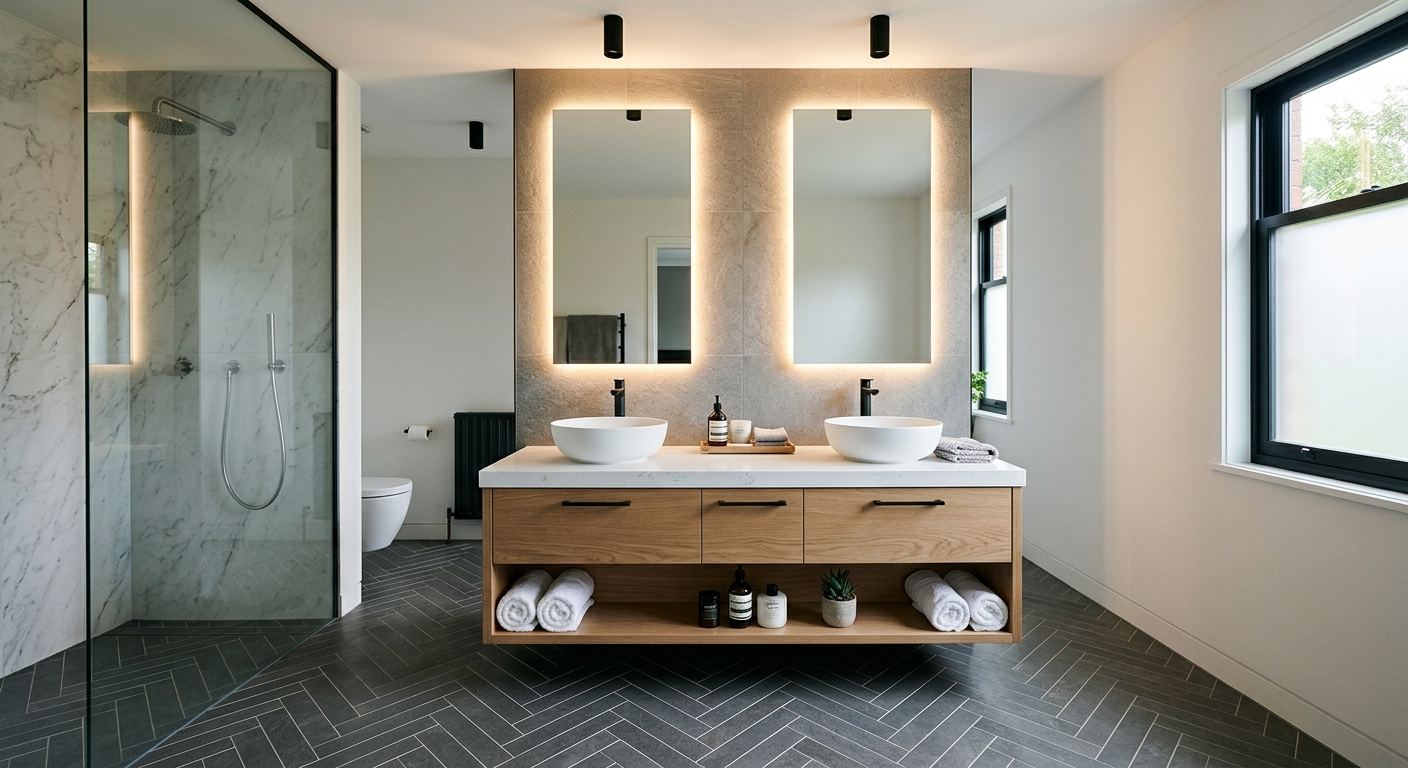
Bathroom renovation options and costs in Gold River
Bathroom renovations in Gold River can range from simple upgrades to full tear-outs, and the right approach depends on your budget, your home’s condition, and how much you want to change the layout. With only 1,246 people in the community and an older housing mix—77.0% of homes were built before 1981—many projects start by replacing dated plumbing layouts, upgrading venting, and addressing fixtures that no longer perform the way they should. On top of that, older floor finishes can occasionally include materials that require extra care during demo (such as asbestos-containing compounds in certain pre-1985 products), which is one reason Vancouver Island bathroom budgets often widen once walls are opened. (Statistics Canada, 2021 Census)
On the Vancouver Island and Coast, labour rates and trade availability are the main cost drivers, not the mild maritime climate. General contractors commonly bill about $80–$120 per hour, while plumbers and electricians often come in at $100–$150 per hour, so anything that involves rough-in work—new drains, new supply routing, added exhaust fans, or electrical updates—can quickly become the largest line item. In areas like the Campbell River-side corridor and the core residential pockets near downtown Gold River, there’s steady demand for bathroom work because trades can be booked around ongoing construction schedules, and travel time affects on-site labour.
Below is a comparison of common options and typical timelines, which will help you move from rough budget to a more accurate quote discussion.
| Renovation Scope |
What's Included |
Typical Duration |
Price Range |
| Cosmetic refresh (paint, fixtures, accessories only) |
Paint, vanity accessory updates, new toilet/vanity top where plumbing is not moved, mirror/light swap, hardware; no wall/floor removal beyond minor prep |
3–7 days |
$3,000–$8,000 |
| Mid-range full renovation (new tile, vanity, tub/shower, electrical) |
Demo and rebuild; tile floor + tub surround, new vanity and toilet, reglaze or replace tub/tub surround as chosen, exhaust fan upgrade, new GFCI as needed, waterproofing and proper caulking |
2–4 weeks |
$15,000–$25,000 |
| High-end full renovation (custom tile, steam shower, heated floors) |
Premium waterproofing system, custom tile shower with niche and bench, steam-ready electrical/controls, heated floors, designer vanity and fixtures, upgraded lighting and ventilation |
4–7 weeks |
$25,000–$40,000 |
| Shower-only installation (convert tub to walk-in shower) |
Remove tub, build walk-in shower base, new shower walls/tile, new glass if selected, plumbing adjustments for the drain location, exhaust and ventilation improvements |
2–3 weeks |
$10,000–$20,000 |
| Bathtub replacement or tub-liner install |
Replace tub with new unit and updated trim, or install a tub-liner system where conditions allow; basic surround touch-up/caulking; plumbing connections checked |
5–10 days |
$3,500–$7,000 |
| Tile-only installation (floor + surround, existing layout kept) |
Tile floor and wall surround only; includes waterproofing prep and surface prep; keeps plumbing and layout in place; limited electrical changes |
1–2 weeks |
$6,000–$18,000 |
Prices are estimates only and vary by project scope, site access and material selection.
What affects the price of bathroom renovation in Gold River
It’s common to see quotes for the “same bathroom” in Gold River vary by 30–50% across Vancouver Island and Coast and the broader BC market. The biggest reasons are labour rates and what older housing stock hides once demolition begins. On this part of the Island, trades typically price for higher on-site time and travel, and general contractors often coordinate multiple trades. Meanwhile, the median household income is $66,500 (Statistics Canada, 2021 Census), which influences how many homeowners choose mid-range materials, and it also affects how conservatively some contractors estimate risk when they can’t see behind finished walls.
For homes built before 1981 (77.0% locally), you’ll often find cast-iron or older drain assemblies, galvanized or mixed supply lines, undersized ventilation paths, and dated electrical that needs updating for today’s BC requirements. Those “hidden conditions” matter more than the mild coastal weather because the work happens indoors—opening walls, upgrading rough-in, and correcting failures before they’re covered. If an asbestos-containing material is discovered in older floor tile or drywall compound, abatement can add roughly $1,500–$5,000+ depending on extent and containment needs. You can also see savings when the existing vent route and electrical locations are workable—those situations keep you closer to the $10,000–$35,000 full renovation band rather than pushing toward higher-cost scopes.
Two concrete examples from Gold River: (1) keeping the toilet and shower valve on the same wall often reduces labour because it avoids moving drains and redoing rough-in; (2) choosing smaller mosaic tile for a complex layout may lower material cost but increase installation labour time—whereas large-format porcelain can reduce grout lines but demands flatter substrates. All of that’s why a “mid-range full renovation” might land around $15,000–$25,000, but a custom high-end scope with heated floors can climb past $25,000–$40,000.
| Price Factor |
Why It Matters |
Cost Impact |
| Layout change — moving drain or supply lines |
Requires rough-in work, patching framing, and re-routing plumbing |
Typically adds several thousand dollars and increases schedule by 1–2 weeks |
| Tile selection — large-format porcelain vs. mosaic vs. ceramic |
Material cost and installation complexity; substrate flatness requirements |
Can swing the tile-only portion by $2,000–$6,000+ depending on size and cuts |
| Fixture tier — builder-grade vs. mid-range vs. designer brands |
Differences in finish quality, valve/trim, and longevity |
Often shifts total project cost by $1,500–$5,000 |
| Subfloor condition — rot or unlevel concrete adds scope |
Waterproofing depends on a stable, level base; repairs are required before tile |
Commonly adds $1,000–$4,000+ |
| Electrical — adding GFCI outlets, exhaust fan, heated floor circuit |
May require a new circuit, fan ducting checks, and code-compliant connections |
Frequently adds $1,500–$6,000+ depending on wiring runs |
| Waterproofing method — membrane type and extent |
Different systems need different prep and application coverage |
Usually adds $800–$3,000+ but reduces long-term failure risk |
| Older-home surprises — asbestos tile, cast-iron drains, galvanized pipes |
Abatement, extra demo, upgrades, and inspection triggers |
Can add $1,500–$5,000+ (or more) if widespread |
| Bathroom size — sq ft drives tile and labour time directly |
More wall/floor area means more prep, waterproofing, and set time |
Directly affects material and labour; larger bathrooms can push to the upper band |
Permits & regulations in British Columbia
In British Columbia, cosmetic updates usually do not require a permit. That typically includes swapping fixtures like faucets and showerheads, replacing a vanity and mirror, painting, and retiling without moving plumbing or changing the structure. If you’re simply refreshing surfaces and keeping the existing plumbing positions intact, you’re generally staying in the “no-permit” zone.
Permits are commonly required when the work changes how the bathroom functions or how services are routed. In most cases, you’ll need a permit and inspections for:
- Relocating plumbing (moving drain or supply lines, changing shower valve location, reworking rough-in)
- Adding or relocating electrical outlets/circuits (for example, new GFCI locations, new heated floor circuit, or wiring a new exhaust fan)
- Structural changes (opening walls for joist repairs, changing framing around wet areas)
Here’s how a Gold River homeowner can verify a contractor the right way, step-by-step. First, ask for the contractor’s BC trade licence (for the relevant trade) and confirm it’s active through the provincial online registry. Second, request a certificate of insurance (liability coverage) and confirm the effective dates cover your project start and completion dates. Third, for work that normally involves workers on site, confirm the appropriate coverage documentation (often WCB-related coverage for workers). If you can, request proof before booking materials. Finally, ask whether the contractor will obtain the correct permits, and confirm who schedules inspections—don’t assume it’s automatic.
Choosing tile, waterproofing and fixtures for your Gold River bathroom
In Gold River, your renovation budget gets shaped by three material decisions more than almost anything else: tile choice, waterproofing system, and fixture tier. First, tile: entry-level ceramic can be cost-effective, but it often involves more breakage and tighter tolerances around cuts depending on how busy your layout is. Porcelain (mid-range) usually costs more per square foot, but it’s dense, easier to maintain, and tends to handle everyday bathroom wear better. Natural stone (marble, travertine, slate) looks premium, yet it can add cost and complexity because it may require sealing, careful selection, and skilled installation to avoid unevenness and staining.
Second, waterproofing: this is where Vancouver Island realities matter. Even with mild coastal temperatures, bathrooms run wet-dry cycles and need reliable barriers to prevent mould in the wall cavities. Paint-on membranes may work for limited areas, but for showers and floor transitions, many homeowners are happiest with a bonded sheet membrane or a tested system approach using compatible boards/primers. In practice, matching your waterproofing method to the substrate and detailing around the drain is what protects you.
Third, fixtures: builder-grade can keep the budget lower, while mid-range or designer brands often improve longevity, valve smoothness, and finish consistency. A practical example: upgrading from a basic shower valve trim to a mid-range valve and trim package can cost an extra $500–$1,500, but it’s often justified because it improves daily use and reduces “quick replacement” risk during resale.
The best combo for your situation is the one that balances risk. If you’re already opening walls for plumbing or electrical, spend on waterproofing and waterproof detailing first—then choose tile and fixtures to match your long-term use and resale expectations.
| Material / Option |
Pros |
Cons |
Price Range |
| Ceramic tile (floor + walls) |
Lower material cost, wide design variety, good for budget-friendly refreshes |
Can be more sensitive to chipping; often less durable than porcelain in heavy traffic |
$2,500–$8,000 |
| Porcelain tile (floor + walls) |
High durability, strong stain resistance, more consistent colour and sizing |
Higher material cost; may require flatter substrates for best results |
$6,000–$12,000 |
| Natural stone (marble, travertine, slate) |
Luxury appearance and unique variation |
Requires sealing/maintenance; more labour-intensive layout and finishing |
$10,000–$18,000 |
| Frameless glass shower enclosure |
Bright, modern look; easier to clean than multiple panel styles |
Glazing and hardware can be costly; needs correct framing alignment |
$2,500–$6,500 |
| Prefab tub surround (acrylic) |
Fast installation, good water resistance when installed correctly, easier maintenance |
Less custom look than full tile; limited design choices |
$1,500–$4,500 |
| Custom shower pan (tile or linear drain) |
Best experience for walk-ins; can improve drainage and modernize the shower |
More complex waterproofing and detailing; must be done precisely around the drain |
$4,000–$12,000 |
How to choose a bathroom renovation contractor in Gold River
Choosing the right contractor in Gold River is mostly about verification, scope clarity, and how they manage the “unknowns” that show up in older homes. Start by confirming British Columbia licensing for the applicable trades (general contractor where required, plus licensed electrician and plumber for their portions). Ask for the contractor’s liability insurance certificate, and make sure coverage is active for your project dates. For worker coverage, request proof of the relevant WCB/WCB-equivalent coverage documentation for the individuals working on your site.
Next, get 2–3 itemised written quotes. You want a breakdown that separates labour from materials and lists line items such as demo, waterproofing, tile setting, exhaust fan work, electrical connections, and disposal. Avoid “lump sum only” proposals—bathrooms in pre-1980 homes can uncover drain stack or supply-line upgrades, and good contractors price allowances transparently. Read the scope carefully for exclusions: disposal included or extra? Permit pull included? Any drywall replacement allowances? Who handles missing/hidden damage uncovered during demo?
Warranty matters too. Ask for the workmanship warranty length and whether it covers waterproofing and tile set failures. Also ask about the product/manufacturer warranty and whether it’s transferable if you sell your home. Finally, pay attention to schedule and payment terms: never pay more than about 10–15% upfront, and hold back a portion until key milestones are complete and the final punch-list is done. Get the start date and completion estimate in writing so you’re not relying on verbal timelines.
- Use itemised labour and material quotes (not a single lump sum)
- Confirm BC trade licences for each trade portion
- Verify liability insurance certificate dates and coverage limits
- Request proof of worker coverage (WCB-related documentation)
- Ask who pulls permits and who books inspections (if required)
- Confirm disposal/haul-away is included
- Get explicit allowance amounts for demo discoveries
- Require a waterproofing specification (system type and coverage details)
- Ask about cement board/underlayment choices for your substrate
- Review warranty terms: workmanship length + what it covers
- Set a payment schedule with a holdback until completion
- Require start date and written completion estimate
Red flags I see with bathroom contractors in Gold River include: quoting only one broad number without line items, refusing to provide insurance/licence documentation, skipping waterproofing specifics (or promising “tile will be fine” without a system), asking for large upfront payments, and starting demo before you’ve agreed on what happens if they uncover older plumbing or hidden wiring issues.
Frequently asked questions — bathroom renovation in Gold River
What adds the most resale value in a bathroom reno?
In Gold River and across Vancouver Island and Coast, the resale value usually comes from upgrades that buyers perceive instantly and trust long-term: clean, modern tile work; a properly vented shower area; and fixtures that look current. The biggest “value signal” is doing the waterproofing correctly and updating ventilation—because moisture problems are expensive to fix later. If your plan is a full renovation, many homeowners target the $10,000–$35,000 full-reno band, and within that range, spending on waterproofing detailing, exhaust fan performance, and a durable tile finish typically beats overspending on high-end trims alone. If your home is older (77.0% built before 1981), investing in safe electrical and updated rough-in connections can also prevent sale-time surprises. (Statistics Canada, 2021 Census)
Can I keep my existing plumbing layout to save money?
Yes—keeping your plumbing layout where possible is one of the simplest ways to save. If you keep the toilet, vanity drain, and shower valve on the same approximate walls and don’t move the drain/supply locations, you reduce rough-in labour and wall opening. That matters more than climate here because contractors charge for opening, patching, and verified waterproofing after changes. In practice, layout retention often keeps you closer to the lower end of the bathroom renovation bands (for example, cosmetic-to-mid scopes) rather than pushing toward the higher-cost end that comes with re-routing. In older Gold River homes, layout changes are also where surprises show up—like cast-iron drain connections or galvanized supply lines—so reducing changes can reduce scope risk.
How much does a walk-in shower cost in Gold River?
A walk-in shower typically falls under a “shower-only installation” scope if you’re converting a tub and keeping the rest relatively similar. On Vancouver Island and the Coast, a walk-in shower conversion commonly lands in the $4,000–$15,000 range for just the shower install, while a fuller conversion (with glass, tile, updated ventilation, and some plumbing adjustment) often fits the $10,000–$20,000 band. Your final number depends on tile complexity, the shower base approach (custom pan vs. simpler options), glass enclosure selection, and whether you need electrical upgrades for lighting/fan and GFCI outlets. In older homes built before 1981, allow for potential drain/vent surprises once walls open.
What's the ROI on a bathroom renovation?
ROI depends on the condition of your current bathroom, how much you change the layout, and whether the reno addresses moisture control and code-compliant services. In Gold River, buyers typically pay a premium for bathrooms that look modern and feel dry/safe—meaning good waterproofing, proper exhaust ventilation, and updated electrical where needed. If you do a “mid-range full renovation” around $15,000–$25,000 and avoid moving plumbing unnecessarily, you’re often positioning the home for faster buyer confidence compared with a cosmetic-only refresh. Going ultra-high-end can work, but the premium only makes sense if your home supports it and the work is still functional and durable. The “best ROI” usually comes from avoiding deferred maintenance and replacing failing surfaces before they cause hidden damage.
Do I need waterproofing behind the tile?
For wet areas—especially showers—yes, waterproofing behind the tile is essential in British Columbia bathroom builds. “Waterproofing behind tile” isn’t a suggestion; it’s how you prevent moisture from migrating into wall cavities and subfloors. Even with the mild coastal climate, bathrooms still experience prolonged wet-dry cycles, and moisture can linger in grout, seams, and transitions. A good system includes the right membrane type for your substrate and proper detailing around the drain and corners, not just paint or caulk. If you’re doing retiling and keeping the layout, waterproofing may still be required depending on what’s currently behind the existing finish. When you open walls in pre-1981 homes, it’s also the time to check for rot or outdated materials that reduce waterproofing reliability.
How do I compare bathroom renovation quotes?
Compare quotes by scope and line items, not just the final total. Ask each contractor for an itemised breakdown covering demo, disposal, waterproofing method, tile labour, plumbing rough-in (if any), electrical work (GFCI/exhaust/heated floor if included), glass enclosure, and finish carpentry. Confirm whether permits are included where required (plumbing relocation, electrical circuit work, structural changes typically need permits/inspections). Check payment schedule—reputable contractors usually keep upfront payments around 10–15% and use milestone-based holds. Also verify licences and liability insurance before you compare pricing. If one quote is dramatically lower than the others (or missing waterproofing details), it often means key items are excluded, or there’s a higher risk of change orders once hidden conditions are found in older Gold River homes.