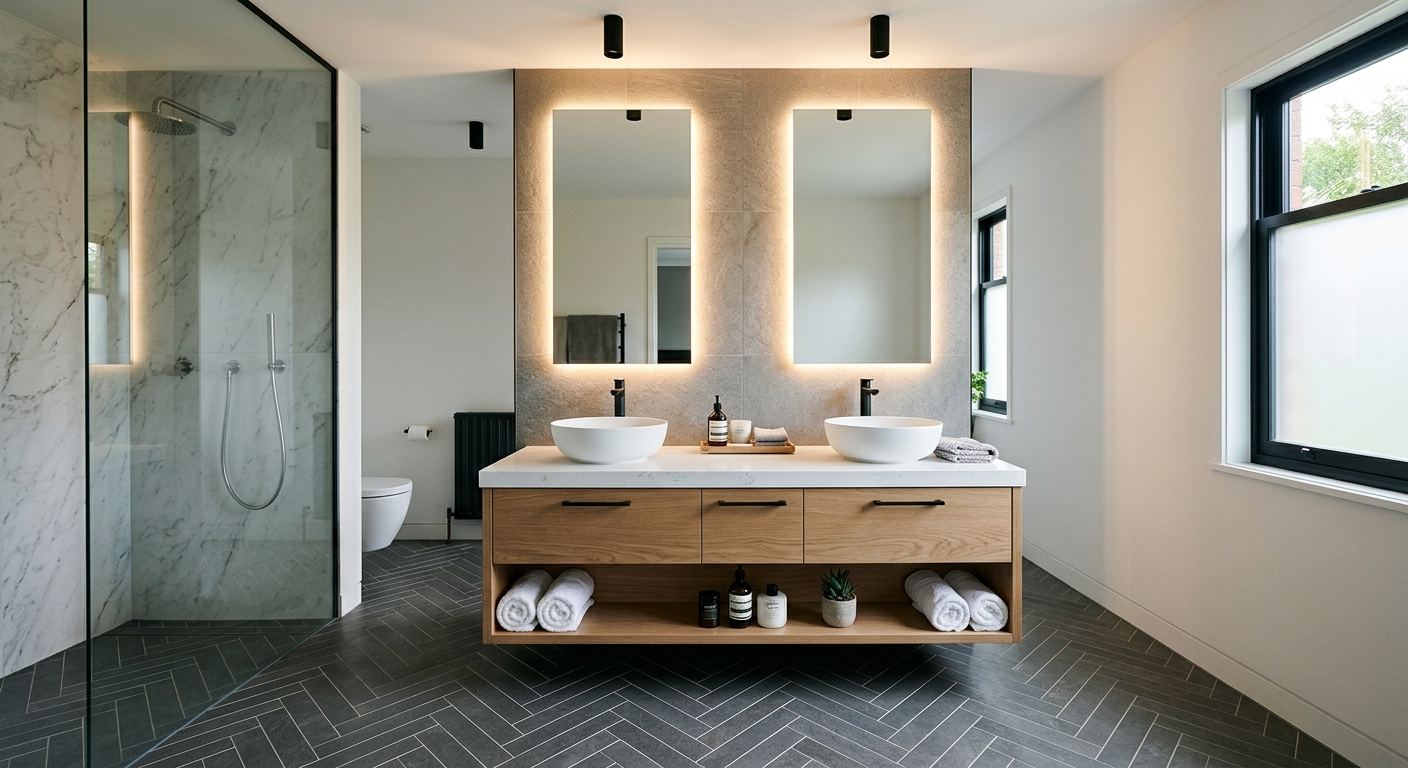
Bathroom renovation options and costs in Queensborough
Queensborough homeowners typically choose their bathroom renovation style based on how much they want to change the layout versus how far they’re willing to go on tile, plumbing, and electrical. With Queensborough’s population at about 11,000 residents (Statistics Canada, 2021 Census), the local contractor pool is busy, and scheduling can tighten during peak renovation months. The bigger budget swing usually comes from the age and build type of nearby homes—Lower Mainland–Southwest is known for mid-century and older construction, which often means dated plumbing layouts, cast-iron or galvanized supply systems, and sometimes asbestos-containing materials around older flooring and drywall compound if they’re disturbed.
That matters because in the Lower Mainland–Southwest region, labour rates and housing age drive bathroom renovation costs more than climate alone. Metro Vancouver-area demand keeps plumber, tiler, and electrician availability high, and once walls and floors open, projects often expand to include plumbing and venting upgrades to meet current British Columbia requirements. Humidity control also becomes a design priority: good exhaust ventilation and proper waterproofing details reduce the risk of mouldy grout and moisture damage over time.
In Queensborough—especially around the older townhouse blocks and nearby established residential pockets—trade demand for tiling and plumbing rough-ins is particularly steady once crews start multi-trade turnarounds. If you’re comparing scope before you call for quotes, use the ranges below as a practical starting point, then adjust based on whether you’re staying with the existing footprint or moving drains and wiring.
| Renovation Scope |
What's Included |
Typical Duration |
Price Range |
| Cosmetic refresh (paint, fixtures, accessories only) |
New vanity top or vanity swap, toilet swap, taps/accessories, paint, caulking, light hardware updates; tile touch-ups only if needed |
3–7 days |
$3,500–$9,500 |
| Mid-range full renovation (new tile, vanity, tub/shower, electrical) |
Demolition, disposal, waterproofing, floor + wall tile, vanity/lighting, tub or shower replacement, new exhaust fan and GFCI (where needed), updated trim and sealing |
2–3 weeks |
$18,000–$35,000 |
| High-end full renovation (custom tile, steam shower, heated floors) |
Custom shower system, premium tile layout, heated floor circuit, high-efficiency ventilation, higher-tier fixtures, more extensive waterproofing, detailed finish work |
3–5 weeks |
$35,000–$45,000 |
| Shower-only installation (convert tub to walk-in shower) |
Tub removal, walk-in shower framing, waterproofing, glass or door option, new shower valve trim, matching floor drainage and tile |
1–2 weeks |
$12,000–$25,000 |
| Bathtub replacement or tub-liner install |
Remove and replace tub and surrounds OR install liner where appropriate, new caulking/sealing, matching faucet/trim updates, surface prep |
5–10 days |
$1,500–$6,000 |
| Tile-only installation (floor + surround, existing layout kept) |
Surface prep, waterproofing system, floor tile and shower surround re-tile, re-seal transitions, re-install fixtures where feasible without relocating plumbing |
5–12 days |
$2,000–$8,000 |
Prices are estimates only and vary by project scope, site access and material selection.
What affects the price of bathroom renovation in Queensborough
In Queensborough, it’s common to see quotes for what looks like the same bathroom turn out 30–50% apart across the Lower Mainland–Southwest and other parts of British Columbia. The reason isn’t climate—it’s mostly the regional labour environment plus what older housing hides once you open walls and floors. In the Lower Mainland–Southwest, labour rates tend to be higher and specialist trades can be booked out, so any delay in plumbing rough-in, electrical, or tiling has a direct cost effect. When you’re doing a mid-range full renovation, a budget in the $18,000–$35,000 band can quickly shift toward the higher end once venting, drains, or electrical circuits are updated.
Older homes (common in the region) are a major cost driver because bathrooms concentrate plumbing and waterproofing at the worst possible locations for hidden failures. It’s not unusual to uncover cast-iron or aging galvanized drain sections, older copper supply lines that need replacing, or insufficient ventilation ducting—each increases the scope and may require permit activity. If pre-1985 materials show signs of asbestos in flooring or drywall compound during demo, abatement protocols can add $1,500–$5,000+ depending on access, containment needs, and disposal requirements.
Concrete Queensborough examples: (1) converting a tub to a walk-in shower often requires drain reconfiguration, which can push a shower-only project beyond the $12,000–$25,000 range if joists or subfloor need reinforcement; (2) large-format porcelain tile may cost more in materials but can lower labour time only when the substrate is very flat—if the subfloor is unlevel, labour increases. (3) upgrading ventilation from a basic fan to a properly ducted exhaust can add electrical work, but it protects your tile installation against moisture-related failures in our coastal-humidity conditions.
| Price Factor |
Why It Matters |
Cost Impact |
| Layout change — moving drain or supply lines requires rough-in work |
Relocating plumbing increases demolition, framing/patching, testing, and often requires permits |
Can add $3,000–$10,000 depending on distance and existing pipe condition |
| Tile selection — large-format porcelain vs. mosaic vs. ceramic |
Harder cutting, more careful setting, and more labour for complex patterns increases install time |
Material and labour can swing by $1,500–$6,000 |
| Fixture tier — builder-grade vs. mid-range vs. designer brands |
Higher tiers cost more and may include different trim valves, rough-in compatibility, and finishing details |
Often adds $800–$4,000 |
| Subfloor condition — rot or unlevel concrete adds scope |
Repairs, membranes, and extra framing level-out are required before tile can be safely installed |
Commonly $1,000–$5,000+ on older bathrooms |
| Electrical — adding GFCI outlets, exhaust fan, heated floor circuit |
New circuits increase electrician time and may require updated safe-breaker and wiring runs |
Typically $700–$3,500 |
| Waterproofing method — membrane type and extent |
Proper waterproofing layers prevent failures behind tile where repairs are expensive |
Usually $600–$2,500 but reduces long-term risk |
| Older-home surprises — asbestos tile, cast-iron drains, galvanized pipes |
Discovery triggers remediation/disposal and additional plumbing replacement |
Can add $1,500–$8,000+ |
| Bathroom size — sq ft drives tile and labour time directly |
More area means more waterproofing, more tile, and more cutting/grouting time |
Price varies broadly by footprint (often $2,000–$12,000) |
Permits & regulations in British Columbia
In British Columbia, many cosmetic bathroom updates typically do not need permits—things like swapping fixtures (toilet, vanity, faucet trim), repainting, replacing a vanity, and retiling within the existing layout are usually handled as interior finishes. However, permits are commonly required when you relocate plumbing (moving a drain or supply line), add or change ventilation that requires new ducting and a new electrical circuit for an exhaust fan, or make structural changes that affect framing or load paths. Electrical work must meet provincial code and be completed by, or signed off by, a licensed electrician.
Plumbing rough-in changes generally require a permit and inspection, especially if you’re altering drain routing, venting, or water supply connections. Before the work starts, confirm what will trigger a permit in your exact scope—your contractor should identify permit pulls in the quote and schedule inspections with you.
To verify a contractor in Queensborough, take these steps: (1) licensing—look up the contractor’s British Columbia trade licence (and the specific licence class for plumbing/electrical if they’re separate); (2) liability insurance—request a current certificate of insurance showing coverage for the renovation period and confirm the policy is active; (3) workers’ protection—ask for proof of WSIB/WCB coverage (or equivalent coverage proof, as applicable in BC for their workers) so you’re not left holding risk. Then ask for the contractor’s clearance letter or proof document and keep it with your signed contract.
Choosing tile, waterproofing and fixtures for your Queensborough bathroom
In Queensborough bathrooms, three material decisions typically decide both the look and the long-term performance: tile choice, waterproofing method, and fixture tier. First, tile: entry-level ceramic is usually the most budget-friendly, but it can be less forgiving for shower walls if your substrate is uneven. Porcelain is denser and more consistent for floors and wet areas, and it often justifies the extra cost when you want fewer replacements over time. Natural stone (marble, travertine, slate) looks premium, but it’s more sensitive to sealing and selection errors; installation can also cost more due to handling and finish requirements.
Second, waterproofing: in the Lower Mainland–Southwest’s humid bathroom environment, the correct system is what keeps water out of the building envelope. A paint-on membrane may be fine for limited surfaces, but many renovations benefit from a bonded sheet membrane or a Schluter-style system with proper details at corners, niches, and transitions. This is where mould risk is reduced—by preventing moisture intrusion behind the tile, not just by improving ventilation.
Third, fixtures: builder-grade trims are a good fit for value renovations, while mid-range and designer brands tend to cost more up front but can improve day-to-day use and resale appeal (especially if you choose modern, durable finishes).
Example: If you’re deciding between mid-range porcelain tile and a ceramic option, the difference might be a few thousand dollars across a typical full reno, but choosing porcelain and a robust waterproofing assembly can be worth it—because the labour to redo failed tile is usually far more than the initial material upgrade.
| Material / Option |
Pros |
Cons |
Price Range |
| Ceramic tile (floor + walls) |
Good value, wide design selection, easier to source, adequate for many wall applications |
Can be less durable for floors if not rated properly; may require more careful layout to avoid unevenness |
$2,000–$6,000 |
| Porcelain tile (floor + walls) |
Lower water absorption, more durable for wet areas, consistent sizes for cleaner results |
Higher material cost; heavier tile can add labour if substrate needs levelling |
$3,500–$8,000 |
| Natural stone (marble, travertine, slate) |
Luxury look, unique veining and texture, strong resale appeal when done right |
Requires sealing/maintenance decisions; more variation means more skilled layout and cutting |
$6,000–$14,000 |
| Frameless glass shower enclosure |
Modern appearance, easier visual cleanup, makes smaller bathrooms feel larger |
More expensive hardware; needs precise tile plane and waterproofing details at edges |
$1,800–$5,500 |
| Prefab tub surround (acrylic) |
Fast install, fewer tile failures from grout-heavy complexity, good for budget refreshes |
Limited design flexibility; can look less custom than tile |
$800–$3,000 |
| Custom shower pan (tile or linear drain) |
Best look for custom layouts; linear drains improve accessibility and water management |
More prep and waterproofing detailing; higher risk if not executed with perfect slope and seals |
$2,500–$9,000 |
How to choose a bathroom renovation contractor in Queensborough
When you’re choosing a contractor for a Queensborough renovation, start with proof: in British Columbia you should confirm the right trade licensing for the work being done (especially plumbing and electrical), and verify liability insurance for the job. Ask for their COI (certificate of insurance) and review the effective dates to make sure it covers the entire build period. For worker coverage, request proof of WSIB/WCB coverage—so if someone is injured on your site, you’re protected rather than forced to manage risk yourself. These checks are fast and save homeowners from expensive disputes later.
Next, get 2–3 itemised written quotes. Avoid lump-sum-only bids; you want a breakdown that separates labour, demolition/disposal, plumbing rough-in, electrical, waterproofing, tile installation, and fixtures/material allowances. Confirm what’s excluded: permit pull fees, asbestos testing or abatement if discovered, subfloor repairs, and whether the quote includes disposal (not just “haul away”). A strong quote will also include a contingency line or at least a clear plan for what happens when the contractor finds older drain lines, outdated wiring, or a moisture-damaged subfloor.
Warranty matters. Ask for the workmanship warranty length and what it covers, plus the product/manufacturer warranty details for tile, membrane, and fixtures—and whether the warranty is transferable to you if you sell the home. For payment schedule, never start with a large deposit; keep upfront payment to about 10–15% and use a holdback until completion and final walkthrough. Finally, ensure your start date and completion estimate are in writing.
- Confirm correct British Columbia trade licences for the scope (plumbing/electrical/tile where applicable)
- Request certificate of insurance with job-date coverage and ensure the insured party matches the contractor name
- Verify WSIB/WCB coverage proof (or equivalent coverage proof) for workers
- Get 2–3 itemised quotes (labour + materials, not just totals)
- Ensure permit pull responsibilities are clearly stated in writing
- Confirm disposal/removal of demo debris and construction waste is included
- Ask how waterproofing will be built (membrane type, thickness, corner treatments, transitions)
- Ask who supplies/installs glass enclosures and shower valves (and which rough-in parts are included)
- Check if the quote includes subfloor assessment and level/repair allowances
- Clarify fixture cut-ins and compatibility if you’re reusing existing valves or vanities
- Review warranty terms for labour workmanship and for products (and confirm transferability)
- Use a payment schedule with a holdback until final completion and punch-list items are done
Red flags in Queensborough include: (1) quotes that sound “too low” but omit waterproofing layers or electrical items; (2) vague scopes that don’t list what’s included for disposal, permits, or subfloor repairs; (3) contractors who avoid providing proof of insurance/licensing/coverage; (4) payment requests higher than 10–15% upfront without a written schedule; and (5) no written timeline for start/completion or no warranty details in the contract.
Frequently asked questions — bathroom renovation in Queensborough
How much does a walk-in shower cost in Queensborough?
A walk-in shower in Queensborough is often priced by the scope of demolition, waterproofing, drain work, and the glass/door package. If you’re converting from a tub and keeping the rough-in reasonable, many projects land in the $12,000–$25,000 range for shower-only installations. If you’re also changing the layout or upgrading ventilation and electrical circuits, costs can move toward the higher end of a full renovation budget (for example, $18,000–$35,000 for a mid-range full reno). Because Lower Mainland–Southwest labour demand is strong, you’ll want an itemised quote that specifically lists waterproofing method, membrane details, glass enclosure pricing, and what’s happening with the drain/venting.
What's the ROI on a bathroom renovation?
Bathroom renovations can improve resale value and day-to-day livability, but ROI depends heavily on how much of the work is visible (tile, vanity, lighting) versus hidden (venting, waterproofing, plumbing upgrades). In Queensborough and the wider Lower Mainland–Southwest, buyers often pay attention to moisture control, exhaust performance, and whether the shower is modern and properly waterproofed—especially in older homes where repairs may have been deferred. A safe planning approach is: prioritize waterproofing and ventilation first (these reduce future problems), then invest in the finishes you’ll enjoy every day. If you’re doing work that pushes toward a high-end full renovation budget of $35,000–$45,000, ROI may be strongest when the rest of the home is updated and finishes are consistent.
Do I need waterproofing behind the tile?
Yes—waterproofing behind the tile is a core requirement for showers and wet areas in British Columbia, not an optional upgrade. Proper waterproofing prevents water from getting into framing and subfloor where it can cause mould, rot, and tile failure. In Queensborough, where bathroom humidity can stay high between uses, homeowners benefit from a complete system: correct substrate prep, full coverage membrane installation (paint-on for limited cases, or bonded sheet/recognised system for better resilience), and careful detailing at corners, seams, and niche penetrations. A good contractor will explain the waterproofing method and how it’s extended at transitions. If you’re comparing quotes, insist the waterproofing steps are listed, not just “waterproofing included.”
How do I compare bathroom renovation quotes?
Compare quotes by scope and line items, not just totals. For Queensborough projects, ask each contractor to break labour into demolition/disposal, plumbing rough-in, electrical, waterproofing install, tile installation, and finishing. Check whether the permit process is included for any plumbing/electrical changes, and confirm what’s excluded (asbestos testing/abatement if discovered, subfloor repair/leveling, glass enclosure supply/installation). Make sure fixture allowances are clearly defined—one quote may include mid-range fixtures while another lists only builder-grade. Also verify the payment schedule and warranty terms. If one bid lands far below the $18,000–$35,000 mid-range band but lacks waterproofing details or electrical/venting upgrades, that’s often where differences are hidden.
Can I live at home during a bathroom renovation in Queensborough?
Many Queensborough homeowners do live at home during a renovation, but it depends on how much demolition is required and whether you can maintain a functional bathroom temporarily. If you’re doing a full renovation, expect days when the shower/tub is out of service and the area is dust controlled. Contractors often schedule demo and rough-in quickly to shorten the period without access. For some households, a powder room setup or temporary access plan helps (for example, using another bathroom on the main floor). If you discover older-home issues—like deteriorated drains or potential asbestos-containing materials—work may pause for testing or remediation, which can extend disruption. Ask the contractor for a day-by-day plan, dust control approach, and a clear timeline for when plumbing fixtures will be reconnected.
What's the best bathtub material for a Queensborough home?
The “best” bathtub material depends on your goals—budget, durability, weight, and the replacement method. In Queensborough renovations, many homeowners replace a tub or add a tub-liner when the existing tub surround is still sound. Typical bathtub replacement or liner installs fall in the $1,500–$6,000 range depending on what’s being removed and how much surround work is needed. For durability, acrylic tubs are common because they’re lighter than cast iron and install with less structural fuss. If you’re doing a full renovation, you may also pair a tub with better waterproofing and a higher-quality exhaust fan to protect surrounding tile and framing. If you’re converting to a shower later, ensure your drainage and venting are planned from the start so future changes don’t cost twice.