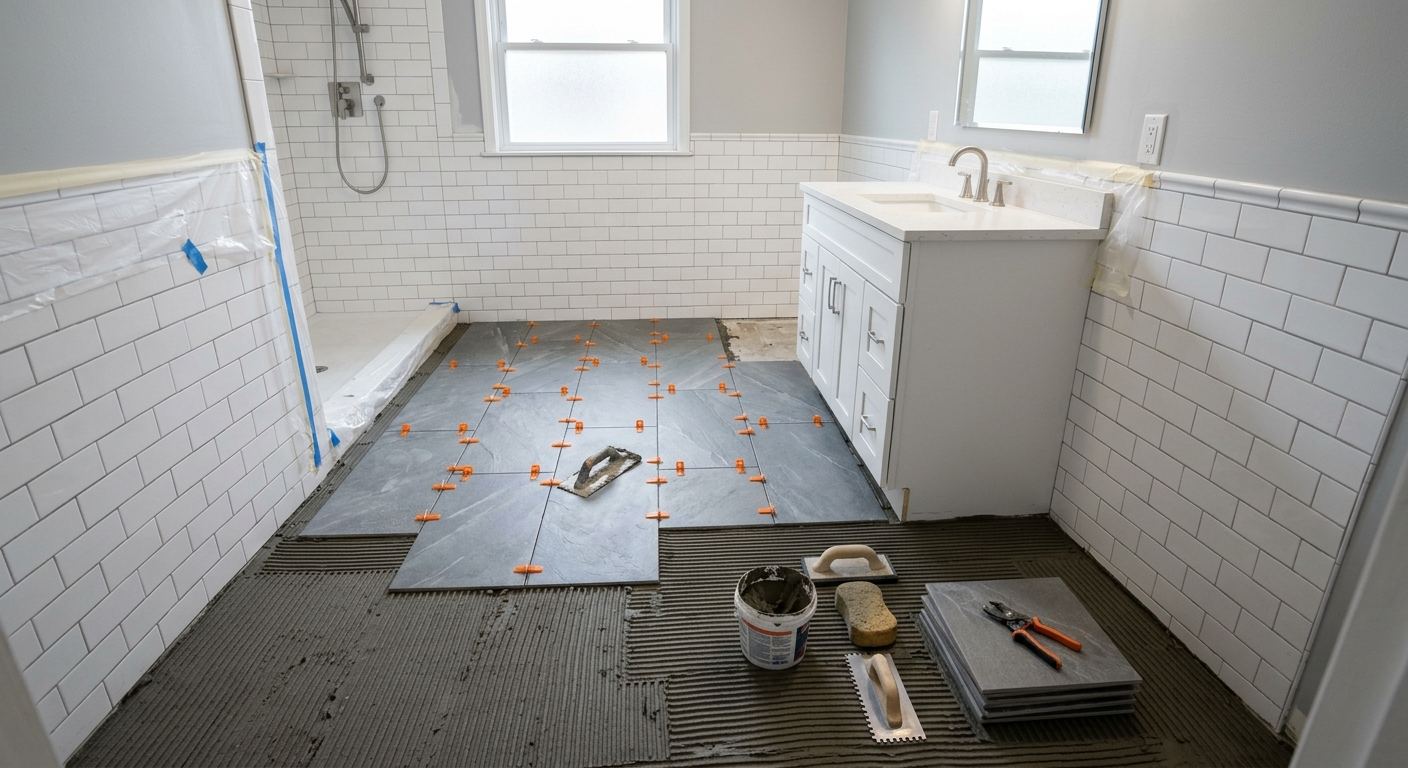
Bathroom renovation options and costs in Oshawa
Oshawa homeowners typically renovate for comfort, resale, and to modernize aging fixtures—especially in neighbourhoods built around the post-war and early-suburban boom. With 58.6% of homes in the local profile built before 1981, many bathrooms start with dated plumbing layouts and finishes that don’t hold up well once walls and floors are opened (think older drain materials, uneven subfloors, and hidden patchwork). In Oshawa, the Toronto economic region also has a strong skilled-trades labour market; bathroom work is labour-intensive, and skilled tilers and plumbers usually charge premium rates compared with smaller markets. That’s why GTA quotes can land in the low-to-mid five figures even for “standard” 3-piece refreshes when electrical, venting, or rough-in adjustments are needed.
Market demand is especially steady in areas like Courtice and West Oshawa, where many homeowners are updating family bathrooms before putting their homes on the market. The climate isn’t the main driver of cost in Ontario (unlike some regions with extreme temperature swings), but humidity still matters: poor ventilation and marginal waterproofing can shorten the life of tile and grout, pushing repairs sooner. With older stock, contractor availability and the likelihood of uncovering issues (venting corrections, supply-line upgrades, or potential asbestos-containing materials) are the biggest cost influences. If you’re comparing options, the right starting point is to choose the scope that matches your condition today, then budget for discovery once demolition begins. Use the table below as a realistic baseline before you request itemised quotes.
| Renovation Scope |
What's Included |
Typical Duration |
Price Range |
| Cosmetic refresh (paint, fixtures, accessories only) |
Paint, caulking, vanity/fixture swap, toilet swap, mirror/accessories; no wall/floor rework |
3–7 days |
$3,000 – $7,000 |
| Mid-range full renovation (new tile, vanity, tub/shower, electrical) |
Demo, subfloor prep as needed, tile floor + surround, new vanity, tub/shower or updated surround, exhaust fan, basic electrical upgrades, waterproofing, disposal |
2–3 weeks |
$12,000 – $20,000 |
| High-end full renovation (custom tile, steam shower, heated floors) |
Custom shower/tile, upgraded waterproofing, niche/linear drain option, heated floor system, higher-end fixtures, upgraded exhaust/venting, labour-intensive plumbing and finishes |
3–5 weeks |
$22,000 – $30,000 |
| Shower-only installation (convert tub to walk-in shower) |
Demo tub, plumbing rough-in adjustments, shower pan/curb, tile surround, glass enclosure (if selected), new fixtures and venting as required |
2–4 weeks |
$18,000 – $28,000 |
| Bathtub replacement or tub-liner install |
Remove and replace tub OR install tub liner (where appropriate), seal/waterproof transitions, new faucet and trim, re-caulk and finish work |
5–12 days |
$1,200 – $3,500 |
| Tile-only installation (floor + surround, existing layout kept) |
Tile floor + walls, prep and leveling, waterproofing, grout/seal; vanity and plumbing mostly retained (unless minor refresh needed) |
1.5–3 weeks |
$7,000 – $15,000 |
Prices are estimates only and vary by project scope, site access and material selection.
What affects the price of bathroom renovation in Oshawa
Two contractors can price the “same” Oshawa bathroom differently, and it’s not unusual to see a 30–50% gap across the Toronto region and wider Ontario. The main reason is labour: in the Toronto economic region, skilled trades demand premium hourly rates, and bathroom work requires tight sequencing—plumbing rough-in, waterproofing, tiling, electrical, then finishing. The second reason is the age profile of local housing. With a large share of homes built before 1981, older systems often hide problems such as cast-iron or undersized drain stacks, galvanized supply lines, and ventilation that no longer meets how bathrooms are used today. Once walls are open, correcting venting, adding shut-offs, and reconfiguring drains can add thousands quickly—pushing some projects from a mid-range budget into a higher band.
As an example, if you’re aiming for a mid-range full renovation budget around $12,000 – $20,000, a single plumbing surprise (like a poor drain fall or missing vent connection) can add scope that pushes you toward the upper $22,000 – $30,000 tier—especially when tiling and waterproofing can’t be left “as is.” Pre-1985 bathrooms also raise the possibility of asbestos-containing materials in vinyl floor tile or older drywall compounds. When discovery triggers abatement protocols, many budgets see an additional $1,500 – $5,000+ before finishing even begins.
Concrete Oshawa examples we see often: (1) a “simple” tile-only plan costs more when the subfloor is out of level and requires cement board and additional prep; (2) a tub-to-shower conversion is higher because it combines tile labour with plumbing rework and shower waterproofing; and (3) electrical upgrades (GFCI outlets, exhaust fan wiring, heated-floor circuits) increase labour but usually prevent callbacks later.
| Price Factor |
Why It Matters |
Cost Impact |
| Layout change — moving drain or supply lines |
Requires rough-in work, possible venting corrections, and additional demolition/restoration |
Often adds $3,000 – $8,000 |
| Tile selection — large-format porcelain vs. mosaic vs. ceramic |
Harder materials and more cutting increase labour; grout lines and patterns change time |
Typically $1,000 – $4,000+ difference |
| Fixture tier — builder-grade vs. mid-range vs. designer brands |
Higher-end valves, faucets, and hardware cost more and may require specialty install |
Often $800 – $3,500+ |
| Subfloor condition — rot or unlevel concrete adds scope |
Extra prep means more materials, more labour, and sometimes additional structural fixes |
Can add $1,500 – $6,000 |
| Electrical — adding GFCI outlets, exhaust fan, heated floor circuit |
Licensed work and wiring runs increase time; heated floors add more components |
Often $800 – $4,500 |
| Waterproofing method — membrane type and extent |
Better systems and full-coverage detailing protect against Ontario humidity-related failures |
Typically $600 – $2,500 |
| Older-home surprises — asbestos tile, cast-iron drains, galvanized pipes |
Can trigger licensed abatement and drain/supply upgrades before finishes begin |
Commonly $1,500 – $5,000+ (varies) |
| Bathroom size — sq ft drives tile and labour time directly |
More square footage means more tile, more waterproofing, and longer install time |
Varies; can swing budgets by $2,000 – $10,000 |
Permits & regulations in Ontario
In Ontario, you can often update a bathroom cosmetically without permits. For most projects, swapping fixtures and finishes—like replacing a vanity, toilet, tub trim, mirror, paint, or redoing tile on existing surfaces—typically does not require a permit. However, once you’re relocating or adding plumbing, changing how the room is built, or extending electrical circuits, permits and inspections are commonly required. If you move plumbing (for example, relocating the shower drain, adding a new shut-off, changing the toilet location, or altering supply lines), that plumbing rough-in work generally needs permits and inspections. Similarly, adding or reconfiguring ventilation often triggers requirements because it may involve new wiring and a properly installed exhaust fan.
Electrical work must also meet Ontario code. Any work that adds circuits, modifies wiring, or involves connections to wet-area electrical components should be performed by a licensed electrician and be signed off where required. Structural changes to walls or openings can also require permits—especially if it affects framing or load-bearing elements.
For Oshawa homeowners, a practical verification process is: (1) ask for the contractor’s Ontario trade licence number (or equivalent evidence of registration) and check it through the appropriate online registry; (2) request a certificate of insurance showing liability coverage (and confirm the date is current); (3) request proof of coverage for workplace safety (WSIB/WCB where applicable) via documentation; (4) get everything in writing—permit pull responsibility, inspection scheduling, and disposal. Finally, confirm the scope includes required permit fees (or clearly states they’re extra) so you’re not surprised after demolition starts.
Choosing tile, waterproofing and fixtures for your Oshawa bathroom
In Oshawa, three material decisions usually determine whether your bathroom renovation lands in the practical $12,000 – $20,000 range or pushes toward the higher $22,000 – $30,000 tier: tile choice, waterproofing method, and fixture tier. First, tile: entry-level ceramic can be a solid value, but it often requires more careful layout planning to avoid awkward cuts in smaller bathrooms. Porcelain is denser, handles moisture better, and tends to look more consistent across floors and walls. Natural stone (marble, travertine, slate) can be stunning, but it adds cost in both materials and labour—plus it needs sealing and more meticulous prep to keep it looking right.
Second, waterproofing: Ontario bathrooms face daily moisture loads and long drying times. A paint-on membrane can work in the right system and with proper detailing, but bonded sheet membranes and modern schluter-style approaches are often preferred for shower areas because they provide robust coverage where water concentrates (corners, curb, niches, and transitions). The key is not just the product—it’s how completely it’s applied.
Third, fixtures: builder-grade faucets and shower valves are usually the easiest to budget for, while mid-range and designer systems can improve day-to-day performance and often look better for longer. A useful way to match budget is to upgrade what you’ll see and touch daily (shower valve, handheld, lighting) while keeping tile choices sensible.
Example: If you have $2,500 available to upgrade, spending it on a better waterproofing system and a properly sized exhaust fan often prevents costly rework later. In contrast, paying for premium stone tile can be justified when you want a long-term “feature” look and can commit to the additional install and maintenance.
| Material / Option |
Pros |
Cons |
Price Range |
| Ceramic tile (floor + walls) |
Generally affordable, wide variety of styles, easier to source |
Can chip more easily; may require more layout attention |
$7,000 – $12,000 |
| Porcelain tile (floor + walls) |
Moisture-resilient, consistent appearance, often better for high-traffic bathrooms |
May be harder to cut; premium looks cost more per sq ft |
$10,000 – $18,000 |
| Natural stone (marble, travertine, slate) |
Luxury look, unique veining and texture |
Higher material and labour cost; needs sealing and careful maintenance |
$14,000 – $24,000 |
| Frameless glass shower enclosure |
Brightens the room, modern look, easier to clean than framed units |
Costs more; requires precise measurement and sturdy waterproofing |
$3,500 – $9,000 |
| Prefab tub surround (acrylic) |
Fast install, consistent finish, typically lower labour than full tile walls |
Fewer design options; may not match “custom” aesthetics |
$1,200 – $3,500 |
| Custom shower pan (tile or linear drain) |
Premium look, tailored slopes, can improve water management |
More labour and detail work; requires strong waterproofing discipline |
$4,000 – $12,000 |
How to choose a bathroom renovation contractor in Oshawa
Choosing the right bathroom renovation contractor in Oshawa is mostly about verifying credentials, then tightening the paperwork so the project doesn’t drift. Start by checking Ontario licensing evidence and requesting proof of liability insurance. You should also ask for WSIB/WCB coverage details (or the applicable documentation) and confirm coverage is current. If a contractor can’t provide documentation, that’s not a “minor issue”—it’s a risk for you and your home during demo, tiling, and plumbing/electrical work.
Next, get 2–3 itemised written quotes. Don’t accept a vague lump sum unless it’s paired with a clear scope. A good quote separates labour and materials and lists inclusions like demolition, disposal, waterproofing system type, tile prep, electrical scope, and whether permits are included. Read exclusions carefully—especially anything related to subfloor repairs, moving plumbing, fixture upgrades, or permit fees. Your contract should also specify who pulls permits, who schedules inspections, and what happens if hidden conditions are discovered.
Warranty matters: look for a workmanship warranty (often tied to the waterproofing and tile install) and understand product/manufacturer warranties separately. Confirm whether warranties are transferable to future owners (important for resale in an area where most dwellings are long-lived).
Finally, manage money flow. Avoid paying more than 10–15% upfront. Use a holdback until completion and final walk-through. Get a written start date and a realistic completion estimate, because bathrooms are sensitive to material lead times (tile, glass, valves), and Oshawa’s contractor availability can affect schedule.
- Verify Ontario trade licence/registration evidence before signing.
- Request liability insurance and confirm the expiry date.
- Ask for WSIB/WCB coverage proof (or applicable documentation) in advance.
- Use itemised quotes: labour, materials, and allowances separated.
- Confirm disposal is included (demo, old fixtures, tile waste).
- Clarify waterproofing method and who supplies the membrane and accessories.
- Confirm whether permits/inspections are included or extra—and who applies.
- Ask who handles hidden-condition discoveries (and how pricing is adjusted).
- Check the electrical scope: exhaust fan, GFCI, heated floor circuit.
- Review the payment schedule; keep a holdback until final sign-off.
- Get a written start and completion timeline with material lead-time assumptions.
- Ensure the contract lists warranty duration for workmanship and products.
Red flags in Oshawa include: (1) contractors who won’t put waterproofing details in writing; (2) quotes that omit disposal or treat plumbing/electrical as “TBD”; (3) no proof of insurance/licence; (4) asking for a large deposit beyond 10–15% without milestones; and (5) vague timelines like “about a month” without start/completion dates.
Frequently asked questions — bathroom renovation in Oshawa
How much does a bathroom renovation cost in Oshawa?
In Oshawa, pricing is driven mainly by labour rates in the Toronto economic region and the condition of older homes. With many homes built before 1981, it’s common to find plumbing venting or drain issues once walls are open, which can move a project upward. As a baseline, a mid-range full renovation typically falls in the low-to-mid five figures—often around $12,000 – $20,000—especially when you’re updating tile, a vanity, and a tub/shower with some electrical and ventilation improvements. If you’re going custom (for example, heated floors, upgraded glass, or a steam-style shower setup), budgets frequently reach the upper band of $22,000 – $30,000. Cosmetic-only refreshes usually cost less because they avoid demo and waterproofing. Always request itemised quotes so you can see what’s included versus what’s “allowance” based.
How long does a bathroom renovation take in Oshawa?
Timelines vary, but a well-managed Oshawa renovation usually comes down to sequencing: demo and rough-ins, waterproofing cure time, then tile installation, followed by fixtures and final trim. A cosmetic refresh can be quick—often 3–7 days—because it avoids major plumbing/electrical rough-in and doesn’t require extensive waterproofing layers. A mid-range full renovation typically takes about 2–3 weeks once trade schedules and materials are confirmed. Higher-end projects—especially those involving custom shower builds and heated floors—often run 3–5 weeks. Tub-to-shower conversions commonly land in the 2–4 week range due to added plumbing rough-in and shower waterproofing detailing. If hidden issues appear (subfloor repairs, older drain corrections, or asbestos-related abatement), time can extend. Build schedule flexibility into your plan and choose materials early to avoid lead-time delays.
Do I need a permit for a bathroom renovation in Ontario?
In Ontario, many cosmetic updates generally do not require a permit. That usually includes swapping fixtures (like taps, vanity, mirror), repainting, and retiling without relocating plumbing or changing structural elements. Permits are more likely needed when you relocate plumbing (moving drain or supply lines), modify the ventilation exhaust approach (especially if new circuits or fan wiring is involved), or change electrical circuits. Electrical work must meet provincial code and should be completed or signed off by a licensed electrician. Plumbing rough-in changes typically require a permit and inspection. For Oshawa homeowners, a smart check is to ask the contractor: “Who pulls the permit, and what inspections are included?” You should also verify the contractor’s Ontario trade licensing evidence, request a current certificate of insurance, and confirm WSIB/WCB coverage documentation before the first day of demolition.
What's the best tile for a bathroom in Oshawa?
The “best” tile depends on how much you want to spend and how your bathroom is used, but moisture performance and installation quality matter most in Oshawa. Porcelain is a strong choice for floors and walls because it’s dense, handles moisture well, and typically offers consistent appearance. Ceramic can be a good entry-level option if you’re sticking to a straightforward layout and you’re choosing an appropriate product rating. Natural stone (marble, travertine, slate) can look high-end, but it adds maintenance (sealing) and usually more labour, so it’s best when you want a luxury finish and are prepared for upkeep. The biggest predictor of long-term success isn’t just the tile—it’s waterproofing and correct tiling practice (proper membrane coverage, correct substrates, and solid grout detailing). If you want a clear budget path, porcelain + solid waterproofing often supports the mid-range $12,000 – $20,000 renovations, while premium stone can push costs toward the upper range.
Should I do a tub-to-shower conversion?
For many Oshawa homeowners, a tub-to-shower conversion is worth it if you want easier access, faster daily cleaning, or a more modern look. It can also improve safety over time (less stepping over a tub). However, it’s not always the cheapest option because conversions usually require plumbing rough-in adjustments and careful shower waterproofing detailing. In the Toronto region’s older housing stock, you may also need drain reconfiguration and venting corrections once demolition starts. Because of the labour intensity, shower installations and conversions often sit higher than straightforward fixture swaps. A typical shower-only installation (convert tub to walk-in) commonly falls around $18,000 – $28,000, depending on glass and tile scope. If your tub is in good condition and your real goal is style, you may be better off with a tub-liner or a partial refresh. A contractor should be able to compare options after a site visit and basic leak/ventilation assessment.
How do I prevent mold in a Oshawa bathroom?
Mold prevention in Oshawa is mostly about managing moisture after showers and getting waterproofing right the first time. Start with ventilation: make sure you have an adequate exhaust fan and that it vents properly, not into an attic or concealed space. Many bathrooms in older homes relied on weaker ventilation setups; upgrading the fan and wiring as needed often reduces condensation. Next, focus on waterproofing at wet-area transitions—shower pans, niches, curb corners, and tub/shower interfaces. The right membrane system and correct detailing are what protect the substrate behind tile, especially in Ontario’s persistent humidity patterns. Use proper caulking at changes of plane and avoid gaps around fixtures. Finally, choose tile/grout that suits your maintenance routine and keep surfaces dry after use. If you’ve seen recurring staining, fogging, or soft spots in the substrate, don’t just repaint—address the waterproofing and ventilation root cause. In a renovation quote, ask what waterproofing system is included and whether it covers the full shower enclosure.