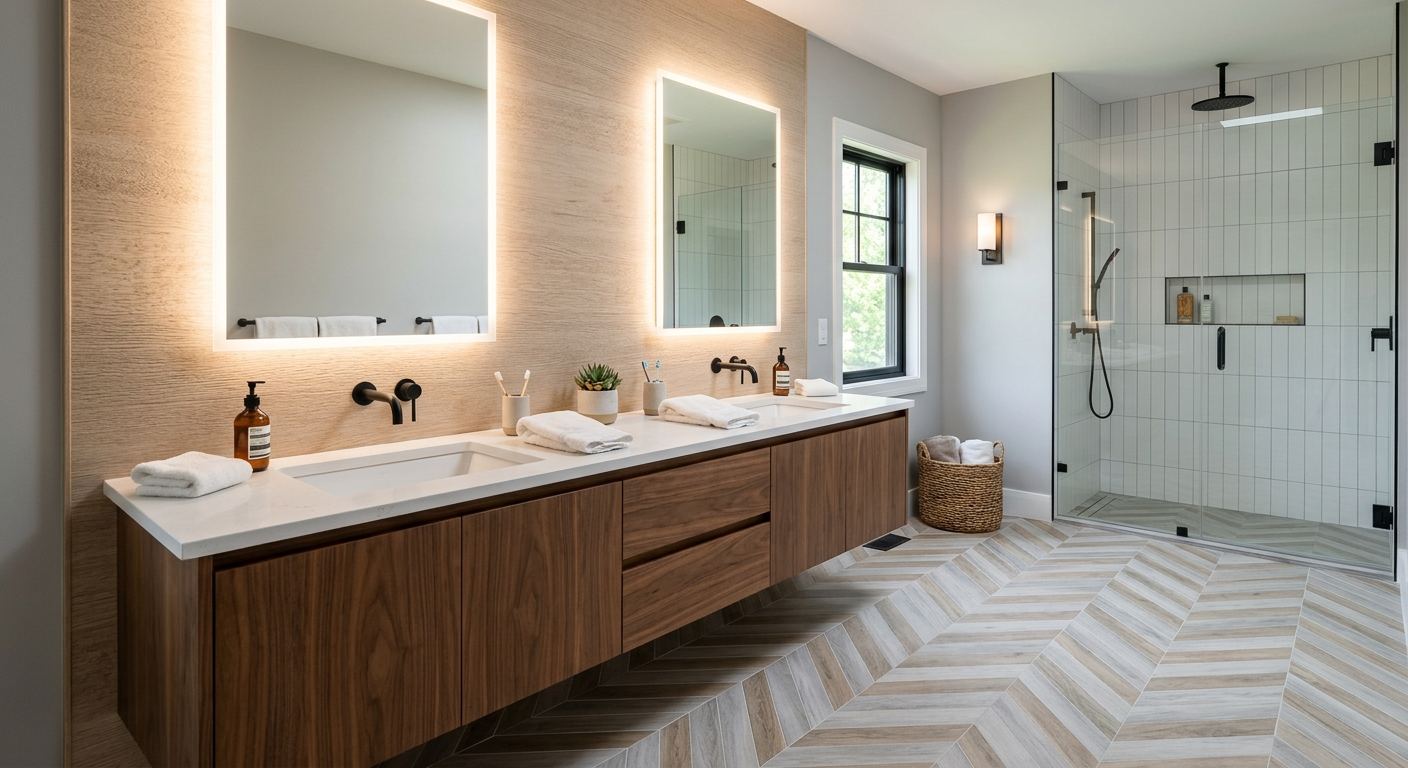
Bathroom renovation options and costs in Edmonton
Edmonton homeowners typically have three renovation lanes to choose from: a cosmetic refresh, a mid-range full reno, or a high-end upgrade that addresses layout, waterproofing and mechanical updates. With Edmonton’s housing stock, cost decisions start earlier than most people expect—40.5% of homes were built before 1981, and that age often means dated plumbing layouts, older venting, and finishes that hide issues behind the wall. Add to that the city’s scale: Edmonton’s population is 1,010,899 (Statistics Canada, 2021 Census), which supports steady competition for crews in core areas, but older neighbourhoods can still be booked quickly due to “open-wall” troubleshooting demand.
Local market conditions mean a “same-looking” bathroom can land far apart in price because labour and upgrade scope drive the baseline more than the weather. Edmonton’s long heating season and frequent temperature swings don’t usually change waterproofing requirements, but they do affect how quickly bathrooms dry and how important exhaust ventilation becomes—especially when older duct runs are undersized or poorly routed. In practice, you’ll see many quote differences based on what we discover after demo: cast-iron or galvanized piping, electrical that needs updating for safe GFCI protection, and exhaust fans that aren’t venting properly. Areas like Oliver and Old Strathcona tend to draw high renovation demand because of the mix of older homes and active neighbourhood upgrades, so scheduling and availability can also influence total timing and cost.
Use the table below as a budgeting baseline, then we can tighten the range once we review your layout, select finishes, and confirm what’s behind the walls and subfloor.
| Renovation Scope |
What's Included |
Typical Duration |
Price Range |
| Cosmetic refresh (paint, fixtures, accessories only) |
New vanity or faucet, toilet refresh (if reusing existing connections), paint, mirror, accessories; no wall opening |
3–7 days |
$3,500–$8,500 |
| Mid-range full renovation (new tile, vanity, tub/shower, electrical) |
Demo and rebuild; tile floor + tub surround, new vanity/toilet, tub-to-shower or new alcove shower, updated exhaust fan and GFCI where needed |
3–5 weeks |
$18,000–$28,500 |
| High-end full renovation (custom tile, steam shower, heated floors) |
Premium tile work, custom shower system, heated floor circuit, higher-tier fixtures, upgraded ventilation and electrical planning |
5–8 weeks |
$28,500–$45,000 |
| Shower-only installation (convert tub to walk-in shower) |
Remove tub; waterproofing and new shower pan; tile surround; updated drain/valve adjustments as needed |
2–4 weeks |
$12,500–$19,500 |
| Bathtub replacement or tub-liner install |
Replace tub with similar footprint or install liner (when conditions allow); new caulking/silicone; basic finish touch-ups |
1–3 weeks |
$4,500–$12,000 |
| Tile-only installation (floor + surround, existing layout kept) |
Tile floor and wall surround only; includes waterproofing work tied to tile areas; preserves existing plumbing locations |
2–4 weeks |
$7,000–$14,000 |
Prices are estimates only and vary by project scope, site access and material selection.
What affects the price of bathroom renovation in Edmonton
In Edmonton, it’s common to see quotes for the “same” bathroom range 30–50% apart once we price labour hours, code upgrades and what’s discovered behind the walls. The big drivers here are regional labour rates and the age of local housing stock—not climate alone. In the Edmonton economic region, many homes were built decades ago, and that’s where costs climb: older drain systems (sometimes cast-iron), galvanized supply lines, and ventilation that doesn’t meet modern expectations. When we open walls, we may find legacy wiring, undersized exhaust ducting, or insufficient bracing that requires additional framing work before tile goes down.
Asbestos surprises can also swing budgets noticeably. For example, in some older homes, asbestos-containing materials may be present in floor tile or older drywall compound. When abatement is required, it can add roughly $1,500–$5,000+ depending on scope and disposal requirements. On top of that, Edmonton’s baseline bathroom renovation band for a full reno commonly starts above “cosmetic-only” pricing guides, with typical full projects landing around $12,000–$35,000 depending on how much plumbing/electrical and waterproofing scope is triggered.
Two practical examples from local installs: first, if you keep the existing plumbing layout, you can often target the lower end of a mid-range reno, because rough-in labour is minimized. Second, if you change tile size from small ceramic to large-format porcelain, the material may be better looking, but it can require more careful substrate prep and layout—raising the installation hours even when the bathroom size stays the same.
| Price Factor |
Why It Matters |
Cost Impact |
| Layout change — moving drain or supply lines |
Requires rough-in work, potential wall opening beyond the wet area, and inspection coordination |
Often adds $2,500–$8,000 |
| Tile selection — large-format porcelain vs. mosaic vs. ceramic |
Higher-density tile can cost more and increases labour time for layout and substrate prep |
Typically $1,000–$6,000+ |
| Fixture tier — builder-grade vs. mid-range vs. designer brands |
Premium fixtures cost more and sometimes require different mounting/valve compatibility |
Usually $750–$5,000+ |
| Subfloor condition — rot or unlevel concrete adds scope |
May require subfloor replacement, leveling, waterproofing expansion and extra framing |
Commonly $1,200–$7,000+ |
| Electrical — adding GFCI outlets, exhaust fan, heated floor circuit |
Modern bathrooms need safe protection and code-compliant fan wiring and vent operation |
Often $800–$6,500 |
| Waterproofing method — membrane type and extent |
Correct waterproofing reduces callbacks; better systems can have more material and labor coverage |
Typically $600–$3,500 |
| Older-home surprises — asbestos tile, cast-iron drains, galvanized pipes |
Abatement, pipe replacement and disposal all expand scope and schedule |
Can add $1,500–$15,000+ |
| Bathroom size — sq ft drives tile and labour time directly |
More surface area means more tile, thinset, membranes and installation hours |
Varies widely (often $2,000–$10,000+) |
Permits & regulations in Alberta
In Alberta, the rule of thumb is: cosmetic updates usually don’t require permits, but anything that changes plumbing, electrical circuits, or structural elements typically does. For a typical Edmonton bathroom, swapping fixtures (like a vanity top, faucet, toilet replacement on the same connections, mirrors and accessories) is generally considered cosmetic and often doesn’t trigger a permit. However, if you’re relocating plumbing—moving a drain location, shifting a toilet flange, or changing supply line routing—expect a permit requirement for the plumbing work, with inspections tied to the rough-in and sometimes final stages.
Electrical changes are the other major permit driver. Adding or relocating receptacles, installing new circuits for an exhaust fan or heated floor, and upgrading bathroom outlets to GFCI protection must meet provincial electrical code requirements. In practice, this work should be performed by a licensed electrician and/or signed off appropriately.
Here’s how a homeowner in Edmonton should verify a contractor step-by-step:
- Request the contractor’s Alberta trade licence number (and confirmation it matches the scope of work).
- Ask for a current certificate of insurance (liability) and confirm the effective dates cover the entire job period.
- Verify WCB coverage/clearance documentation (commonly provided as a clearance letter or proof of account).
- Confirm who pulls permits (and whether it’s included in your quote).
- Keep copies of licence/insurance documents with your contract.
If any company can’t provide licence, insurance and WCB proof during the quoting stage, treat that as a major red flag.
Choosing tile, waterproofing and fixtures for your Edmonton bathroom
In Edmonton, your biggest “budget levers” are tile choice, waterproofing method, and fixture tier. These decisions affect not only material cost but also the labour complexity—especially in older homes where substrate prep and moisture control matter.
1) Tile choice: ceramic tile is usually the entry point and is fine for many bathrooms, but it’s typically more forgiving than porcelain in terms of lippage and breakage during installation. Porcelain tile is denser and often used for a sleeker look and better durability. Natural stone (marble, travertine, slate) is a luxury option and can require extra care, sealing, and careful layout to manage variation.
2) Waterproofing method: a paint-on membrane can work in many situations, while bonded sheet membranes and engineered systems (including common modern shower systems) are chosen when you want robust protection under tiled wet areas. In Edmonton’s heated-season reality, proper exhaust ventilation and correct membrane coverage help prevent persistent dampness—mould risk goes up when bathrooms stay humid longer than they should.
3) Fixture tier: builder-grade fixtures keep upfront costs lower, while mid-range and designer brands can improve longevity, comfort, and resale appeal. Sometimes the price difference is justified—e.g., spending more on a quality valve trim and cartridge may prevent leaks and future replacement.
As a concrete example: upgrading from entry-level ceramic to mid-range porcelain in a 60–80 sq ft tile area often increases material cost, but it can be justified when you select a larger-format porcelain that reduces visible grout lines. If your goal is to control budget, keep the layout simple and invest where it counts—waterproofing and the shower valve system—rather than chasing the priciest stone everywhere.
| Material / Option |
Pros |
Cons |
Price Range |
| Ceramic tile (floor + walls) |
Good value, wide design variety, easier to cut and install than many premium tiles |
Can be less durable than porcelain in some high-traffic use; may show wear sooner |
$2,500–$6,500 |
| Porcelain tile (floor + walls) |
Higher durability, better moisture resistance, often cleaner look with larger formats |
More expensive materials; larger-format installs can require extra substrate prep |
$4,000–$9,500 |
| Natural stone (marble, travertine, slate) |
Luxury appearance and unique variation; great for high-end design |
Needs sealing/maintenance; variations increase layout time and material waste |
$7,000–$16,000 |
| Frameless glass shower enclosure |
Bright, modern look; helps visually enlarge the bathroom |
Hardware and glass quality vary; installation must be perfectly aligned |
$2,500–$7,000 |
| Prefab tub surround (acrylic) |
Faster install, fewer tile cuts, typically easier to waterproof correctly when paired properly |
Less custom look than tile; seams/hardware can date faster |
$1,200–$3,800 |
| Custom shower pan (tile or linear drain) |
Integrated look, better drainage performance, can enable premium custom slope design |
Higher labour and waterproofing complexity; requires careful detailing |
$3,500–$12,000 |
How to choose a bathroom renovation contractor in Edmonton
Start by confirming the contractor’s Alberta compliance. Ask for (1) trade licence information relevant to their scope, (2) liability insurance certificate showing coverage during your project dates, and (3) WCB coverage proof/clearance letter. In Edmonton, many homeowners are surprised that a “nice quote” can still be risky if the company can’t document insurance and WCB—so don’t wait until after you sign. Request these documents in the quoting stage and save them with your contract.
Next, get 2–3 itemised written quotes that separate labour and materials (tile, fixtures, membrane system, demolition, disposal, electrical/plumbing line items). A lump-sum number hides scope gaps like what happens if subfloor is soft, whether the permit pull is included, and whether your exhaust fan and duct changes are part of the plan. Read the exclusions carefully: disposal, protected work areas, drywall patching, and return visits for minor punch items should be clear.
Warranty also matters. Look for a workmanship warranty (length and what it covers), plus the manufacturer/product warranties (and whether registration is required). Confirm if warranties are transferable if you sell your home. Payment schedule should be conservative—typically no more than 10–15% upfront, with the remainder tied to measurable milestones and a holdback until completion.
Finally, demand a written timeline with a start date and completion estimate, plus a process for material delays (especially tile and glass).
- Provide licence, liability insurance and WCB clearance proof up front.
- Use itemised labour/material breakdown—no “mystery allowance” line items.
- Clarify who pulls permits and who schedules inspections.
- Confirm disposal/removal included (old tile, fixtures, debris).
- Ask how they handle hidden conditions (subfloor rot, plumbing corrosion, wiring).
- Verify waterproofing system type and coverage areas in writing.
- Get detailed specs for exhaust fan sizing/ducting and electrical tie-in.
- Confirm GFCI placement for new/modified circuits.
- Ask who supplies and installs shower glass (and what tolerances/adjustments are covered).
- Request a workmanship warranty period and exclusions.
- Use milestones for payments; keep a holdback until punch list completion.
- Get start date, milestones, and completion estimate in the contract.
Red flags in Edmonton bathrooms: contractors who won’t provide written scope and exclusions; quotes that are far below the local band for full renos (for Edmonton, commonly $12,000–$35,000 depending on scope); vague waterproofing descriptions (“we waterproof it” without specifying membrane system); skipping permit responsibility or “not needed” statements without explaining why; and payment requests exceeding 10–15% upfront without a clear materials order schedule.
Frequently asked questions — bathroom renovation in Edmonton
What's the best tile for a bathroom in Edmonton?
The “best” tile for an Edmonton bathroom usually comes down to porcelain for floors and wet areas because it’s denser and less prone to absorbing moisture. If you want a premium look, porcelain often beats entry-level ceramic on durability and can handle larger-format designs that reduce grout lines. For showers, pick a tile system that’s compatible with the waterproofing membrane your contractor is using, and ensure proper backer and sealing at corners and transitions. Edmonton’s older housing stock (many homes built pre-1981) can mean extra substrate prep, so a tile that is unforgiving of uneven surfaces (like large-format porcelain) can increase labour if the base needs correcting. As a budgeting reference, tile-only work often lands roughly in the $7,000–$14,000 range when floor + surround are both included.
Should I do a tub-to-shower conversion?
For many Edmonton homeowners, a tub-to-shower conversion is a practical upgrade—especially if you don’t regularly use the tub or you want easier access and a cleaner, more modern layout. It also tends to simplify cleaning since you’re eliminating a full-size tub deck. That said, conversion cost depends on how much plumbing rough-in and waterproofing detail is required after demo. In this region, shower-only conversions commonly fall around $12,500–$19,500, and the range widens if you need to adjust the drain location, address ventilation, or upgrade electrical for a new exhaust fan. If your current plumbing layout can be reused, you often get better value, but older homes may reveal galvanized supply lines or older venting that changes the scope.
How do I prevent mold in a Edmonton bathroom?
Mould prevention is mostly about keeping moisture from lingering. In Edmonton homes—many of which were built decades ago—common causes include weak exhaust ventilation, poorly vented fan ducts, and inconsistent waterproofing details at edges and niches. Make sure your reno includes a properly sized exhaust fan, correct duct routing and sealed penetrations, and a waterproofing system designed for tiled wet areas (not just paint-on skim coverage). Also choose finishes and grout that match the wet-area expectations. If you’re renovating a home built before 1981, be prepared for hidden conditions behind walls; older assemblies can trap moisture. The cheapest fix (“more caulking”) usually isn’t enough—address the ventilation and waterproofing correctly during the reno to avoid repeat problems.
What adds the most resale value in a bathroom reno?
In Edmonton, resale value typically tracks with what buyers can see and what reduces future maintenance risk. The biggest “value multipliers” are a clean, functional layout; modern waterproofing and ventilation; and durable, attractive finishes. A well-done mid-range full renovation that includes updated tile work, a new vanity, and code-updated electrical (like GFCI protection and a proper exhaust fan) often performs best. If you’re choosing where to spend, prioritise the waterproofing system, the shower valve/trim quality, and the ventilation strategy before you go overboard on niche luxury items. Budget-wise, many full renos land in the $12,000–$35,000 band depending on material tier and mechanical upgrades—those core improvements are what most buyers recognize as “done right.”
Can I keep my existing plumbing layout to save money?
Yes—keeping the existing plumbing layout is one of the most reliable ways to control cost in Edmonton. When the drain and supply locations stay where they are, you reduce rough-in labour, wall openings, and inspection complexity. That usually makes your project land closer to the lower end of the mid-range spectrum. In contrast, moving a drain or relocating fixtures often triggers more demo and rebuild work, plus more coordination for permits and inspections. In older Edmonton homes (many built before 1981), even “staying put” can uncover surprises like aging piping or venting issues, so allow a contingency. But generally, if you’re planning around the existing footprint, you can channel savings into better tile, a better waterproofing system, or a higher-tier vanity and exhaust fan.
How much does a walk-in shower cost in Edmonton?
A walk-in shower price depends on whether it’s a shower-only installation (replacing a tub) or a full rebuild, plus tile and glass choices. For a common conversion scenario—convert tub to walk-in with proper waterproofing, tile surround, and necessary drain/valve adjustments—many Edmonton projects land around $12,500–$19,500. If you expand to a full bathroom reno with electrical upgrades and updated ventilation, the total can move into the broader full-renovation range of $12,000–$35,000 depending on materials and whether any older-home surprises show up. Glass enclosure upgrades can add several thousand dollars. A detailed quote with itemised labour and allowances is the best way to confirm your exact range once walls are opened.