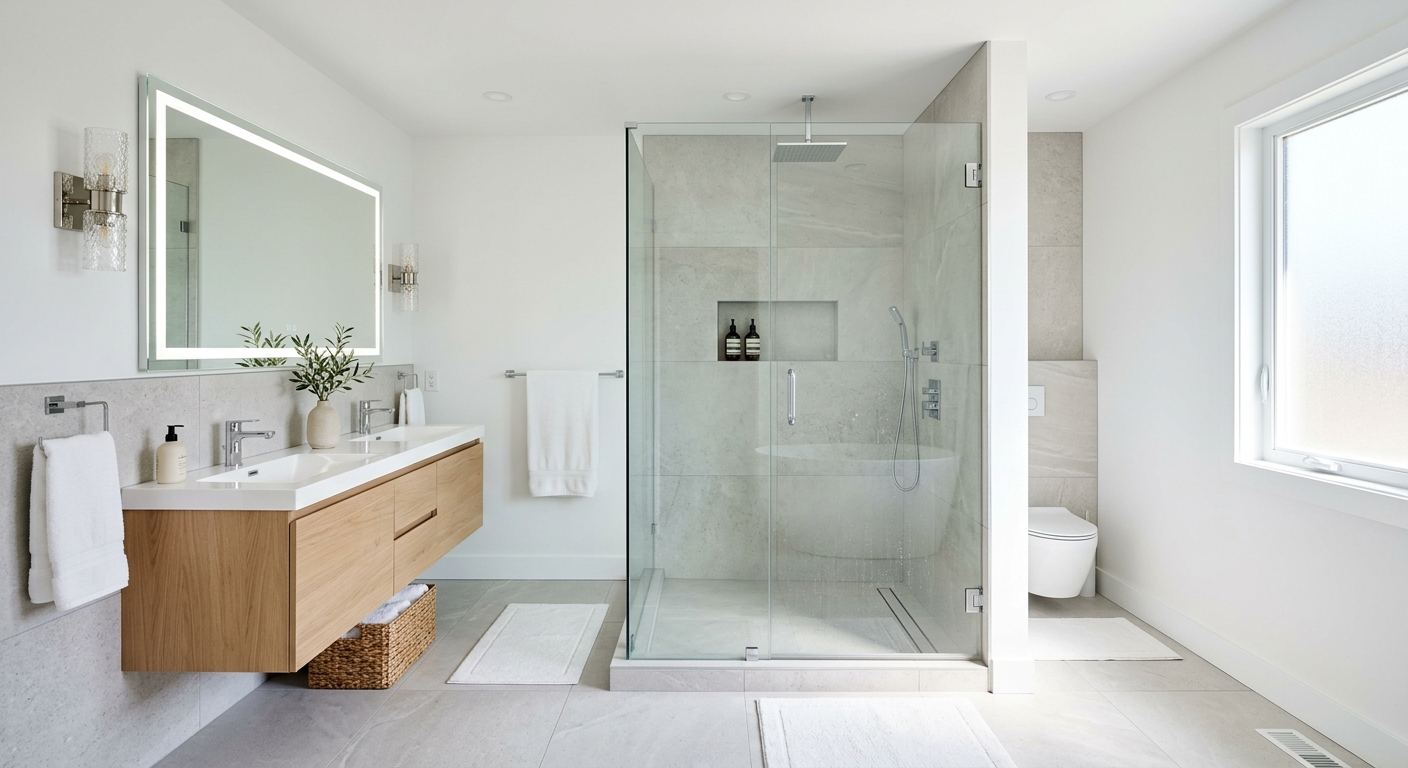
Bathroom renovation options and costs in Banff
Bathroom renovations in Banff usually start with a choice of scope, because the budget swing is driven by the amount of work behind the walls—not the snow outside. In Banff, 38.1% of homes were built before 1981, so many projects begin with dated plumbing layouts, older venting routes, and drainage details that can require upgrades once walls open up. That same older housing stock can also mean higher odds of hidden materials (for example, asbestos-containing floor tile or older joint compound in some pre-1985 finishes).
In the Banff–Jasper–Rocky Mountain House region, costs are shaped more by regional labour availability and trade pricing than by temperature swings. The corridor from Calgary to Edmonton sets much of the labour baseline, and in Banff the limited pool of local crews plus the complexity of permit-ready work tends to keep labour as the largest portion of the job. Climate still matters indirectly: efficient exhaust and properly detailed waterproofing reduce moisture problems that can show up quickly in a colder, slower-drying building envelope.
Trade demand is especially strong around the core visitor-and-residential areas like Banff Avenue and nearby neighbourhoods where older condos and houses are commonly retrofitted. If you’re planning a repair-to-renewal upgrade, comparing options side-by-side helps you decide whether to keep the layout or budget for plumbing/venting changes. The table below summarizes common bathroom renovation paths and realistic ranges for Banff.
| Renovation Scope |
What's Included |
Typical Duration |
Price Range |
| Cosmetic refresh (paint, fixtures, accessories only) |
Paint, vanity tapware, toilet refresh (swap), lighting/vanity mirror, re-caulking, towel bars, accessories; no plumbing relocation, no full retile |
3–7 days |
$3,000–$8,500 |
| Mid-range full renovation (new tile, vanity, tub/shower, electrical) |
Demo and rebuild of surfaces, floor + tub/shower surround tile, new vanity and mirror, tub or standard shower, exhaust fan upgrade, GFCI receptacle updates, proper waterproofing |
2–4 weeks |
$14,000–$22,000 |
| High-end full renovation (custom tile, steam shower, heated floors) |
Premium tile system, custom shower (tile or linear drain), heated floor circuit, upgraded lighting, designer vanity, improved waterproofing system details, more extensive plumbing/venting coordination if needed |
4–7 weeks |
$22,000–$28,000 |
| Shower-only installation (convert tub to walk-in shower) |
Remove tub, install walk-in shower base/pan system, tile surround, new shower controls, rework drain/supply rough-in as required, exhaust fan check/upgrade |
2–3 weeks |
$6,000–$14,000 |
| Bathtub replacement or tub-liner install |
Replace existing tub with similar size (or install liner where feasible), plumbing hookups, new caulking/waterproofing at tub edges, fresh trim and finishes |
1–2 weeks |
$1,200–$4,500 |
| Tile-only installation (floor + surround, existing layout kept) |
Remove/prepare existing tile, install new floor + wall tile, waterproofing/membrane where required, grout/finish work; keeps plumbing location as-is |
1–3 weeks |
$2,500–$12,000 |
Prices are estimates only and vary by project scope, site access and material selection.
What affects the price of bathroom renovation in Banff
Homeowners in Banff often notice that two quotes for the same bathroom can land 30–50% apart, even when the finish list looks similar on paper. The biggest drivers in the Banff–Jasper–Rocky Mountain House region are labour rates and the age of local housing stock, not outdoor temperature. With 8,305 people living in Banff (Statistics Canada, 2021 Census) and a comparatively limited contractor footprint, scheduling and trade demand can tighten up during busy periods—raising labour-driven line items such as rough-in sequencing, setting tile, and inspection coordination.
Older homes in the region frequently hide cast-iron or copper drain stacks that need upgrading, galvanized supply lines that are prone to corrosion, and bathrooms with ventilation that no longer meets modern expectations. Poor venting and under-sized fan ducting can also turn a “simple re-tile” into a full scope, because the work must be done to stop moisture and protect the framing. In pre-1985 homes, discovery of asbestos in vinyl floor tile or older drywall compound can trigger abatement protocols; that kind of remediation commonly adds about $1,500–$5,000+ depending on extent and access.
Concrete examples I see in Banff: (1) keeping the toilet and shower in the same location can keep you closer to a tile-only band, while moving the drain often pushes you toward the mid-range full renovation band (for example, $14,000–$22,000 when electrical and ventilation updates are included); (2) large-format porcelain and niche add-ons can increase labour and substrate prep, but the price usually stays justified if waterproofing and substrate flattening are done properly. (3) a poorly sloped slab or rotted subfloor can force extra underlayment and cementitious backer prep—adding costs even when you don’t change the layout.
| Price Factor |
Why It Matters |
Cost Impact |
| Layout change — moving drain or supply lines |
Requires rough-in work, pipe/vent adjustments, and sometimes opening more wall or floor than expected |
Often adds $2,500–$8,000 depending on how far fixtures move |
| Tile selection — large-format porcelain vs. mosaic vs. ceramic |
Harder tile needs better substrate prep, more cutting accuracy, and more labour time |
Commonly shifts tile portions by $1,000–$5,000 |
| Fixture tier — builder-grade vs. mid-range vs. designer brands |
Higher tiers cost more and can require specific valves, trims, or installation tolerances |
May add $800–$4,000 |
| Subfloor condition — rot or unlevel concrete |
Rot means structural repair and prep; unlevel surfaces increase the build-up time for tile |
Typically $700–$3,500+ |
| Electrical — adding GFCI outlets, exhaust fan, heated floor circuit |
New circuits/rough-ins trigger inspections and increase electrician labour |
Often $600–$3,500 depending on complexity |
| Waterproofing method — membrane type and extent |
Proper waterproofing coverage prevents leaks and future mould/mildew—especially around wet zones |
Typically $500–$2,500 (but reduces long-term risk) |
| Older-home surprises — asbestos tile, cast-iron drains, galvanized pipes |
Hidden materials can require certified remediation, plus plumbing replacement and extra inspections |
Can add $1,500–$5,000+ or more |
| Bathroom size — sq ft drives tile and labour time directly |
More surface area increases tile, mortar, waterproofing, setting time and drying cycles |
Often $1,000–$6,000 across common Banff sizes |
Permits & regulations in Alberta
In Alberta, many bathroom updates are treated as cosmetic work, meaning they typically do not need permits. Swapping fixtures (like a vanity, toilet, or faucet), painting, replacing a mirror, and doing standard re-caulking generally fall into “like-for-like” maintenance. Replacing tile on surfaces without moving plumbing also often stays in the cosmetic/finish category, provided there’s no structural change and the plumbing locations remain the same.
Permits usually are required when you change the plumbing/electrical scope. For example, relocating plumbing—moving a drain or supply lines for a new shower, converting a tub to a walk-in, or changing the toilet position—commonly requires a permit and inspections for the rough-in and final work. Electrical work that adds or modifies circuits (new GFCI receptacles in the bathroom, wiring an exhaust fan with a dedicated circuit, or installing heated floors) must meet Alberta electrical code requirements and be performed by a licensed electrician; inspections are typically tied to the circuit work. If any walls are opened and structural components are altered, additional approvals may apply.
Here’s how a Banff homeowner can verify a contractor before signing: (1) ask for the contractor’s Alberta trade licence details (and any sub-trade licence numbers used on the project), (2) request a current certificate of insurance showing liability coverage, (3) confirm workers’ compensation clearance (WSIB/WCB coverage) for the trades assigned, and (4) keep the documents in your file so they’re easy to reference if an inspection issue comes up. Then confirm whether permits are pulled by the contractor (and included in the quote) or by the homeowner—so the responsibility is clear in writing.
Choosing tile, waterproofing and fixtures for your Banff bathroom
In Banff, the three material decisions that most strongly control your bathroom renovation budget are tile type, waterproofing system, and fixture tier. Start with tile: ceramic is the entry-level choice and can be cost-effective for straightforward floors and walls, while porcelain (often slightly denser and more water-resistant) handles wet-room demands better and usually holds up longer in high-moisture areas. Natural stone (marble, travertine, slate) creates a luxury look, but it typically requires more careful installation, sealing/maintenance habits, and tighter substrate preparation—so labour and prep costs rise.
Next, waterproofing: in an Alberta bathroom, the “best” system isn’t the cheapest product—it’s the correct method for your shower build. A paint-on membrane can be fine for some assemblies, but a bonded sheet membrane often provides robust protection when installed to manufacturer requirements. Systems like Schluter-style approaches can also work well because they’re designed to integrate with the tiling and drainage details. The goal is consistent waterproofing coverage in corners, niches and around transitions—because preventing moisture ingress reduces mould risk in a colder climate where drying can be slower.
Finally, fixtures: builder-grade taps and trims save upfront, but mid-range or designer valves can improve daily feel, reliability, and resale appeal. In a Banff renovation, a practical example is choosing porcelain tile plus a premium waterproofing system: you might spend more than a basic ceramic package, but it can prevent the kind of leak-related rework that can erase savings. If you’re targeting a mid-range full renovation budget (around $14,000–$22,000), align the tile and waterproofing quality first, then upgrade fixtures where they’re most visible.
| Material / Option |
Pros |
Cons |
Price Range |
| Ceramic tile (floor + walls) |
Affordable, wide style selection, good for general wall use |
Can be less resilient for wet-room floors than porcelain; more attention needed for substrate prep |
$2,500–$7,000 |
| Porcelain tile (floor + walls) |
Durable for wet areas, consistent sizing, excellent long-term performance |
Higher material cost and often needs careful cutting/installation planning |
$5,000–$12,000 |
| Natural stone (marble, travertine, slate) |
High-end look, unique veining and character |
Sealing/maintenance, variation in tiles, extra labour for precision finishing |
$8,000–$18,000 |
| Frameless glass shower enclosure |
Bright, modern look; easier visual cleanliness than heavy doors |
More expensive hardware; installation needs good alignment and waterproofing detail |
$2,000–$6,000 |
| Prefab tub surround (acrylic) |
Fast install, easier sealing at joints, often lower labour |
Fewer design choices than tile; can look less custom |
$900–$2,800 |
| Custom shower pan (tile or linear drain) |
Premium drainage lines, clean modern design, integrates with tile layout |
More trades time for waterproofing and correct slope; can increase inspection scope |
$3,500–$14,000 |
How to choose a bathroom renovation contractor in Banff
Choosing the right bathroom contractor in Banff is mostly about proof: licensing, insurance, a detailed scope, and a warranty you can actually use. Start by verifying Alberta trade licence information for the contractor and confirm that any electrical and plumbing work is handled by the properly licensed trades. Ask for a certificate of insurance showing liability coverage, and request documentation that workers’ compensation is in place (WSIB/WCB coverage, depending on how the contractor operates). Don’t accept “we’ll get it later”—make sure the paperwork is current before work begins.
Next, require 2–3 written, itemised quotes. Not lump sums—each quote should separate labour and materials (demo/disposal, waterproofing, tile installation, electrical items, fixtures, and any waterproofing system components). Read the scope line-by-line: what’s excluded (niches, curbless modifications, flange/drain upgrades, subfloor repairs), and is permit pulling included? Confirm disposal included or if hauling/dump fees are extra. A proper bathroom renovation quote in Banff should include an allowance for hidden-condition contingency—especially in homes built before 1981 (38.1% in the profile) where plumbing and venting surprises are more common.
For warranty, ask for workmanship warranty length (e.g., tile and waterproofing labour coverage), product/manufacturer warranty details, and whether the warranty transfers if you sell your home. Payment schedule matters too: never pay more than 10–15% upfront, and hold back a meaningful portion until completion and turnover. Finally, get your start date and completion estimate in writing, plus how delays for tile/stone orders are handled.
- Ask for Alberta licence numbers and confirm they match the work (and the trades assigned).
- Verify current liability insurance via certificate of insurance.
- Confirm workers’ compensation coverage (WSIB/WCB) for the contractor and subcontractors.
- Require itemised labour + materials (tile, waterproofing system, electrical, fixtures, disposal).
- Check whether permits/inspections are included in the quote price.
- Confirm disposal/dump fees—don’t assume it’s included.
- Ensure the quote includes waterproofing scope (areas covered, membrane type, return details).
- Ask who is responsible for hidden-condition discoveries (and the process to approve changes).
- Review the ventilation/exhaust plan (fan size, duct route, and electrical requirements).
- Get a written schedule with start date, milestones, and estimated completion.
- Clarify warranty: workmanship duration, exclusions, and whether it transfers to a new owner.
- Confirm payment terms: keep deposits low and add a holdback until final walkthrough.
Concrete red flags I’ve seen with bathroom contractors in Banff: (1) quotes that are “estimate only” with no itemisation for tile, waterproofing, or electrical, (2) promises to “avoid permits” when the job changes plumbing or adds circuits, (3) refusal to provide insurance/licence documentation, (4) no written waterproofing method or vague “we’ll waterproof it,” and (5) demanding large upfront deposits (bigger than 10–15%) without a clear contract payment schedule.
Frequently asked questions — bathroom renovation in Banff
What's the ROI on a bathroom renovation?
In Banff, a bathroom renovation can improve buyer confidence and day-to-day livability, but the ROI depends heavily on whether you solve functional issues (ventilation, waterproofing, fixture performance) versus only upgrading finishes. Because many local homes were built before 1981 (38.1%), buyers often scrutinize moisture control and the “behind-the-wall” basics—so a renovation that includes proper waterproofing and ventilation can outperform a cosmetic refresh. If you’re budgeting for a mid-range full renovation (typically $14,000–$22,000), focus on durability items first: waterproofing system quality, exhaust fan performance, and plumbing reliability. Pure cosmetic updates usually cost less, but they may not change the perceived quality if ventilation or layout issues remain. (Statistics Canada, 2021 Census) shows the local mix of households is meaningful, and homeowners often prioritize practical comfort that translates well at sale time.
Do I need waterproofing behind the tile?
Yes—if you want the bathroom to stay dry long-term, waterproofing behind tile is generally the correct approach for wet areas in Alberta. In a Banff bathroom, moisture is a constant concern because colder indoor conditions can slow drying after showers. The key is waterproofing designed for the assembly: membranes applied where water will reach (shower walls, tub-to-wall transitions, corners, niches, and floor/wet-zone edges) and detailed to manufacturer requirements. In older Banff homes, the risk is higher when outdated venting or drainage details were never upgraded, because small leaks can stay hidden until subfloor or framing is affected. A proper waterproofing plan is one reason mid-range full renovations (often $14,000–$22,000) cost more than tile-only projects. If you’re keeping the layout, you still need the correct waterproofing build-up behind the tile in the wet zone.
How do I compare bathroom renovation quotes?
Start by comparing quotes line-by-line, not by the total price. Ask each contractor to provide an itemised breakdown: demolition and disposal, waterproofing method, tile setting scope, electrical items (GFCI receptacle and exhaust fan), and plumbing rough-in changes if any. In Banff—where many homes are older (38.1% built before 1981)—hidden-condition allowances matter, so compare how each quote handles “unknowns” once walls open (for example, galvanized supply issues, undersized venting, or cast-iron drain components). Also check whether permits and inspections are included, because moving plumbing or adding circuits can require permitting. If one quote is close to your target band but missing electrical, ventilation, or waterproofing details, it may look cheaper but cost more later through change orders. Use realistic reference ranges like shower installation (often $6,000–$14,000) and tile-only work (often $2,500–$12,000) to sanity-check what you’re being offered.
Can I live at home during a bathroom renovation in Banff?
Often, yes—but it depends on whether you can keep one functional bathroom and how disruptive your scope is. With a cosmetic refresh, you can usually stay in the home since you’re not opening walls or relocating plumbing. For mid-range full renovations (typically $14,000–$22,000) or shower conversions, living in place can be harder because demo, plumbing rough-in, and tile/waterproofing sequencing make the shower/tub unusable for stretches. In Banff, the scheduling and drying timeline may also affect daily comfort since grout and waterproofing systems need proper cure time. A practical approach is to confirm a phased plan with your contractor: what you lose access to each week, whether a temporary setup is possible, and how dust control will be managed. If you only have one bathroom, discuss staging early—especially in older homes where plumbing or venting upgrades may require inspection delays.
What's the best bathtub material for a Banff home?
“Best” usually means durable, easy to maintain, and compatible with how your bathroom is built. Common options include acrylic tubs and cast-iron tubs; acrylic tends to be lighter, easier to install, and often quicker to finish around with tile or surround. Cast iron is extremely durable but can be heavier and may require more careful handling during replacement. If your goal is to reduce renovation disruption, a tub-liner system can sometimes be considered, but it depends on the condition and surface preparation requirements. In Banff homes built before 1981 (38.1% in the profile), it’s worth checking drain rough-in condition before choosing “same-size replacement” assumptions—older drains and supply lines can affect what’s feasible. For bathtub replacement or tub-liner installs, budgets often land in the $1,200–$4,500 range. The best choice is the one that fits your waterproofing detailing and your existing plumbing conditions.
Is it worth renovating a bathroom before selling in Banff?
It can be worth it if your bathroom issues are visible and functional—not just cosmetic. In Banff’s older housing stock (38.1% built before 1981), buyers frequently look for signs of outdated waterproofing, poor ventilation, or fixtures that don’t match modern expectations. If your bathroom has moisture staining, recurring fan problems, or outdated plumbing components, renovating now can reduce buyer objections and show you’ve addressed building-envelope and maintenance risks. For a modest refresh, ROI depends on whether the “bones” are sound; if layout and venting are already updated, cosmetic upgrades may be enough. If you’re doing a mid-range full renovation, aligning the spend to durable improvements—proper waterproofing and a fan strategy—can be a smarter resale play than chasing only high-end finishes. Homeowner households in Banff make up a large portion of local households (42.0% own, Statistics Canada, 2021 Census), so practical comfort tends to matter in showings. A well-planned renovation in the $14,000–$22,000 band often gives the most balanced results when your goal is to sell without surprises.