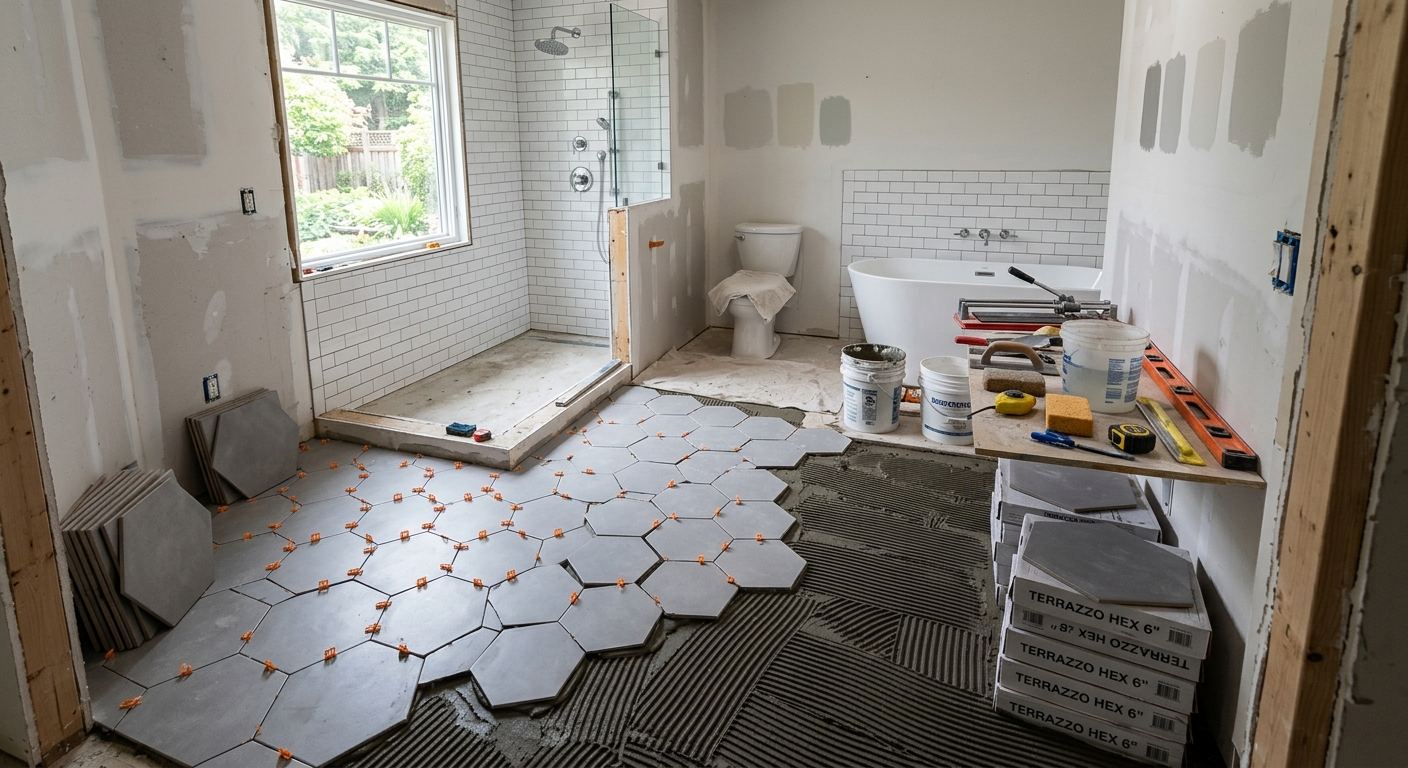
Bathroom renovation options and costs in Glenbrook
Bathroom renovations in Glenbrook, Alberta typically fall into a few predictable tiers, but the final price is often shaped by what your contractor finds once walls are opened. With a Glenbrook population of 7,240 (Statistics Canada, 2021 Census), the local housing market is steady, and trade coordination is usually smooth—yet many of the homes in the Calgary economic region are older, which means dated plumbing layouts, cast-iron or copper drain lines, and a higher chance of asbestos in certain older materials. In practice, that’s why “cosmetic” updates can expand into full remodel scope once demolition begins.
Calgary’s renovation costs are driven more by local labour rates and the age/condition of the housing stock than by climate swings. You still need to plan for winter performance—drafty exterior walls, intermittent heating, and condensation risk all increase the importance of correct ventilation and waterproofing details. Many homeowners start with a refresh near the Glenbrook area along 37 Street S.W. or in the broader Calgary belt where older subdivisions dominate; contractors often see higher demand for bath upgrades in these older pocket neighbourhoods because people want the same footprint improved without moving plumbing.
To help you budget realistically, use the table below as a baseline. It also assumes you’re renovating an older bathroom (not a brand-new install), since hidden rough-in and venting issues are common in the Calgary region.
| Renovation Scope |
What's Included |
Typical Duration |
Price Range |
| Cosmetic refresh (paint, fixtures, accessories only) |
Paint, mirror/lighting swap, vanity accessories, taps, toilet replacement (if needed), caulking/trim touch-ups; no wall removal |
2–5 days |
$2,000–$6,500 |
| Mid-range full renovation (new tile, vanity, tub/shower, electrical) |
Demolition, waterproofing, tile floor + tub surround, new vanity, updated exhaust fan, new or refreshed lighting, tub/shower re-install, basic electrical upgrades as required |
3–6 weeks |
$15,000–$25,000 |
| High-end full renovation (custom tile, steam shower, heated floors) |
Premium tile (labour-intensive layouts), custom shower/steam features, heated floor system, higher-tier fixtures, additional waterproofing detailing, expanded electrical and ventilation work |
5–9 weeks |
$25,000–$35,000 |
| Shower-only installation (convert tub to walk-in shower) |
Convert footprint, new shower pan/liner or tiled base, waterproofing, glass enclosure, plumbing modifications (typical), new exhaust/lighting updates as needed |
2–4 weeks |
$10,000–$18,000 |
| Bathtub replacement or tub-liner install |
Remove existing tub (and re-seat), new tub or high-quality liner system, re-caulk, refit surround finishes, basic plumbing connection adjustments |
1–3 weeks |
$1,500–$3,000 |
| Tile-only installation (floor + surround, existing layout kept) |
Tile floor and tub/shower surround, surface prep and underlayment, waterproofing system appropriate to tile assembly, grout/caulking, matching trim |
1.5–3.5 weeks |
$6,000–$14,000 |
Prices are estimates only and vary by project scope, site access and material selection.
What affects the price of bathroom renovation in Glenbrook
Two homeowners in Glenbrook can receive quotes that differ by 30–50% for what looks like the same bathroom upgrade. That gap usually comes down to three things: regional labour rates, the age and condition of the housing stock, and how much “hidden scope” is discovered once trades start demolition. In the Calgary economic region, contractors commonly price for uncertainty—older drain stacks, venting constraints, and subfloor repairs can all turn a mid-range job into a full remodel. Even when the renovation sits in the low five figures at first glance, hidden plumbing and ventilation upgrades can shift you into the $15,000–$25,000 band quickly.
Calgary-area homes often show problems like cast-iron or galvanized drain sections that require upgrading for proper flow and modern code expectations, plus older supply lines that aren’t ideal for new fixture pressure. Ventilation is another budget driver: if the bathroom exhaust isn’t vented correctly or wiring capacity is limited, adding the right exhaust fan and circuit work increases labour and material time. If asbestos is discovered in older vinyl floor tile or older drywall compound (often pre-1985), you’ll typically see abatement protocols, containment, and disposal—adding roughly $1,500–$5,000+ depending on scope.
Concrete Glenbrook examples I see often: (1) keeping the original tub-to-drain alignment lowers labour because it avoids rough-in and drywall patching; (2) choosing large-format porcelain can increase install time due to layout planning and substrate prep, even if material cost looks similar; (3) an older subfloor that’s unlevel may push the installer toward additional underlayment and thin-set build-up to meet waterproofing tolerances—adding days to the schedule.
| Price Factor |
Why It Matters |
Cost Impact |
| Layout change — moving drain or supply lines requires rough-in work |
New drain/supply routing affects demolition, framing, and re-tiling |
$2,000–$10,000 |
| Tile selection — large-format porcelain vs. mosaic vs. ceramic |
Harder substrates, more cutting, and higher labour time for intricate patterns |
$1,000–$6,000 |
| Fixture tier — builder-grade vs. mid-range vs. designer brands |
Higher-tier valves, faucets, and vanities can include premium finishes and parts |
$500–$8,000 |
| Subfloor condition — rot or unlevel concrete adds scope |
Repairs and leveling add materials, labour, and drying/curing time |
$1,000–$7,000 |
| Electrical — adding GFCI outlets, exhaust fan, heated floor circuit |
May require licensed electrician work, new circuits, and panel capacity checks |
$800–$4,500 |
| Waterproofing method — membrane type and extent |
Better systems and correct overlaps reduce failure risk under wet-cycle conditions |
$500–$3,000 |
| Older-home surprises — asbestos tile, cast-iron drains, galvanized pipes |
Abatement and replacement add labour, delays, and disposal/containment steps |
$1,500–$8,000+ |
| Bathroom size — sq ft drives tile and labour time directly |
More floor/wall surface means more waterproofing, setting time, and grout work |
$1,000–$6,000 |
Permits & regulations in Alberta
In Alberta, not every bathroom change requires a permit, but moving into plumbing or electrical upgrades usually does. For Glenbrook homeowners, a typical rule of thumb is: cosmetic work and “like-for-like” swaps rarely trigger permits, while changes that affect building systems or structure do. Swapping fixtures (tap/toilet vanity accessories), re-painting, and even replacing a vanity or mirror generally does not require a permit. Re-tiling over existing sound surfaces without changing plumbing is usually treated as a finish-only scope.
What does require a permit is often the part that expands budgets after demolition. If you relocate plumbing—moving a drain or supply lines for a new vanity or a converted tub-to-shower layout—you should expect permit and inspection requirements for plumbing rough-in. Adding or replacing bathroom ventilation with a new exhaust fan that requires new wiring or a new circuit also typically involves permit activity and electrical sign-off through the required licensed trades. If you’re changing structural elements (even small wall changes), that can also require permitting depending on the work.
Step-by-step, verify your contractor before signing: (1) check the contractor’s Alberta trade licence status via the provincial online registry tools provided for licensed individuals/businesses; (2) ask for a current certificate of insurance and ensure it’s active for the project’s time window; (3) confirm WSIB/WCB coverage where applicable and request documentation; (4) request your contractor’s clearance letter documentation (where required by the trade/coverage process). A reputable contractor will provide these without pressure and will align permits to the exact scope you’re approving.
Choosing tile, waterproofing and fixtures for your Glenbrook bathroom
In Glenbrook bathrooms, your budget is mostly determined by three material decisions: tile choice, waterproofing method, and fixture tier. First, tile selection. Ceramic tile is the entry option and can be cost-effective, but it’s generally less forgiving in terms of stain resistance and consistency from batch to batch. Porcelain tile is a stronger mid-range pick for Alberta bathrooms because it’s denser and handles frequent wetting better. Natural stone (marble, travertine, slate) looks premium, but it often requires sealing and more careful installation planning.
Second is waterproofing. Paint-on membranes are budget-friendly but must be applied exactly to the manufacturer’s specs, including correct thickness and cure time. Bonded sheet membranes and well-designed systems (including modern shower detailing approaches) can offer more dependable protection when installed correctly, which matters in a climate where bathrooms see rapid temperature changes and condensation. The best waterproofing approach doesn’t just “cover”—it ties into corners, transitions, and drains so water can’t sneak behind tile assemblies.
Third is fixture tier. Builder-grade fixtures reduce upfront cost, but premium valves, better flow control, and finish durability can reduce service calls. For example, if you spend an extra $1,500–$3,000 on a better shower valve and matching trims, it can be worth it—especially when you’re already paying labour for wall openings and re-tiling.
Matching budget to your situation in Calgary-area older homes usually means investing first in the waterproofing layer and the drain/shower base details, then picking tile, and only then “upgrading style.” If you’re aiming for a mid-range renovation, that commonly sits in the $15,000–$25,000 zone; if you go heavy on heated floors and premium tile layouts, you’re more likely to approach the upper end of the full-reno band.
| Material / Option |
Pros |
Cons |
Price Range |
| Ceramic tile (floor + walls) |
Lower material cost, good for straightforward layouts |
More susceptible to wear/staining; often requires extra care with grout sealing |
$3,000–$7,000 |
| Porcelain tile (floor + walls) |
Denser, better moisture performance, wider range of looks/styles |
More expensive tile and can be heavier to install with precision |
$5,000–$11,000 |
| Natural stone (marble, travertine, slate) |
Luxury appearance, unique veining and character |
Higher labour, sealing/maintenance, higher variability in slabs |
$8,000–$16,000 |
| Frameless glass shower enclosure |
Modern look, opens up the space, easy to wipe clean |
Requires precise framing alignment; premium hardware adds cost |
$2,000–$6,500 |
| Prefab tub surround (acrylic) |
Faster install, fewer complex tile cuts, good water resistance when sealed properly |
Less design flexibility; may require careful integration at edges |
$500–$2,500 |
| Custom shower pan (tile or linear drain) |
Integrated drainage, more custom design for accessibility and styling |
More trades coordination and waterproofing detailing; higher labour |
$3,500–$10,000 |
How to choose a bathroom renovation contractor in Glenbrook
Choosing a bathroom renovation contractor in Glenbrook is mostly about proof: licensing, coverage, clear scope, and realistic scheduling. Start with Alberta trade licence verification. Ask the contractor for their Alberta licence details (or the individual trade certification that covers the work). Next, confirm liability insurance—request a current certificate of insurance, and confirm it aligns with the project dates. Finally, verify WSIB/WCB coverage where applicable by asking for documentation; don’t rely on verbal assurance.
For pricing, get 2–3 itemised written quotes. You want a breakdown that separates labour, demolition/disposal, waterproofing, tile setting, plumbing rough-in, electrical allowance, and fixture supply. Avoid “all-in” numbers without line items—bathrooms routinely change once surfaces are opened. Read the scope carefully for what’s excluded: permit pull included or not, tile removal/haul-away included, disposal and dumpster fees, and whether subfloor repairs are included or are treated as an allowance.
Warranty matters too. Confirm the workmanship warranty length and what it covers (for example, shower leak repairs attributable to installation). Product/manufacturer warranties apply to fixtures but don’t replace workmanship coverage—ask if they’re transferable to you if you sell. Keep payment predictable: never pay more than 10–15% upfront. Hold back a portion until the job is substantially complete and cleaned.
Timeline should be in writing: include a start date, duration estimate, and contingency for material lead times. A contractor who can’t provide a schedule that accounts for tile curing, membrane cure times, and inspection windows is usually the one who runs late.
- Confirm Alberta licence for the specific trade(s) doing the work, not just general contracting.
- Request and review the certificate of liability insurance (active, correct address/project).
- Verify WSIB/WCB coverage with documentation, not only a promise.
- Demand itemised quotes (labour vs materials vs allowances) instead of a single lump sum.
- Ask whether permits are included and who applies/pays for them.
- Clarify disposal: dumpster/rubbish haul-away included or not.
- Confirm waterproofing method and who supplies the membrane system products.
- Ask how they handle subfloor issues (levelness requirements, allowances, repair approach).
- Check who orders fixtures and glass—lead times can stall the whole schedule.
- Require a written workmanship warranty and confirm start date (usually completion).
- Payment schedule: limit upfront to 10–15% and hold back until completion and walkthrough.
- Get start date and estimated completion in writing, including inspection-dependent steps.
Red flags I commonly see in Glenbrook bathroom quotes: missing itemisation (no line items for plumbing rough-in or waterproofing), no permit clarity, “guaranteed” timelines that ignore tile/membrane cure times, vague warranty wording, and requests for large deposits beyond 10–15% without a detailed contract scope.
Frequently asked questions — bathroom renovation in Glenbrook
What adds the most resale value in a bathroom reno?
In Glenbrook and across the Calgary region, the biggest resale boosts usually come from visible, durable upgrades: a modern vanity with good storage, an updated toilet and lighting, and—most importantly—an excellent shower waterproofing build. Buyers notice if the bathroom feels clean, bright, and “dry” (no recurring grout discoloration or musty smells), which is why the waterproofing and ventilation work matters more than swapping accessories alone. If you’re doing a full renovation, typical homeowner projects land in the $15,000–$25,000 mid-range band depending on tile and whether plumbing locations stay put. For older housing stock, investing in proper membrane systems and exhaust fan upgrades often delivers more long-term value than simply replacing finishes.
Can I keep my existing plumbing layout to save money?
Yes—keeping your existing plumbing layout is one of the most reliable ways to control cost in Alberta, especially in older Calgary-area homes where concealed drain/venting upgrades can appear once walls are opened. If you keep the vanity and tub/shower roughly in the same location, contractors can often reduce demolition, framing patching, and plumbing rough-in scope. That can keep you closer to a mid-range renovation budget like $15,000–$25,000, rather than pushing toward higher remodel costs associated with moving drain and supply lines. Just confirm with your contractor during the site visit: even “same layout” jobs may still require pipe upgrades or venting fixes for safe function.
How much does a walk-in shower cost in Glenbrook?
A walk-in shower in Glenbrook typically costs more than a basic tub swap because you’re converting the base, installing the shower pan and waterproofing details, and often adding a glass enclosure. In the Glenbrook market, shower-only installations commonly land around $10,000–$18,000, depending on whether the drain location changes and how complex the tile layout is. If you’re moving fixtures or adding heated floor circuits, it can edge higher. If you keep the footprint and use a straightforward curb or linear drain plan, you can often keep the project closer to the low-to-mid end of that range.
What's the ROI on a bathroom renovation?
ROI varies based on how much of the work is “skin-deep” versus system-level. In Glenbrook, you usually see better value when improvements address moisture performance (waterproofing, exhaust, correct ventilation), then update finishes (tile, vanity, lighting). A cosmetic refresh can improve enjoyment quickly, but it generally won’t provide the same resale advantage as replacing a failing shower build or updating plumbing and ventilation. If you invest in the $15,000–$25,000 mid-range full renovation band and your contractor keeps plumbing in place, you’re more likely to align spending with buyer expectations. Over-customizing (very high-end fixtures and complex heated floors) can be harder to recoup fully in resale.
Do I need waterproofing behind the tile?
Yes—proper waterproofing behind tile is essential for a shower and for wet-wall zones in any Glenbrook bathroom. Alberta bathrooms experience frequent temperature changes and condensation cycles, and grout joints alone are not waterproof. In a correct assembly, waterproofing is installed to the correct system specification (membrane type, overlaps, and cure times), and it’s tied into corners, transitions, and the drain area so water can’t migrate behind the tile. Contractors typically apply waterproofing as part of a shower or full tile scope; if someone proposes “just grout and caulking,” that’s a reliability risk.
How do I compare bathroom renovation quotes?
To compare quotes in Glenbrook, strip each estimate down to scope and allowances. Make sure each contractor lists labour and materials separately: demolition/disposal, waterproofing system, tile setting, plumbing rough-in scope, electrical allowance, and glass/fixture supply. Confirm whether permits are included and who applies; check what’s excluded (subfloor repairs, asbestos abatement contingency, disposal costs). Compare the schedule realistically—tile and membrane cure times should be accounted for. Finally, verify the contractors’ Alberta licence and insurance/coverage documentation so you’re comparing like-for-like risk. If one quote is dramatically lower than $15,000–$25,000 mid-range expectations for a full reno, ask exactly what system-level work is missing.