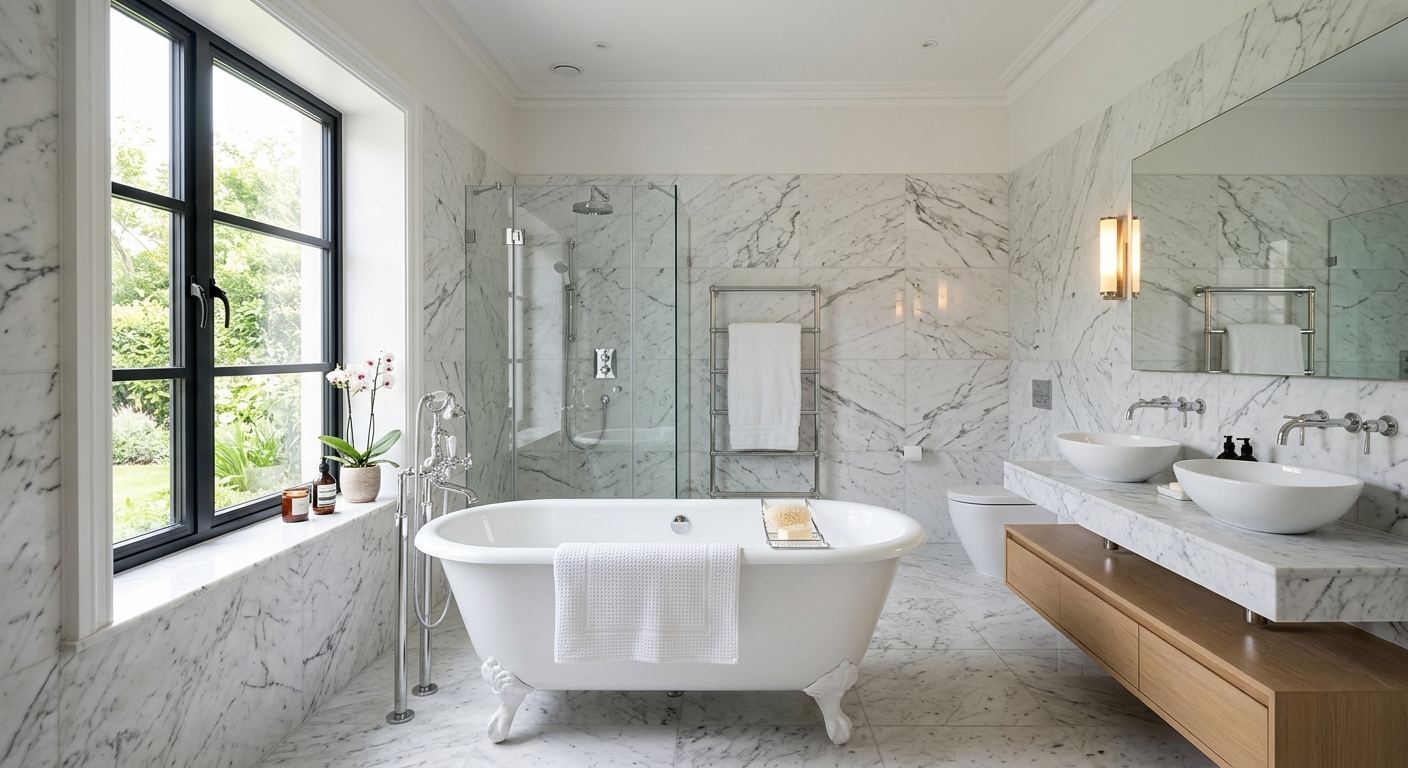
Bathroom renovation options and costs in Cumberland
Cumberland bathroom renovations are as much about the build year as they are about style. In Cumberland, with 39.1% of homes built before 1981 (Statistics Canada, 2021 Census), many projects start with dated plumbing layouts, older drain routing, and wiring that may not match today’s ventilation and electrical expectations. On Vancouver Island and the Coast, the mild maritime climate doesn’t usually drive drywall drying times the way harsher regions do; instead, costs rise because older homes often hide legacy cast-iron or galvanized piping, inadequate fan ducting, and uneven subfloors that only show up once walls are open.
Labour is also the big driver. In southern BC, general contractors commonly bill around 80–120 per hour, and plumbers/electricians are often 100–150 per hour, so a few unexpected rough-ins can move a project quickly into a higher budget tier. Trades demand tends to be especially strong around the Town Centre area and along the main commuter corridors into the Comox Valley, where contractors get booked fast once summer work ramps up. If your house is pre-1981, contractors in Cumberland typically factor in the possibility of asbestos-containing materials (for example, older floor tile or drywall compound) and plan inspection and, if required, abatement—one reason full renos are commonly quoted in the $10,000–$35,000 band even before your finishes are chosen.
Below are practical renovation options to help you compare quotes apples-to-apples before you select tile, fixtures, and glass.
| Renovation Scope |
What's Included |
Typical Duration |
Price Range |
| Cosmetic refresh (paint, fixtures, accessories only) |
Repaint, replace vanity top or vanity, swap toilet or sink fixtures (like-for-like), new towel bars, mirror/accessories, reseal where needed |
2–5 days |
$3,000–$8,000 |
| Mid-range full renovation (new tile, vanity, tub/shower, electrical) |
Remove existing surfaces, rebuild waterproofing, new tile floor and surround, new vanity, new tub/shower valve trim (or shower components), updated exhaust fan, basic electrical updates (GFCI as needed) |
2–4 weeks |
$15,000–$28,000 |
| High-end full renovation (custom tile, steam shower, heated floors) |
All new layout components, premium tile work, custom shower/steam option, heated floor circuit, upgraded ventilation, higher-tier fixtures, glass and trim upgrades, tighter waterproofing build-up |
4–7 weeks |
$28,000–$45,000 |
| Shower-only installation (convert tub to walk-in shower) |
Remove tub, install shower base/pan, new waterproofing and tile surround, new valve/trim, glass door (if included), ventilation checks |
1–3 weeks |
$9,000–$18,000 |
| Bathtub replacement or tub-liner install |
Replace tub (or install a liner where feasible), new caulking/reseals, patch and refinish adjacent surfaces, test drainage, sometimes basic fan/valve updates |
5–10 days |
$4,000–$9,000 |
| Tile-only installation (floor + surround, existing layout kept) |
Demo only the tile, repair subfloor as required, install waterproofing system, tile floor and wall surround, grout/seal, re-install existing fixtures (no plumbing relocation) |
1–2.5 weeks |
$6,500–$14,500 |
Prices are estimates only and vary by project scope, site access and material selection.
What affects the price of bathroom renovation in Cumberland
Two homeowners in Cumberland can receive dramatically different quotes for the “same” bathroom renovation—often 30–50% apart across Vancouver Island and Coast contractors and the broader BC market. The big reasons are regional labour rates and the age of the housing stock, not the weather. On Vancouver Island, contractors commonly bill by the hour at rates such as 80–120 per hour for general contracting and 100–150 per hour for plumbers/electricians, so once you start opening walls, labour multiplies. In homes built before 1981 (39.1% of Cumberland housing stock, Statistics Canada, 2021 Census), hidden conditions are common: cast-iron or older drain stacks, galvanized supply lines, undersized or improperly vented exhaust fans, and dated electrical that needs updating for today’s safety expectations.
In these older structures, asbestos-containing materials can appear in some vinyl flooring, drywall compounds, or insulation. When discovery occurs, abatement protocols (and sometimes testing) can add roughly $1,500–$5,000+ before you even pick tile. That’s why many full remodels land within the $10,000–$35,000 band for Vancouver Island and the Coast even when the climate is relatively forgiving and the bathroom doesn’t need major heating.
Here are practical Cumberland examples that change the price fast. If you keep the existing tub location and replace only the tile (“tile-only installation”), you typically control rough-in labour and stay closer to the mid-range. If you convert from a tub to a walk-in shower and move the drain or valve, your plumber’s scope expands—often pushing the project toward the higher end of shower-only installation pricing. And if your subfloor is out of level from years of moisture exposure, your contractor may need additional framing/patching before waterproofing, which increases material and labour time.
| Price Factor |
Why It Matters |
Cost Impact |
| Layout change — moving drain or supply lines requires rough-in work |
Relocating plumbing means demolition, new piping runs, slope planning for drains, and often permits/inspections |
Often adds several thousand dollars and 3–10+ labour hours |
| Tile selection — large-format porcelain vs. mosaic vs. ceramic |
Harder materials require better substrate flatness and can demand more careful cutting; mosaics increase labour |
Can shift costs by roughly $2,000–$7,000 depending on area and complexity |
| Fixture tier — builder-grade vs. mid-range vs. designer brands |
Valves, shower heads, and trims vary in performance and longevity; branded components also impact supply lead times |
Typical spread of $500–$3,500 for fixtures alone |
| Subfloor condition — rot or unlevel concrete adds scope |
Waterproofing only performs when the substrate is stable; repairs may be needed before membrane installation |
Frequently adds $1,000–$4,000+ for patching/framing |
| Electrical — adding GFCI outlets, exhaust fan, heated floor circuit |
Electrical work needs proper circuit protection, correct fan ducting/controls, and safe connections |
Commonly adds $800–$5,000 depending on scope and wiring distance |
| Waterproofing method — membrane type and extent |
Different systems require different thickness and prep; full coverage reduces mould risk in BC humidity |
Can add $600–$3,000 but reduces long-term failure risk |
| Older-home surprises — asbestos tile, cast-iron drains, galvanized pipes |
Discovery can require testing/abatement, additional demolition, and replacing sections of pipe |
Often adds $1,500–$5,000+ (sometimes more if drains are badly corroded) |
| Bathroom size — sq ft drives tile and labour time directly |
More square footage means more thinset, backer/substrate work, waterproofing, and setting/grouting labour |
Small bathrooms may keep mid-range budgets; larger spaces can push toward high-end bands |
Permits & regulations in British Columbia
In British Columbia, many bathroom updates are considered cosmetic and typically do not require a permit—for example: swapping a vanity, replacing like-for-like fixtures (toilet, sink, faucet trim), repainting, replacing accessories, or retiling when plumbing locations remain unchanged. However, permits are commonly required when you change the systems behind the finishes. Work that does usually require a permit and inspections includes relocating plumbing (moving drain or supply lines), adding or changing ducting for an exhaust fan, and making electrical changes such as adding dedicated circuits, installing heated floor systems, or adding new GFCI-protected outlet locations connected to updated wiring.
Electrical must meet BC code and be done or signed off by a licensed electrician. Plumbing rough-ins that alter pipe routes or connections typically require permit approval and inspection before the walls close. Start by asking your contractor to list exactly what requires permitting for your scope, then confirm whether the contractor will pull the permit(s) or if you must.
To verify a Cumberland contractor in BC step-by-step: (1) Check trade licensing for the relevant trades through the provincial online registry (look up the business and/or individual licence number). (2) Request a current certificate of insurance and ensure it includes liability coverage appropriate for renovation work; verify expiry dates. (3) Ask about WSBC/WCB clearance—many contractors can provide a clearance letter or proof of coverage for the work crew. (4) Confirm the contractor’s warranty terms in writing and that disposal/dump fees are included (or clearly excluded) so scope matches the permit work.
Choosing tile, waterproofing and fixtures for your Cumberland bathroom
When planning a Cumberland bathroom renovation, three material decisions usually determine both your budget and your long-term performance. First is tile choice. Ceramic tile is a solid entry option and can be cost-effective, but it often takes more careful layout for durability in wet zones. Porcelain tile is denser, generally less porous, and handles moisture better—common for floors and shower surrounds on Vancouver Island. Natural stone (marble, travertine, slate) looks premium, but it can add labour and risk if the stone isn’t installed and sealed correctly.
Second is waterproofing. Even with BC’s mild coastal climate, bathrooms still cycle through steam, splashes, and frequent humidity. A proper waterproofing system—installed over correct substrate prep—prevents mould and grout breakdown. Options commonly include paint-on membranes (often used for simpler assemblies), bonded sheet membranes (great where strong waterproofing is required), or well-proven tiling systems that combine approved board plus membrane/liners and corner detailing. The “right choice” is the one matched to your assembly and stress points: tub surrounds, curbless entries, and bench corners all behave differently.
Third is fixture tier. Builder-grade fixtures can meet code and work well, but mid-range and designer options often reduce maintenance issues (better valves, smoother cartridges) and improve resale appeal—especially in a community where many homes are older and buyers look for “done right” ventilation and finishes. For a concrete example, moving from entry-level ceramic to porcelain may add a few thousand dollars overall, but when it coincides with robust waterproofing and better tile selection for wet-wall longevity, it’s a cost that typically pays back through fewer early repairs.
| Material / Option |
Pros |
Cons |
Price Range |
| Ceramic tile (floor + walls) |
Good value, wide style selection, straightforward to source |
Often higher slip/porosity considerations; may wear faster in heavy traffic if not chosen correctly |
$2,500–$6,500 |
| Porcelain tile (floor + walls) |
More moisture-resistant, durable finish, supports modern large-format layouts |
May require extra substrate flatness; cutting and setting large formats takes careful workmanship |
$4,500–$10,000 |
| Natural stone (marble, travertine, slate) |
High-end look, unique veining, premium feel for luxury bathrooms |
Requires sealing and maintenance; installation is often more labour-intensive and prone to variation |
$8,000–$18,000 |
| Frameless glass shower enclosure |
Bright, modern look; easier visual cleaning; premium perceived value |
Higher cost and lead times; needs correct framing/fastener detailing |
$2,000–$6,500 |
| Prefab tub surround (acrylic) |
Faster install, consistent surfaces, generally more budget-friendly |
Fewer design options than tile; seams and edges must be sealed properly |
$1,500–$3,500 |
| Custom shower pan (tile or linear drain) |
Curbless/wet-room flexibility, modern drainage options, excellent for accessibility |
More complex waterproofing detailing; must be built to exact slope and membrane requirements |
$3,500–$12,000 |
How to choose a bathroom renovation contractor in Cumberland
Choosing the right contractor matters more in Cumberland than many people expect because older housing stock can turn “a simple reno” into a systems project (venting, drainage, and wiring) once walls are open. Start with verification in British Columbia. Ask for the contractor’s relevant trade licensing (where applicable), then request a certificate of liability insurance showing current coverage and the correct business name. For coverage for the crew, ask for proof of WSBC/WCB clearance—good contractors can provide documentation without hesitation.
Next, get 2–3 itemised written quotes. You want labour and materials broken down—especially for demo, plumbing rough-in, electrical, waterproofing, tile setting, glass, and disposal. Avoid lump-sum-only quotes that don’t identify what is included. Read the scope line-by-line: clarify whether permit pulling is included, whether dumpster costs and haul-away are included, what happens if asbestos-containing materials are found, and what product warranties apply to waterproofing and install workmanship.
For warranties, ask how long the workmanship warranty runs (for example, for waterproofing and tiling), whether it’s in writing, and if it transfers to a future homeowner. For payment, never agree to pay more than 10–15% upfront; hold back the remainder until key milestones are complete (rough-ins inspected, waterproofing complete, and final trim installed). Finally, request a start date and a realistic completion estimate in writing, including lead times for glass, tile, and specialty valves.
- Provide BC licence details and clear evidence of liability insurance coverage
- Show WSBC/WCB clearance (or equivalent proof) for the renovation crew
- Quote is itemised: demo, rough-in, waterproofing, tile labour, electrical, and disposal each listed
- Scope states whether permits are pulled by the contractor
- Workmanship warranty length is stated and tied to waterproofing/tile installation
- Product/manufacturer warranty documents are included for fixtures, glass, and waterproofing system components
- Payment schedule stays within 10–15% deposit and includes milestone holdback
- Timeline includes your finish selections and accounts for material lead times
- Subfloor prep and repair allowances are clearly described (not “assumed”)
- Vent fan upgrade and ducting details are specified if you’re replacing a shower/tub
- Clarify what happens if hidden damage is found after demolition (written change-order process)
- Confirm who is responsible for cleanup and dust control during demolition and tiling
Red flags to watch for in Cumberland: (1) quotes with no waterproofing details (just “tile and grout”), (2) no mention of ventilation or fan ducting when upgrading showers/tubs, (3) willingness to proceed without verifying electrical/plumbing permitting needs, (4) large deposits or “no change orders” language that avoids documenting hidden conditions, and (5) vague timelines without material lead-time planning.
Frequently asked questions — bathroom renovation in Cumberland
How much does a walk-in shower cost in Cumberland?
A walk-in shower cost in Cumberland depends heavily on whether you’re converting a tub and whether the drain/valve location changes. As a planning reference, shower-only installations in the Cumberland tier commonly fall in the $4,000–$15,000 band for many typical jobs, but conversions that require significant waterproofing detailing, new glass, or electrical/vent updates often trend higher. If your home is older (39.1% built before 1981, Statistics Canada, 2021 Census), budget a little extra for possible plumbing upgrades or ventilation corrections once walls open. In practice, expect the best comparisons when quotes specify: shower base type or pan, the waterproofing system, glass enclosure scope, and whether the exhaust fan and GFCI outlet are included.
What's the ROI on a bathroom renovation?
Bathroom ROI in British Columbia varies by home value, finish quality, and whether the renovation improves safety and functionality (venting, waterproofing, accessibility). While Statistics Canada provides demographic context (for example, Cumberland has a median household income of $86,000 in 2020, Statistics Canada, 2021 Census), the resale impact is more strongly tied to buyer perception: clean, dry, mould-resistant surfaces, modern fixtures, and code-appropriate electrical and ventilation. High-quality waterproofing and durable tile work tend to hold value better than surface-level refreshes. A full renovation often sits within the $10,000–$35,000 Vancouver Island and Coast band; you’ll generally see stronger buyer appeal when the job includes proper membrane systems, updated exhaust fan performance, and electrical safety updates (like GFCI) rather than only repaint and accessories.
Do I need waterproofing behind the tile?
Yes—under normal bathroom tiling assemblies in Cumberland, waterproofing behind the tile is strongly recommended and typically expected in good workmanship. Vancouver Island’s humidity and frequent steam means showers are constantly exposed to moisture; if waterproofing is skipped or done incorrectly, you risk grout failure, elevated moisture in framing, and eventual mould. In BC, many contractor quotes treat waterproofing as a core scope item: membrane type, coverage extent, and proper corner/transition detailing. Your contractor should specify whether you’re using a membrane system (paint-on or sheet/bonded systems) and how it integrates with the shower pan/curb/tub surround. Skipping waterproofing may save money short-term, but it can turn into expensive repairs—often far beyond the mid-range $15,000–$28,000 tier once walls are opened again.
How do I compare bathroom renovation quotes?
In Cumberland, comparing quotes is about matching scope, not just price. Ask each contractor for an itemised breakdown: labour and materials for demo, plumbing rough-in, electrical, waterproofing system, tile setting and grout, glass enclosure, disposal, and any permit-related work. Confirm what’s excluded—particularly subfloor repairs, asbestos testing/abatement allowances, and fan/ducting upgrades. Because older homes (39.1% built before 1981, Statistics Canada, 2021 Census) commonly reveal legacy pipework or ventilation issues, a “cheap” quote can become a “change order” after demolition unless the risk is addressed upfront. Also check warranty terms for workmanship and products, payment schedule, and whether timelines depend on your material selections. A higher quote can be better value when it includes proper waterproofing and code-compliant ventilation/electrical changes.
Can I live at home during a bathroom renovation in Cumberland?
Sometimes, but it depends on scope and how your bathroom is being rebuilt. For a cosmetic refresh, you may manage while staying home since it’s typically limited to a short install window. For a full renovation or shower conversion, expect dust and limited bathroom access during demo and waterproofing phases. Many Cumberland homeowners plan a temporary setup with a functioning half-bath, a portable toilet, or using an alternate shower for part of the schedule. If your project touches plumbing/electrical rough-ins, you’ll usually need the main bathroom mostly offline for safety and inspection steps. A well-organised contractor will schedule demolition and rough-ins efficiently, keep containment controls tight, and provide a clear timeline so you can plan groceries, laundry, and shower access. Clarify start date and completion estimate in writing before you sign.
What's the best bathtub material for a Cumberland home?
The “best” bathtub material for a Cumberland home is the one that fits your installation constraints, expected use, and the surrounding waterproofing system. Acrylic tubs are common because they’re lighter, can simplify installation, and are usually easier to transport—often making them a practical mid-range choice. Fibreglass/steel options can be durable, but installation details and sound considerations vary by model. In older homes (39.1% built before 1981, Statistics Canada, 2021 Census), the bigger decision is often whether you’re replacing the tub or converting to a walk-in shower based on access needs and drainage/ventilation outcomes. If you’re replacing a tub, many projects land in the $1,500–$7,000 fixture replacement/tub-liner band, but full budgeting should include resealing, waterproofing transitions, and any needed electrical or exhaust updates.