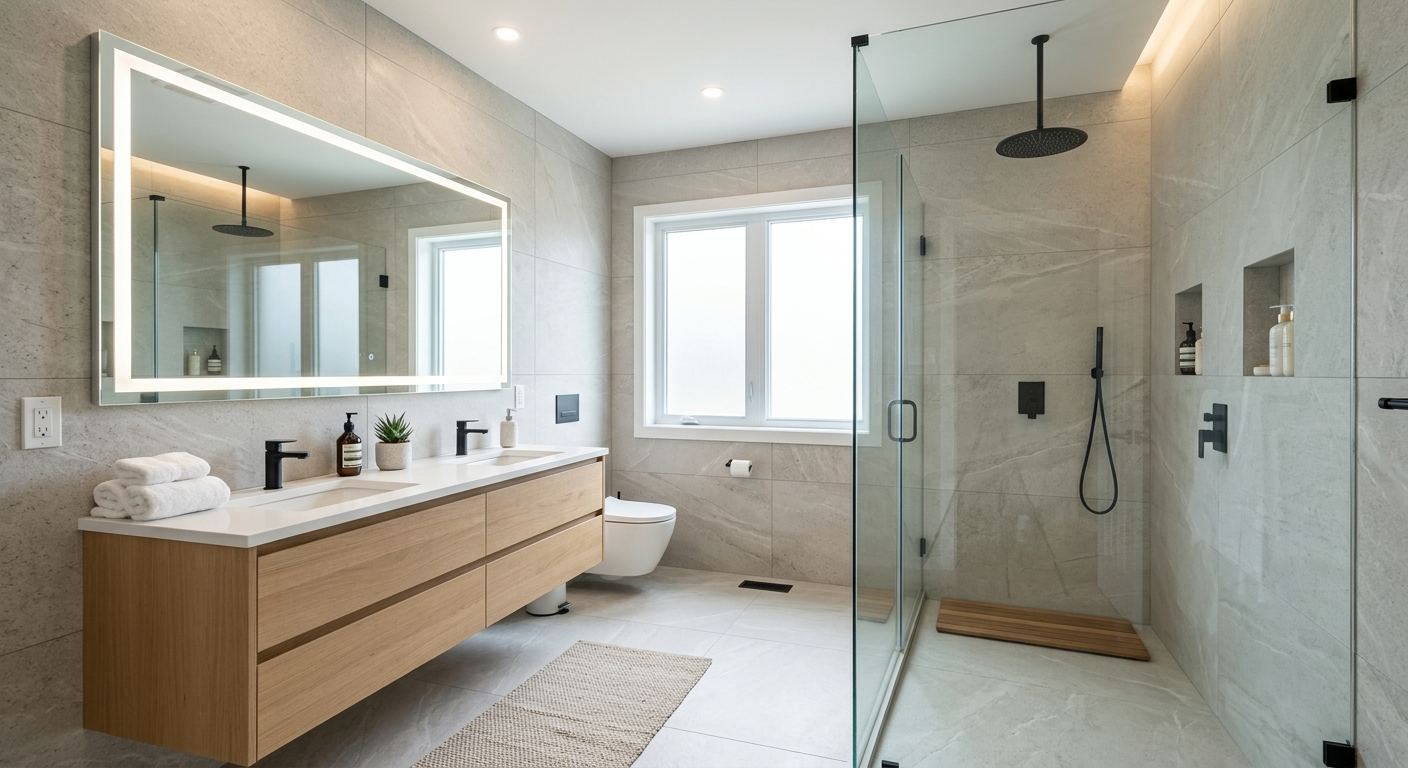
Bathroom renovation options and costs in Clair Hills
Bathroom renovations in Clair Hills typically fall into a few clear options, and the right choice depends on how much you want to change versus how much you’re willing to uncover after walls come down. With a population of 6,145 (Statistics Canada, 2021 Census), Clair Hills feels like a smaller community, but you still hire from the wider GTA workforce. That matters because the Toronto economic region’s pricing is driven more by labour availability and the age of area homes than by climate alone. Many older post-war and 1960s–1980s properties around the area can have dated plumbing layouts and drain stacks that may be undersized or corroded, and that’s where budgets often expand. In some pre-1985 homes, asbestos-containing materials can also be hiding in floor tile or drywall compounds, which triggers licensed abatement and adds time.
Toronto-area weather isn’t what drives bathroom cost the way labour and housing age do, but humidity does affect bathroom performance. If your ventilation or waterproofing is off, you’ll see faster wear around grout lines and wet zones—so contractors prioritize membrane continuity and exhaust fan sizing. Skilled trades are especially in demand in nearby established pockets and commuting corridors; in Clair Hills, many homeowners route work through contractors serving the broader north end of Toronto and surrounding municipalities because those crews are used to complex rough-ins, older venting, and permit coordination.
Below are realistic price ranges you’ll see for common bathroom scopes, then we’ll break down the specific factors that make quotes differ in Clair Hills.
| Renovation Scope |
What's Included |
Typical Duration |
Price Range |
| Cosmetic refresh (paint, fixtures, accessories only) |
Paint, new vanity or toilet/finish fixtures (like-for-like), lighting trims, mirrors, accessories; no plumbing relocation |
3–7 days |
$3,000–$7,500 |
| Mid-range full renovation (new tile, vanity, tub/shower, electrical) |
Remove existing finishes, prep walls/subfloor, new tile (floor + walls), vanity replacement, tub or shower surround, new exhaust fan/fixtures, updated electrical to code |
2–4 weeks |
$12,500–$22,000 |
| High-end full renovation (custom tile, steam shower, heated floors) |
Custom shower system or steam-ready layout, premium tile work, linear/featured drain or custom pan, heated floor circuit, designer fixtures, upgraded ventilation and waterproofing system |
3–6 weeks |
$22,000–$30,000 |
| Shower-only installation (convert tub to walk-in shower) |
Convert tub to walk-in, new shower pan (tile or prefab depending on spec), new valve/trim, curb/threshold adjustments, waterproofing, tile work in wet zone |
2–3 weeks |
$8,000–$14,000 |
| Bathtub replacement or tub-liner install |
Replace bathtub and fixtures, refinishing/liner option where allowed, new surround to match, sealing and caulking, basic plumbing connections |
5–10 days |
$1,200–$3,500 |
| Tile-only installation (floor + surround, existing layout kept) |
Tile removal as needed, new tile installation for floor and walls, waterproofing upgrade where required, grout/caulking and finishing; limited electrical/plumbing changes |
1–3 weeks |
$3,500–$10,000 |
Prices are estimates only and vary by project scope, site access and material selection.
What affects the price of bathroom renovation in Clair Hills
In Clair Hills, you’ll often see quotes for the “same” bathroom run 30–50% apart, especially when comparing a cosmetic refresh to a true full renovation. In the GTA, labour rates and the age of the housing stock typically drive that gap more than climate. A dated bathroom layout can force contractors into extra rough-in work: drains may be cast-iron or corroded, supply lines can be galvanized or undersized, venting may not meet current Ontario expectations, and ventilation ducting might need rework. Once walls and floors are open, hidden conditions are common in older post-war and 1960s–1980s homes—so the labour-intensive steps (demo, framing corrections, waterproofing continuity, tile setting, and re-plumbing) expand the scope.
As an example, if asbestos-containing materials are discovered in vinyl floor tile or old drywall compound (more common in pre-1985 homes), abatement protocols add both cost and scheduling complexity. Budgeting an extra $1,500–$5,000+ is a prudent allowance when a contractor can’t confirm what’s behind the finish layers. On the other hand, keeping the plumbing where it is can pull you toward the lower end of ranges like $12,000–$22,000 for a mid-range full renovation, while significant line rerouting can push the project toward $22,000–$30,000 in high-end scopes.
Concrete Clair Hills examples that commonly raise or lower costs: (1) a subfloor that’s soft or unlevel can add concrete patching, new underlayment, and more tile labour time; (2) an older venting path may require drain reconfiguration rather than “treating the problem later,” which is why upfront inspection and careful estimating matters.
| Price Factor |
Why It Matters |
Cost Impact |
| Layout change — moving drain or supply lines |
Rough-in plumbing, subfloor cutting, new vents/shut-offs, and patching drywall |
Often +$3,000–$10,000 depending on rerouting distance |
| Tile selection — large-format porcelain vs. mosaic vs. ceramic |
More cuts, skill requirements, and heavier materials increase labour and waste |
Typically +$1,000–$4,000 |
| Fixture tier — builder-grade vs. mid-range vs. designer brands |
Higher-end trims and valves cost more and may require matching parts |
Typically +$500–$3,500 |
| Subfloor condition — rot or unlevel concrete adds scope |
Extra demo, structural repairs, and additional prep layers |
Often +$800–$4,500 |
| Electrical — adding GFCI outlets, exhaust fan, heated floor circuit |
Licensed work, circuit capacity checks, and safe ventilation upgrades |
Typically +$500–$3,000 |
| Waterproofing method — membrane type and extent |
Proper wet-zone protection prevents leaks and mould; materials and labour vary |
Typically +$600–$2,500 |
| Older-home surprises — asbestos tile, cast-iron drains, galvanized pipes |
Abatement, drain replacement, valve changes, and additional inspections |
Can add +$1,500–$8,000+ |
| Bathroom size — sq ft drives tile and labour time directly |
More wall area, longer waterproofing, and longer tile setting |
Usually +$1,000–$6,000 |
Permits & regulations in Ontario
In Ontario, many bathroom updates are treated as cosmetic and usually do not need a permit—especially when you keep plumbing and electrical where they are. Typically no permit is required for: swapping a vanity, repainting, replacing a toilet or sink with like-for-like connections, updating mirrors, replacing fixtures that connect to existing shut-offs, and retiling that doesn’t change plumbing locations. You can still expect code-compliant installation for waterproofing and safe electrical practices, but the permit requirement is usually tied to scope.
Work that does commonly require permits includes: relocating a sink, toilet, tub, or shower drain/supply lines (moving rough-in plumbing), adding or relocating electrical outlets or changing circuits (especially for new exhaust fan circuits or heated flooring), and structural changes to walls (for example, opening to reframe or relocating a load-bearing element). Any electrical work must meet Ontario electrical code requirements and be completed or signed off by a licensed electrician.
For Clair Hills homeowners, verify your contractor step-by-step: (1) find their Ontario trade licence details via the relevant provincial registry information they provide; (2) ask for a certificate of insurance and confirm liability coverage is current; (3) request evidence of WSIB/WCB coverage (or a clearance letter where applicable) so you’re not stuck with liabilities if a worker is injured. Then confirm permit responsibility in writing: who pulls the permit, what inspections are scheduled, and whether disposal and site protection are included.
Choosing tile, waterproofing and fixtures for your Clair Hills bathroom
Three material decisions usually determine whether your Clair Hills bathroom renovation lands in the mid-range or high-end territory: tile choice, waterproofing method, and fixture tier. First is tile. Ceramic tile can be a good entry point, but it’s more sensitive to uneven substrates and can show wear sooner in high-traffic wet zones. Porcelain tile is denser and less porous, often easier to maintain, and it holds up well against Ontario’s bathroom humidity cycles when paired with correct grout sealing and proper substrate prep.
Second is waterproofing. In Ontario, bathrooms don’t “dry out” fast enough when ventilation is underpowered, so waterproofing continuity matters more than marketing claims. A paint-on membrane can work in limited scenarios, but bonded sheet membranes (or a complete system approach) typically offer stronger barrier reliability for wet-wall assemblies and shower niches. Third is fixtures. Builder-grade faucets and trims keep upfront cost lower, while mid-range and designer lines often justify their price through smoother valve performance, better finishes, and improved resale appeal—especially for visible elements like shower valves and hardware.
Where the money is justified: if you’re converting a tub to a walk-in, it’s common to spend closer to the shower installation band of $8,000–$14,000 because the waterproofing and tile labour are doing the heavy lifting. Upgrading from basic materials to a robust waterproofing approach within that budget is usually smarter than paying extra for decorative tile while cutting corners on membrane continuity.
| Material / Option |
Pros |
Cons |
Price Range |
| Ceramic tile (floor + walls) |
Lower material cost, wide style selection, good for many renovation budgets |
More variation in performance; can be less forgiving on uneven substrates |
$3,000–$7,500 |
| Porcelain tile (floor + walls) |
More durable, less porous, better stain resistance; holds up well in wet zones |
Higher material cost; heavier tile can increase installation time and waste |
$4,500–$10,000 |
| Natural stone (marble, travertine, slate) |
Luxury look, unique variation, premium curb appeal |
Sealing/maintenance requirements, batch matching costs, higher labour for precision cuts |
$8,000–$18,000 |
| Frameless glass shower enclosure |
Modern appearance, easier visual maintenance, can make small baths feel bigger |
Hardware cost; installation must be perfectly plumb and properly anchored |
$4,000–$8,500 |
| Prefab tub surround (acrylic) |
Fast install, consistent surface, often fewer cracks than field tile in some designs |
Less “custom” look; requires correct backing and waterproofing around seams |
$1,200–$3,500 |
| Custom shower pan (tile or linear drain) |
Fully custom slope and drainage; excellent for accessibility and design consistency |
More labour and waterproofing steps; final cost depends heavily on linear drain selection |
$5,000–$12,000 |
How to choose a bathroom renovation contractor in Clair Hills
Choosing the right bathroom contractor in Clair Hills is mostly about verifying capability and matching scope, not just finding the lowest number. Start with Ontario licensing and coverage. Ask for their Ontario trade documentation and confirm liability insurance is current (certificate of insurance, not a screenshot). Next, request proof of WSIB/WCB coverage or a clearance letter. This matters because bathroom renovations are labour-intensive, involve cutting and removal, and often bring in subcontractors for electrical and plumbing.
Then get 2–3 itemised written quotes—not one page with a lump sum. Look for a line-by-line breakdown that separates labour from materials, includes demolition, waterproofing, tile setting, disposal, and any required permit work. Confirm what’s excluded: for example, asbestos testing, drain replacement, subfloor repairs, or product upgrades. Also check warranty terms: workmanship warranty length, product/manufacturer warranty details, and whether warranties are transferable to future owners.
For payment schedule, never agree to pay more than about 10–15% upfront. Hold back a portion until completion and final walkthrough items are signed off. Finally, require a written timeline with a start date, milestones (demo, rough-in, waterproofing, tile), and a realistic completion estimate—GTA scheduling can be busy, but you should still have dates tied to work steps.
- Verify Ontario licence details and ask for the certificate number.
- Confirm liability insurance limits are appropriate for renovation work.
- Provide WSIB/WCB proof or a clearance letter before starting.
- Request itemised quotes (labour vs materials) and compare apples-to-apples scopes.
- Ask whether permits are included, who pulls them, and what inspections are expected.
- Confirm disposal/recycling is included in the estimate.
- Get waterproofing method specified (membrane type, coverage, and wet-zone boundaries).
- Ask how they handle older-home surprises (asbestos, cast-iron drains, vent issues) if discovered.
- Require tile layout and substrate prep notes (screed/patching/underlayment plan).
- Review warranty: workmanship duration and product warranty documentation.
- Agree on a payment schedule with a clear holdback until punch list completion.
- Ensure timeline includes sequencing for plumbing/electrical inspections.
Common red flags I see in Clair Hills bathroom projects: (1) quotes that don’t describe waterproofing or just say “tile install” without specifying the membrane system; (2) no mention of permits or inspections where plumbing/electrical is changing; (3) asking for large upfront payments beyond 10–15%; (4) vague warranty language with no workmanship duration; and (5) refusal to provide itemised pricing or proof of WSIB/WCB and liability coverage before work starts.
Frequently asked questions — bathroom renovation in Clair Hills
How much does a walk-in shower cost in Clair Hills?
In Clair Hills (within the GTA pricing environment), a walk-in shower typically costs more than many homeowners expect because the work is labour-heavy once walls are opened. If you’re converting a tub to a walk-in, many full “shower conversion” projects land in the $8,000–$14,000 range depending on waterproofing approach, tile complexity, and whether the drain/venting needs correction. If you keep the existing plumbing locations and choose simpler tile layouts, you may be closer to the lower end. If the contractor finds older drain materials or needs to adjust rough-in to meet Ontario code expectations, budgets can climb toward the upper end of the local shower installation band (GTA labour premiums apply).
What's the ROI on a bathroom renovation?
ROI varies by neighbourhood appeal and the quality of the finish, but in Clair Hills you can think of bathroom renovations as both a resale feature and a “livability” upgrade. A mid-range full renovation is often the sweet spot for value—typically within the $12,000–$22,000 band—because it balances durability (waterproofing, ventilation, and correct tile work) with modern fixtures buyers expect. High-end finishes (closer to $22,000–$30,000) can improve marketability, but not all buyers will pay back every luxury option like custom steam-ready layouts. Your best ROI comes from fixing what’s already failing: leaks, poor ventilation, outdated plumbing, and worn tile/grout in wet zones.
Do I need waterproofing behind the tile?
Yes—waterproofing behind tile is one of the most important parts of a bathroom renovation in Ontario, including Clair Hills. If water gets into the wall assembly, it can contribute to mould risk and premature failure even when tile looks fine. The “need” is driven by how bathrooms are used and by Ontario’s humidity cycles, not by climate mythology. For showers and wet-wall areas, reputable installers use a waterproofing membrane system at the appropriate thickness/extent and ensure continuity at corners, niches, seams, and transitions. A contractor should be able to specify the method (for example, membrane type) and how they prepare the substrate before tiling.
How do I compare bathroom renovation quotes?
Compare quotes like a detective: scope first, then numbers. In Clair Hills, quotes can differ 30–50% because labour-intensive parts—plumbing rough-in, waterproofing, and tile work—may be included or treated as “allowances.” Ask each contractor for itemised breakdowns: demolition, disposal, waterproofing method, tile labour, and what electrical/plumbing changes are included. Confirm whether permits are included and who pulls them, and whether there’s a line for subfloor repairs or allowance for older-home surprises (like cast-iron drains or asbestos-containing materials). If one quote is a lump sum and the other is detailed, the detailed one is usually easier to verify and less likely to trigger change orders mid-project.
Can I live at home during a bathroom renovation in Clair Hills?
Sometimes yes, but it depends on whether you can create a temporary functional setup. Many homeowners in Clair Hills choose to stay home if the reno is limited to one bathroom and the schedule is tight (for example, cosmetic refresh or tile-only work with minimal plumbing disruption). For full renovations, you may have to use a secondary bathroom, and during demolition and rough-in (plumbing/electrical), access to showers/sinks will be limited. A shower-only conversion is often faster than a full bath reconfiguration, which can reduce how long you’re without a working wet area. Ask your contractor for a written day-by-day plan and staging plan for dust control, access routes, and where water shut-offs will occur.
What's the best bathtub material for a Clair Hills home?
The “best” bathtub material is usually the one that matches your installation situation and long-term maintenance preferences. For many Clair Hills homeowners, an acrylic tub is a practical choice because it’s typically easier to install and maintain, and it tends to be lighter than older cast-iron units. If you’re doing a bathtub replacement, budget expectations often fall in the $1,200–$3,500 band for the tub/fixture replacement scope, but the actual total can rise if you’re also updating surround tile, waterproofing, or valve locations. If your goal is the highest resilience for wet areas, the real differentiator is the surrounding waterproofing and correct sealing at transitions—not only the tub shell material.