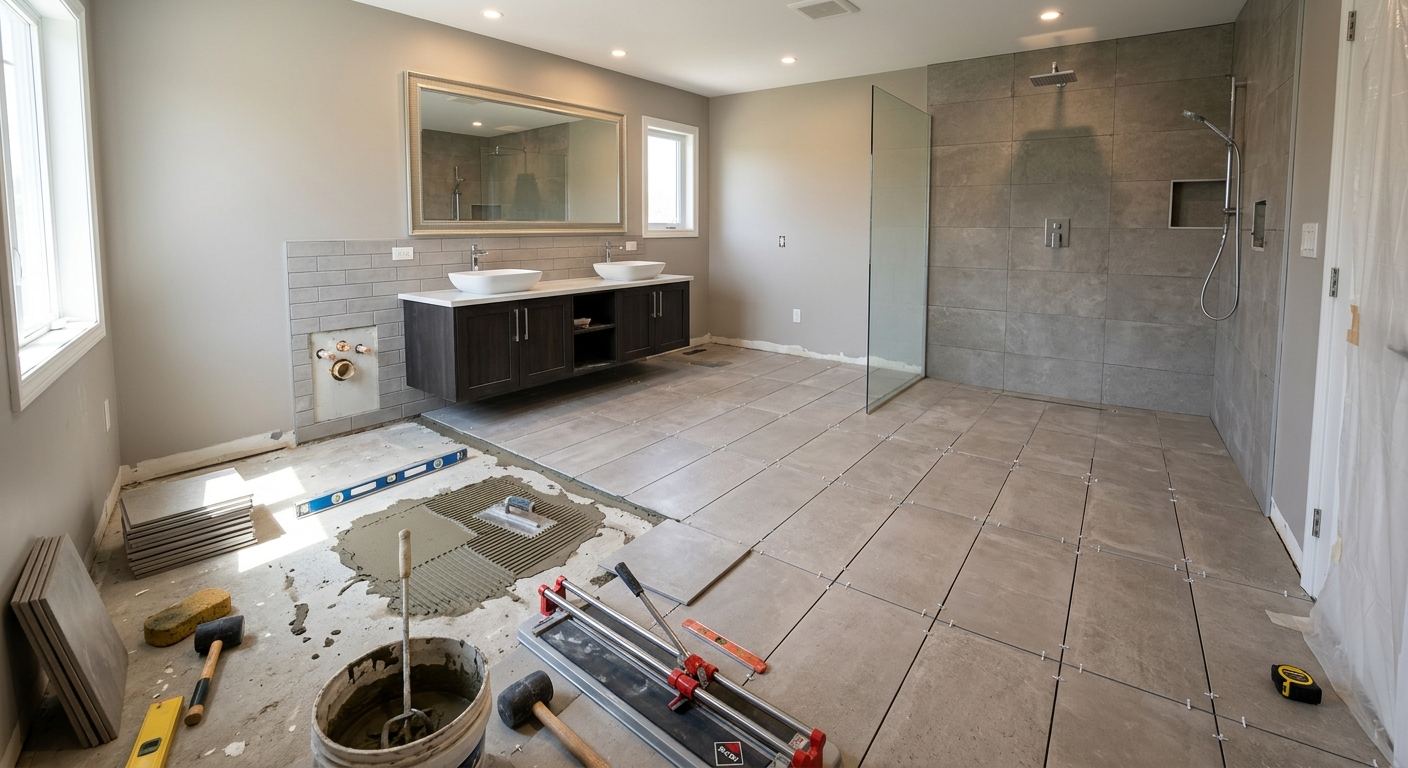
Bathroom renovation options and costs in Cobourg
Choosing a bathroom renovation in Cobourg usually starts with deciding how much you want to change. The pricing you see locally typically hinges on the realities of the housing stock: in Cobourg and nearby areas, 52.1% of homes were built before 1981, so dated plumbing layouts, older venting, and sometimes hidden asbestos in older floor materials can turn a “simple refresh” into a fuller scope. With 68.7% of households owning their homes in the area (Statistics Canada, 2021 Census), many projects are planned as long-term improvements rather than quick cosmetic makeovers.
In the Muskoka–Kawarthas market, bathroom renovation costs are driven more by labour rates and multi-trade coordination than by extreme climate. Contractors around Cobourg, Peterborough, and Kawartha Lakes often charge slightly less than major GTA centres, but the province-wide 2026 construction labour market still affects scheduling, especially when plumbing, electrical, waterproofing, and tilework are coordinated under one roof. That coordination matters because many older bathrooms require re-piping, exhaust fan upgrades, or added GFCI protection to meet modern electrical safety expectations.
For homeowners in neighbourhoods like downtown Cobourg and the East side (where older homes are common), trade demand is especially high for re-venting and tile-ready waterproofing. Once we inspect your rough-in conditions and wall/floor surfaces, we can place your project into the right cost band—then you’ll be able to compare quotes fairly from start to finish. Here’s a practical breakdown to help you match expectations to budget.
| Renovation Scope |
What's Included |
Typical Duration |
Price Range |
| Cosmetic refresh (paint, fixtures, accessories only) |
Paint, vanity/fixture swaps without moving plumbing, toilet swap, new accessories, caulking, deep clean and minor resealing |
3–7 days |
$3,000–$6,000 |
| Mid-range full renovation (new tile, vanity, tub/shower, electrical) |
Demo and disposal, updated waterproofing, new tile floor and surround, new vanity and mirror, tub-to-shower trim work or tub/shower replacement, exhaust fan upgrade, GFCI outlet upgrades where required |
2–3 weeks |
$12,000–$20,000 |
| High-end full renovation (custom tile, steam shower, heated floors) |
Custom tile detailing, higher-end fixtures, heated floors, premium waterproofing system, larger-format tile, steam shower prep (as applicable), upgraded electrical plan and dedicated circuits, niche/build-out carpentry |
3–5 weeks |
$20,000–$28,000 |
| Shower-only installation (convert tub to walk-in shower) |
Demo, new shower pan and waterproofing, tile walls and curb/linear drain option, glass enclosure, new valve trim, exhaust fan checks/upgrade, new GFCI outlet(s) if needed |
1.5–2.5 weeks |
$4,500–$9,000 |
| Bathtub replacement or tub-liner install |
Remove and replace tub (or liner system where suitable), plumbing connections check, re-caulk/seal, updated wall surround edges, basic waterproofing at transitions |
4–8 days |
$800–$2,500 |
| Tile-only installation (floor + surround, existing layout kept) |
Prep and leveling (where required), waterproofing system tied to your scope, tile floor and shower surround, grout/seal, reinstallation of fixtures if they’re being kept |
1–3 weeks |
$1,500–$4,500 |
Prices are estimates only and vary by project scope, site access and material selection.
What affects the price of bathroom renovation in Cobourg
Even when two homeowners ask for the “same” bathroom reno, quotes across Muskoka–Kawarthas and Ontario can land 30–50% apart. In practice, that difference is mostly labour and coordination: modern bathrooms need accurate rough-ins (plumbing and electrical), careful waterproofing, and clean tile installation schedules—so a small discovery can ripple into multiple trades. In Cobourg’s older housing stock, 52.1% of homes built before 1981 often means your bathroom may have cast-iron or older drain assemblies, and supply lines that are harder to adjust cleanly. When we open walls and floors, we’re looking for hidden issues that increase the budget even if the visible finishes stay similar.
Ventilation is another common cost driver. If your current exhaust fan is undersized or not ducted correctly, the contractor will often recommend upgrading the duct run and adding proper controls, which ties into electrical work and can move a renovation toward the full renovation band (often $12,000–$20,000). For electrical safety, older bathrooms sometimes need new GFCI protection and dedicated fan wiring. Also, asbestos surprises in older vinyl floor tile or old drywall compounds (more common in pre-1985 homes) can trigger abatement and add roughly $1,500–$5,000+ to your budget depending on extent.
Concrete Cobourg examples we see: (1) a layout that keeps the toilet and tub in place usually stays closer to tile-only or mid-range full renovation costs, while moving drains for a walk-in shower adds rough-in time; (2) large-format porcelain tile often costs more in materials and setting labour than mosaic or ceramic; and (3) bathrooms over older basements or where subfloor is uneven can require extra prep before waterproofing. That’s why a project can start as “cosmetic” but still need a waterproofing-first approach.
| Price Factor |
Why It Matters |
Cost Impact |
| Layout change — moving drain or supply lines |
Requires plumbing rough-in, possibly subfloor demo, and re-routing ducting |
Often adds 20–40% versus keeping the layout |
| Tile selection — large-format porcelain vs. mosaic vs. ceramic |
Material cost and complexity of cuts, leveling, and grout lines |
Can swing tile portion by $1,000–$3,000+ |
| Fixture tier — builder-grade vs. mid-range vs. designer brands |
Higher tiers cost more and may need more precise installation tolerances |
Typical variation $500–$4,000+ depending on fixtures |
| Subfloor condition — rot or unlevel concrete adds scope |
Waterproofing systems won’t perform over movement or soft spots |
Commonly adds $800–$3,500 |
| Electrical — adding GFCI outlets, exhaust fan, heated floor circuit |
Requires licensed electrical work and safe circuit planning |
Often adds $300–$2,500+ |
| Waterproofing method — membrane type and extent |
Coverage, prep, and product system determine long-term failure risk |
Can shift budget by $600–$2,000+ |
| Older-home surprises — asbestos tile, cast-iron drains, galvanized pipes |
Abatement, disposal, pipe replacement, and extra testing affect schedule |
Adds roughly $1,500–$5,000+ depending on discovery |
| Bathroom size — sq ft drives tile and labour time directly |
More walls/floor increases material and installation hours |
Large bathrooms can cost $3,000–$8,000+ more |
Permits & regulations in Ontario
In Ontario, the permit requirement depends on what you change—not just that you’re renovating. Cosmetic updates like swapping a vanity, replacing fixtures, re-painting, and retiling with the same layout typically do not require a building permit because you’re not altering plumbing routes, structural elements, or electrical circuits. However, if your plan involves relocating plumbing (moving a drain or supply line), adding or modifying an exhaust fan with new ducting or wiring, or making structural changes (like moving framing or opening walls), permits and inspections are commonly required. Electrical work must meet provincial requirements and be performed by (or signed off by) a licensed electrician.
For homeowners in Cobourg, a practical step-by-step verification process protects you. First, ask for the contractor’s Ontario trade licence details and confirm it before work starts. Second, request a certificate of liability insurance and check that coverage is current and adequate for renovation scope (and that the certificate names you or your property correctly if your lender/insurance requires it). Third, confirm WSIB/WCB coverage where applicable—ask for the clearance letter or proof of coverage and keep it with your contract documents.
Finally, don’t assume permits are handled: ask whether the permit pull is included in the price, who submits it, and what inspections are expected. If a contractor won’t provide clear answers on permits, inspections, and licensed trades, treat it as a major scope risk—especially in older homes where hidden conditions can force electrical and plumbing changes.
Choosing tile, waterproofing and fixtures for your Cobourg bathroom
In a Cobourg bathroom renovation, your three biggest “buy right once” decisions are tile choice, waterproofing method, and fixture tier. Start with tile: entry-level ceramic is cost-effective, but it often comes with higher risk of cracking if the substrate isn’t perfectly prepared. Porcelain mid-range tile usually performs better in wet areas and handles day-to-day humidity more consistently. Natural stone (marble, travertine, slate) looks premium but adds installation complexity—stone requires careful sealing and a layout approach to avoid difficult fitting lines on older floors. In Cobourg’s humid seasonal swings (winter freeze-thaw plus summer moisture), the right tile system matters, but the base preparation matters even more.
Next is waterproofing. A paint-on membrane can work for certain conditions, but in wet-zone showers you generally want a proven system with proper prep and thickness. Bonded sheet membrane offers excellent coverage when installed correctly, and systems built around a reliable shower assembly approach (such as a frameless, engineered shower strategy) reduce the chance of leaks at corners and transitions. The goal is simple: prevent mould and grout failure by keeping water out of the structure.
Finally, fixture tier affects both budget and resale. Builder-grade fixtures cost less but may require replacement sooner (especially valves and trim). Mid-range upgrades often strike the best balance for long-term reliability and comfort. Designer brands can be worth it if you want specific finishes that match your home and you’re staying in the full renovation band; otherwise, you may get better value by allocating extra to waterproofing and subfloor prep.
Concrete example: upgrading to mid-range porcelain tile and a stronger waterproofing system can cost more upfront, but it’s often justified compared with “saving” on tile while risking rework. If you’re aiming for a mid-range full renovation (often $12,000–$20,000), your money is usually best spent on waterproofing and tile prep rather than only upgrading vanity hardware.
| Material / Option |
Pros |
Cons |
Price Range |
| Ceramic tile (floor + walls) |
Budget-friendly, wide style selection, easy availability in local suppliers |
Less forgiving than porcelain in demanding wet-zone applications; may chip if substrate isn’t stable |
$1,500–$3,000 |
| Porcelain tile (floor + walls) |
Denser and more durable for showers/floors, better moisture performance, holds up to regular cleaning |
Costs more and may require more precise layout and subfloor prep |
$2,500–$4,500 |
| Natural stone (marble, travertine, slate) |
High-end look, unique veining/texture, strong design impact |
Requires sealing/maintenance and careful installation to avoid unevenness and staining |
$3,500–$7,500 |
| Frameless glass shower enclosure |
Modern look, visually opens the bathroom, often improves perceived space |
More expensive hardware; needs accurate framing alignment and good waterproofing at edges |
$1,800–$4,000 |
| Prefab tub surround (acrylic) |
Fast install, lower labour compared with full tile surrounds, easy cleaning |
Less “custom” look; can be less forgiving if the tub area framing is not perfect |
$800–$2,500 |
| Custom shower pan (tile or linear drain) |
Better design flexibility, modern drainage options (linear drains), upgraded shower function |
Higher labour and strict waterproofing requirements; layout/grade must be correct |
$4,500–$9,000 |
How to choose a bathroom renovation contractor in Cobourg
Choosing the right contractor in Cobourg is mostly about proof and process. First, verify Ontario licensing and coverage: ask for their Ontario trade licence details, a certificate of liability insurance, and proof of WSIB/WCB coverage (a clearance letter or current proof of coverage). You want documents, not promises—before demo starts, so there’s no gap in accountability.
Second, get 2–3 itemised written quotes with a labour + materials breakdown. A real quote should list items like demo/disposal, plumbing rough-in allowances, electrical allowances, waterproofing system products, tile supply/setting, glass enclosure costs, and fixture delivery assumptions. Avoid lump sums that don’t show what you’re paying for, especially in older homes where scope changes are common.
Third, read the scope carefully. Confirm what’s excluded (for example, drywall repair beyond a set allowance, subfloor repairs, permits, or replacement of any hidden plumbing that fails once opened). Ask whether permit pull is included and who handles inspections. Warranty matters too: request the workmanship warranty length, whether product warranties are provided directly by manufacturers, and whether warranties are transferable to future owners.
For payment schedule, protect yourself: never pay more than 10–15% upfront. Use holdback until completion and confirm final payment ties to sign-off of workmanship. Get your timeline in writing, including a start date and realistic completion estimate with weather-dependent milestones handled appropriately.
- Confirm Ontario trade licence details and that the right licensed trades will be used for electrical and plumbing.
- Request current certificate of liability insurance and verify coverage dates before work begins.
- Ask for WSIB/WCB proof (or a clearance letter where applicable) and keep copies.
- Get itemised quotes (labour + materials) instead of one global number.
- Make sure waterproofing products and methods are named—not just “waterproofing included”.
- Confirm tile prep scope: leveling, membrane coverage, and substrate requirements.
- Check whether permits, inspections, and associated admin fees are included.
- Clarify disposal and dump fees (including demolition materials) are included or added.
- Ask how change orders work and whether they’re priced in writing.
- Verify lead times for fixtures and glass so your timeline doesn’t stall.
- Confirm warranty terms: workmanship length, what voids it, and product warranty transferability.
- Use a payment schedule with 10–15% max upfront and a holdback until punch-list completion.
Concrete red flags in Cobourg: a contractor who won’t provide a licence/insurance/WSIB document on request; quotes that omit waterproofing specifics or don’t account for demolition and disposal; insisting on large upfront payments (beyond 10–15%); vague scopes with “allowances” that aren’t itemised; and avoiding written permits/inspection responsibility when plumbing, electrical, or ventilation changes are included.
Frequently asked questions — bathroom renovation in Cobourg
How do I compare bathroom renovation quotes?
Start by comparing apples to apples: ask each contractor for an itemised quote that breaks labour and materials (demo/disposal, plumbing rough-in, electrical, waterproofing, tile setting, and glass/fixtures). Make sure the waterproofing method and products are specified, because “waterproofing included” can still mean different system quality. Also compare whether permits and inspections are included if plumbing or electrical are changing—Ontario projects often hinge on that. In Cobourg’s older homes (52.1% built before 1981), ask how they handle older drain stacks, ventilation upgrades, and potential asbestos assessment/discovery. Finally, compare total cost against realistic bands: a mid-range full renovation commonly lands in the $12,000–$20,000 range, while tile-only jobs are often much lower but can’t substitute for a full waterproofing rebuild.
Can I live at home during a bathroom renovation in Cobourg?
Often yes, but it depends on your bathroom location and how invasive the work is. In Cobourg, many homeowners can stay home during a cosmetic refresh or tile-focused updates if the work can be staged and a functional powder/secondary washroom is available. For a full renovation, expect periods where the shower/tub is out of service during demo, rough-ins, waterproofing curing, and final finishes. A typical mid-range full renovation (commonly $12,000–$20,000) can run about 2–3 weeks, and your routine may need a temporary setup (barrier protection, a clean zone, and access to an alternate bathroom). If your project includes moving plumbing or new electrical circuits for a fan/GFCI, plan for short interruptions while trades complete specific tasks and inspections.
What's the best bathtub material for a Cobourg home?
The “best” bathtub material depends on your priorities—installation speed, durability, and long-term maintenance. For older Cobourg homes, we usually see two practical routes: replacing with a durable tub in a straightforward way, or using a tub-liner system when the existing tub base is in good condition and the surrounding framing is sound. Acrylic tub/liner options can be cost-effective, and bathtub replacement or tub-liner work often falls in the $800–$2,500 range. If you’re doing a full renovation and want maximum longevity and design consistency, you may choose a higher-end replacement tub integrated into a properly waterproofed surround. The key is not only the tub material, but also the waterproofing at seams and the condition of the subfloor beneath—older pre-1981 layouts sometimes need fixes before finishes go back on.
Is it worth renovating a bathroom before selling in Cobourg?
It can be, especially if your current bathroom has visible wear or functional issues like poor ventilation, outdated fixtures, or tiles that are failing. In a housing market where many homes were built before 1981 (52.1%), buyers often notice craftsmanship and water-safety details. A cosmetic refresh may help appearance, but buyers typically value durability: a properly waterproofed shower, solid fan performance, and safe electrical (GFCI and proper fan wiring where required). If your renovation is being done specifically to sell, consider budgeting for a mid-range full renovation in the $12,000–$20,000 territory rather than pushing to the highest-end custom builds. High-end upgrades can impress, but they only pay off if they match the home’s value and buyer expectations. Keep receipts and warranty documentation because that’s part of the value story.
How do I plan a bathroom renovation on a tight budget in Cobourg?
To make budget stretch in Cobourg, protect the fundamentals first: waterproofing and safe electrical. If your layout is staying the same, you can often target a cosmetic refresh or a tile-forward approach instead of moving plumbing. Compare options against the practical bands: a cosmetic refresh (paint/fixture/accessories only) can be much lower than a full renovation, while tile-only installations are a way to get a big visual upgrade without the full rough-in scope. When you’re choosing finishes, prioritize the areas that prevent future leaks—grout and caulking quality, membrane system continuity, and correct slope/grading for shower pans. Don’t cut corners on ventilation; older homes may need exhaust fan upgrades to reduce moisture. If you discover asbestos or aged plumbing during demo in pre-1981 homes, expect scope growth, and plan a contingency so the project doesn’t stall.
What's the difference between a cosmetic and a full bathroom renovation?
A cosmetic renovation changes the look without reworking the core systems. Typically that means paint, fixture swaps, new vanity/accessories, and sometimes retiling while keeping the same layout and not moving plumbing or adding major electrical changes. A full bathroom renovation is broader: it includes demolition, new tile and waterproofing throughout the wet zones, potential plumbing rough-in updates, exhaust fan and GFCI electrical work, and often subfloor prep to ensure the installation is stable. In Cobourg’s older housing stock (with 52.1% built before 1981), full projects are more likely to uncover issues like cast-iron drain components, older supply lines, inadequate venting, or (in some cases) asbestos in older floor materials. That’s why full renovations commonly fall in the $12,000–$28,000 band, while cosmetic refreshes are usually far less.