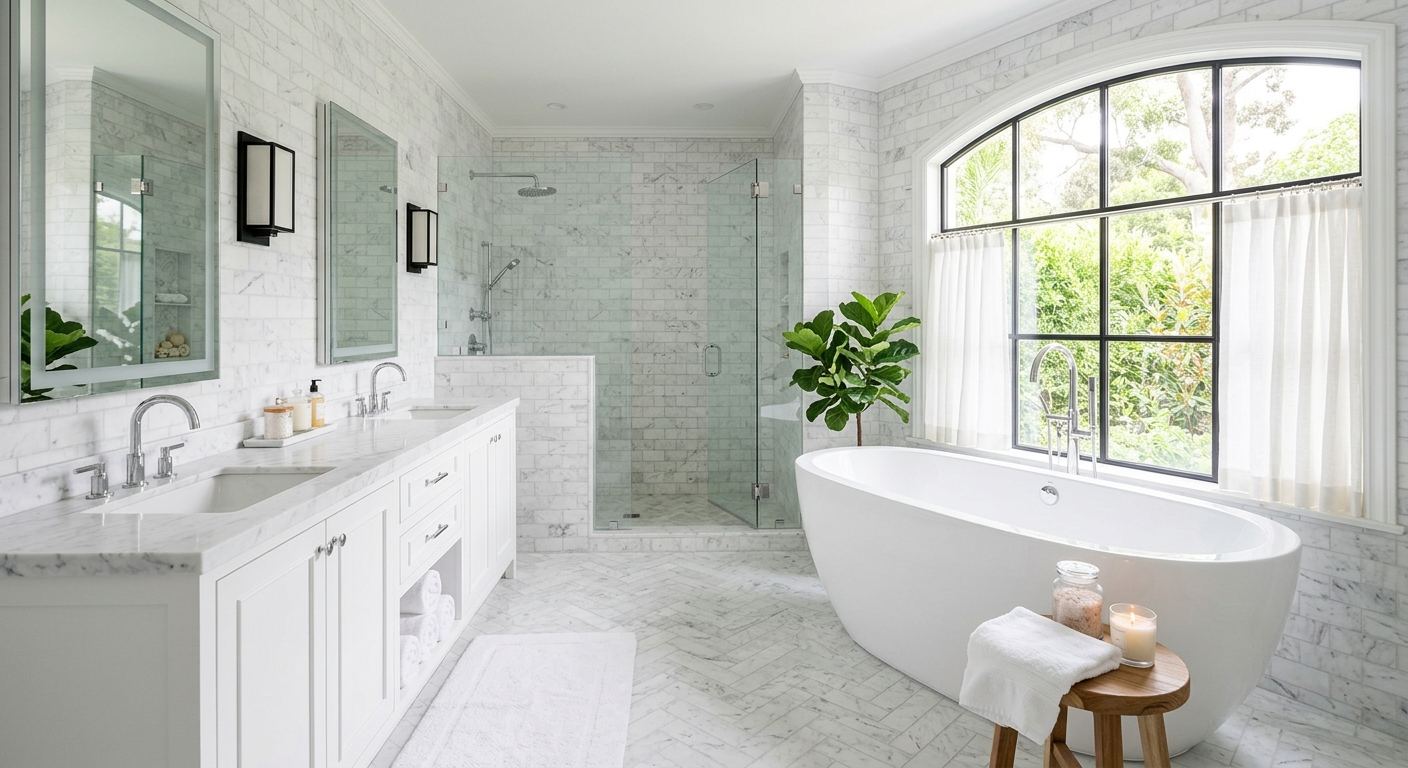
Bathroom renovation options and costs in Stratford
In Stratford, Ontario, bathroom renovations range from quick cosmetic updates to full rebuilds, and the right option depends on what you’ll tolerate once the room is opened up. With 64.5% of homes in the broader area built before 1981, many bathrooms sit on older drain and venting setups, dated waterproofing, and sometimes floor tile installations that can complicate demolition. Even when the visible finish looks fine, hidden scope can surface after tile comes off—cast-iron drains, copper supply lines, galvanized piping, or older materials that must be handled carefully.
Stratford–Bruce Peninsula pricing is also shaped by labour availability. When multiple renovations land in the same weeks, trades like plumbers, electricians, and tile setters can be booked ahead, and quotes reflect that scheduling pressure more than local weather. The region’s seasonal swings mean bathrooms are used year-round and ventilation matters; strong exhaust and correct waterproofing are key to preventing moisture problems over time.
Demand for bathroom work is especially steady around the Old East Village and parts of the downtown core, where homeowners often refurbish older detached homes. The most efficient path is usually to decide early whether you’re staying with the existing layout and drain location—because that single choice can move a project between the mid-teens and low-thirties for full renovations, versus narrower price bands for showers or tile-only work.
Use the table below to compare realistic scopes before you collect quotes.
| Renovation Scope |
What's Included |
Typical Duration |
Price Range |
| Cosmetic refresh (paint, fixtures, accessories only) |
New paint, lighting swaps, faucet/handle replacements, toilet seat or trim, towel bars, vanity accessories; no moving plumbing or retiling |
2–5 days |
$1,800–$6,000 |
| Mid-range full renovation (new tile, vanity, tub/shower, electrical) |
Remove finishes; install vanity and toilet; new tub/shower surround or tile walls; updated exhaust fan (as needed); electrical upgrades like GFCI; waterproofing and re-grouting |
2–4 weeks |
$14,000–$28,000 |
| High-end full renovation (custom tile, steam shower, heated floors) |
Custom layout finish work; premium waterproofing system; heated flooring circuit; designer fixtures; niche/bench details; possible plumbing/venting upgrades; upgraded lighting and ventilation |
4–7 weeks |
$28,000–$35,000 |
| Shower-only installation (convert tub to walk-in shower) |
Demo tub; new waterproof shower area; new shower pan/linear drain or pan conversion; glass or curtain-ready frame; new valve trim; exhaust/fan check |
1.5–3 weeks |
$7,500–$14,000 |
| Bathtub replacement or tub-liner install |
Remove and set tub replacement (or install quality liner system where appropriate); new surround finish; sealant and caulking; plumbing connections checked |
1–2 weeks |
$1,200–$5,000 |
| Tile-only installation (floor + surround, existing layout kept) |
Tile floor and walls; waterproofing to relevant wet areas; grout and silicone detailing; assumes plumbing stays where it is |
1–3 weeks |
$4,500–$18,000 |
Prices are estimates only and vary by project scope, site access and material selection.
What affects the price of bathroom renovation in Stratford
Even when two homeowners ask for the “same” bathroom reno, Stratford–Bruce Peninsula quotes can differ by 30–50% because the final price is tied to what must be corrected once demolition starts. In Ontario, labour rates and trade scheduling often swing faster than material costs, and older housing stock can force contractors to rebuild beyond the visible finishes. Stratford’s local profile reflects this reality: with 64.5% of homes built before 1981, you’re more likely to run into dated plumbing layouts, older venting, and subfloor conditions that require stabilization before tile can be installed.
In this region, climate isn’t the main driver—your bathroom cost is driven more by how well you can stop moisture, and by what’s uncovered behind tile. Poor substrate often means added prep and waterproofing work. For example, upgrading ventilation from a weak fan to code-compliant exhaust can be a small line item, but it becomes more expensive if electrical needs new wiring runs. Discovery is the cost multiplier: if asbestos-containing vinyl floor tile is present (common in pre-1985 builds), contractors may need abatement protocols. That typically pushes budgets up by about $1,500–$5,000+, depending on access and scope.
Concrete examples from Stratford jobs: (1) keeping the tub at the same wall and staying with existing plumbing keeps you closer to the lower end of full-reno bands—around $14,000–$28,000; (2) converting a tub to a walk-in shower with a linear drain often lands higher, because slope, membrane work, and plumbing rough-in are labour-heavy, pushing many projects toward $7,500–$14,000 for shower-only conversions. (3) large-format porcelain tile can look simple, but it demands a flatter substrate—if the floor is out of level, prep can add days.
That’s why identical square footage can price very differently in Stratford than in newer subdivisions.
| Price Factor |
Why It Matters |
Cost Impact |
| Layout change — moving drain or supply lines requires rough-in work |
Relocating plumbing means opening walls, adjusting venting, and re-establishing proper slopes |
Can add $3,000–$10,000 depending on distance and accessibility |
| Tile selection — large-format porcelain vs. mosaic vs. ceramic |
Material cost and labour complexity change with cutting, patterning, and grout lines |
Typically shifts budget by $1,200–$8,000 |
| Fixture tier — builder-grade vs. mid-range vs. designer brands |
Higher tiers cost more upfront and often include better valves, finishes, and trims |
Commonly $800–$6,000 difference for the same function |
| Subfloor condition — rot or unlevel concrete adds scope |
Tile and waterproof systems fail on movement; substrate repairs are essential |
Can add $1,500–$7,000 after inspection |
| Electrical — adding GFCI outlets, exhaust fan, heated floor circuit |
Code-compliant bathrooms need correct protection and safe ventilation wiring |
Often $600–$5,500, higher if rewiring is required |
| Waterproofing method — membrane type and extent |
Full coverage and correct tying into transitions prevent leaks and mould |
Typically $400–$3,500 difference depending on system |
| Older-home surprises — asbestos tile, cast-iron drains, galvanized pipes |
Hidden materials can trigger abatement; old piping can require replacement to modern standards |
Often $1,500–$5,000+, sometimes more if multiple issues appear |
| Bathroom size — sq ft drives tile and labour time directly |
More area means more waterproofing, thinset, labour hours, and cleanup |
Budget can move by $2,000–$12,000 across sizes |
Permits & regulations in Ontario
In Ontario, not all bathroom work needs a permit, but several common changes do. For Stratford homeowners, a “cosmetic-only” job—swapping a vanity, repainting, changing a faucet, replacing trim, or installing new accessories—usually does not require permits because you’re not changing plumbing, electrical circuits, or the structure. Similarly, replacing finishes in place (like retiling over existing surfaces) typically stays in the cosmetic lane if there’s no rough-in modification.
What does require a permit more often includes plumbing rough-in changes: moving a toilet, relocating a sink drain, changing where a shower valve sits, or altering the venting or supply routing. Adding or upgrading electrical components also commonly triggers permitting when new circuits are involved—especially adding or reworking an exhaust fan with new wiring, adding GFCI outlets, or installing a heated floor system. Any electrical work must meet Ontario electrical code and be performed by a licensed electrician or signed off appropriately.
Step-by-step: first, verify the contractor’s Ontario trade licence (where applicable to their trade) and confirm liability insurance. Next, request a certificate of insurance and check that coverage matches the work scope and dates. Then verify WSIB/WCB coverage: ask for clearance documentation or proof of coverage so you’re not left responsible if a worker is injured on-site. Finally, confirm who pulls permits—your quote should state whether permits and inspections are included or excluded.
Choosing tile, waterproofing and fixtures for your Stratford bathroom
For a Stratford bathroom, three material decisions usually determine whether you hit your budget or end up paying for “fixes to prevent fixes.” First is tile choice. Ceramic tile is a solid entry point for floors and walls, but it can be less forgiving if your subfloor isn’t dead flat. Porcelain tile is usually denser and handles daily use better, and mid-range porcelain often pairs well with reliable installation methods. Natural stone (marble, travertine, slate) looks premium, but it can require more precise cutting, sealing/maintenance considerations, and careful substrate prep—so the labour and detailing matter.
Second is waterproofing. Ontario bathrooms stay humid because shower steam and daily humidity are year-round realities, so waterproofing isn’t optional. A paint-on membrane can work in some systems, but a bonded sheet membrane or a properly detailed system (including the correct overlaps and corner/transition detailing) is what typically gives homeowners confidence when the job is done right. Third is fixture tier. Builder-grade valves and trims cost less upfront, but mid-range or designer options often reduce maintenance headaches later, especially with reliable cartridges and finishes that stand up to hard water.
To justify cost, consider a practical example: upgrading from entry ceramic to mid-range porcelain might add a few thousand dollars, but the increase is often “worth it” if you’re also doing the full waterproofing and you want a finish that will look sharp for longer. If your budget is tight, it’s often better to spend on waterproofing quality and installation than to chase luxury stone on a bathroom where layout stays unchanged.
Match your choices to your situation: if your home is older (many in Stratford are), prioritize substrate prep and waterproofing coverage because they prevent mould and costly tear-outs.
| Material / Option |
Pros |
Cons |
Price Range |
| Ceramic tile (floor + walls) |
Lower material cost, good variety of looks; generally straightforward for standard layouts |
More variation in durability by product; may be less forgiving for poorly leveled substrates |
$4,500–$10,500 |
| Porcelain tile (floor + walls) |
Hard-wearing, better for busy bathrooms; typically less prone to chipping; often more consistent for large formats |
Material can cost more; bigger panels require a flatter subfloor to avoid lippage |
$7,500–$18,000 |
| Natural stone (marble, travertine, slate) |
Luxury appearance; unique patterning; strong resale appeal |
More installation time; sealing/maintenance may be required depending on stone; higher breakage risk |
$12,000–$28,000 |
| Frameless glass shower enclosure |
Modern look, easy cleaning, can make smaller bathrooms feel larger |
More expensive glass/fasteners; requires precise wall alignment |
$1,800–$6,500 |
| Prefab tub surround (acrylic) |
Fast install; consistent surfaces; can reduce labour compared with full custom tile |
Fewer design options; less “craft” look than tile; seams require careful sealing |
$1,200–$5,000 |
| Custom shower pan (tile or linear drain) |
Best long-term performance when properly waterproofed; linear drain looks sleek and modern |
Labour-intensive: slope setting, membrane detailing, and drain trim precision |
$3,500–$12,000 |
How to choose a bathroom renovation contractor in Stratford
When you’re hiring a bathroom contractor in Stratford, start with proof—not promises. Verify Ontario licensing/eligibility for the trades involved, and request liability insurance documentation before work begins. Ask how they handle WSIB/WCB coverage and get written proof or a clearance letter so you’re protected if an incident happens on your property. If a contractor can’t provide these items promptly, it’s a sign to keep looking.
Next, get 2–3 itemised written quotes. You want labour and materials broken out (demo, rough-in/installation, waterproofing, tile setting, electrical/plumbing line items, disposal, and any permit work). Avoid “one number” lump sums where exclusions are unclear. Read the scope carefully: what’s included in demolition and drywall patching, who supplies cement board, is disposal and landfill included, and does the contractor include permit pull and inspections if required? For warranties, ask for workmanship warranty length and whether product warranties are provided by the manufacturer. If you plan to sell, confirm whether warranties are transferable.
Payment schedule matters. Avoid paying more than 10–15% upfront. Hold back the balance until the job is complete and deficiencies are corrected. Finally, insist on a written start date and an estimated completion window, because older homes often reveal unknowns once tile and finishes come off.
- Request current liability insurance and confirm coverage dates match your project.
- Verify WSIB/WCB clearance or proof of coverage in writing.
- Confirm which permits (if any) will be pulled and who pays for them.
- Get itemised labour/material quotes, not lump sums.
- Ask what’s included for waterproofing, transitions, and curb details.
- Confirm whether disposal and site cleanup are included.
- Require a written timeline: demolition start, rough-in, tile, and final install.
- Ask for tile and waterproofing product names and warranty terms.
- Check workmanship warranty length and how claims are handled.
- Insist on a sensible payment schedule (10–15% max deposit).
- Request examples of similar Stratford bathroom projects and references.
- Clarify how they handle hidden issues discovered after demo.
Red flags specific to Stratford bathroom renos: vague scopes (“we’ll see once we open it” without allowances), no written waterproofing plan, missing insurance/WSIB proof, payment requests that exceed 15% early, and contractors who won’t specify who is doing electrical/plumbing work when permits or code inspections apply.
Frequently asked questions — bathroom renovation in Stratford
How do I plan a bathroom renovation on a tight budget in Stratford?
If you’re budgeting for a Stratford, Ontario bathroom, the best strategy is to protect the areas that determine longevity: waterproofing and substrate prep. Choose a scope that limits change orders—keep the existing layout and don’t move the drain/supply lines unless you truly need to. That keeps you in the lower cost bands like a tile-focused project rather than a full rebuild. If you’re doing a full reno, many homeowners target the mid-range range of $14,000–$28,000 by reusing what’s serviceable (for example, staying with the same tub location) and selecting mid-range fixtures. Because many homes were built before 1981, plan a small contingency for hidden conditions behind tile—ask your contractor what they typically see during demo.
What's the difference between a cosmetic and a full bathroom renovation?
A cosmetic renovation in Stratford typically means changing finishes without relocating plumbing or doing major rough-in work. Think paint, lighting swaps, faucet and trim replacements, new accessories, and sometimes re-caulking. If you’re retiling but keeping the same surfaces and no plumbing is moved, some contractors still call it cosmetic; however, once you’re rebuilding the waterproofing system or opening walls for venting/supply changes, it moves toward a full renovation. A full bathroom renovation usually includes demolition, new waterproofing, updated electrical like GFCI and exhaust fan work where needed, and new fixtures and finishes. In pricing terms, cosmetic refreshes often run far below a mid-range full renovation (which commonly lands around $14,000–$28,000), while “open-up-and-fix” jobs can rise toward the upper band.
How do I choose the right contractor for my bathroom in Stratford?
Start with verification: ask for Ontario licensing/eligibility for the trades involved, and request liability insurance plus WSIB/WCB clearance or proof of coverage. Then compare itemised quotes—labour, materials, disposal, and whether permits are included—because two “same-size” bathrooms can differ hugely once older plumbing or subfloor issues are discovered. A good contractor will outline what’s excluded (for example, asbestos abatement or replacing cast-iron drains if encountered) and how they’ll price unknowns. Review warranty terms carefully: you want a written workmanship warranty plus product/manufacturer warranties, and clarity on whether they’re transferable. Finally, keep an eye on scheduling and communication; a contractor who can’t give a start date and completion estimate in writing is harder to trust.
What's the most common mistake homeowners make in bathroom renovations?
The most common mistake is under-budgeting for hidden scope and waterproofing details—especially in older Stratford homes. Homeowners may assume they’re “just replacing the tile,” but once demolition begins, contractors often discover issues like uneven subfloors, inadequate ventilation, older drain/venting needs, or sometimes asbestos-containing vinyl floor tile in pre-1985 installations. That’s where budgets jump, and it’s why quotes for the same visible finishes can vary. Another frequent mistake is choosing tile or fixtures first and waterproofing last. If you want the project to last through Ontario humidity and daily use, waterproofing and substrate work must be specified early. If you’re aiming for value, keep the layout stable and be ready for contingency—your contractor should explain what’s typical for homes built before 1981.
How long does tile installation take in a Stratford bathroom?
Tile installation timing depends on bathroom size, whether the layout changes, and how much substrate correction is needed. For many Stratford bathrooms where the layout stays the same, tile work is commonly a 1–3 week block within the overall project schedule. The time is usually driven by prep and waterproofing: cement board or substrate repairs, membrane cure times, and careful setting/drying. Larger-format porcelain or complex patterns can add cutting and leveling time, and a custom shower with a linear drain can extend the schedule due to slope setting and more detailed waterproofing transitions. Keep in mind that older housing may add extra days for corrections once tile comes off. If your contractor’s timeline is only based on “tile setting days” and ignores prep and cure, ask for a more complete breakdown.
How much does a bathroom renovation cost in Stratford?
Bathroom renovation costs in Stratford generally fall into Ontario project bands, but the final number depends on scope and hidden conditions common in older homes. As a practical benchmark for this area, a full bathroom renovation typically lands in the $14,000–$35,000 range. Shower-only conversions (like turning a tub into a walk-in) commonly budget around $7,500–$14,000, while bathtub replacements can be closer to $1,200–$5,000 depending on whether it’s a simple swap or part of a bigger rebuild. Stratford has a homeowner-leaning market—65.8% of households are homeowners (Statistics Canada, 2021 Census)—so contractors are often busy with remodels, and labour availability can influence timing and pricing. If your home was built before 1981, build in contingency for subfloor and plumbing/venting discoveries.