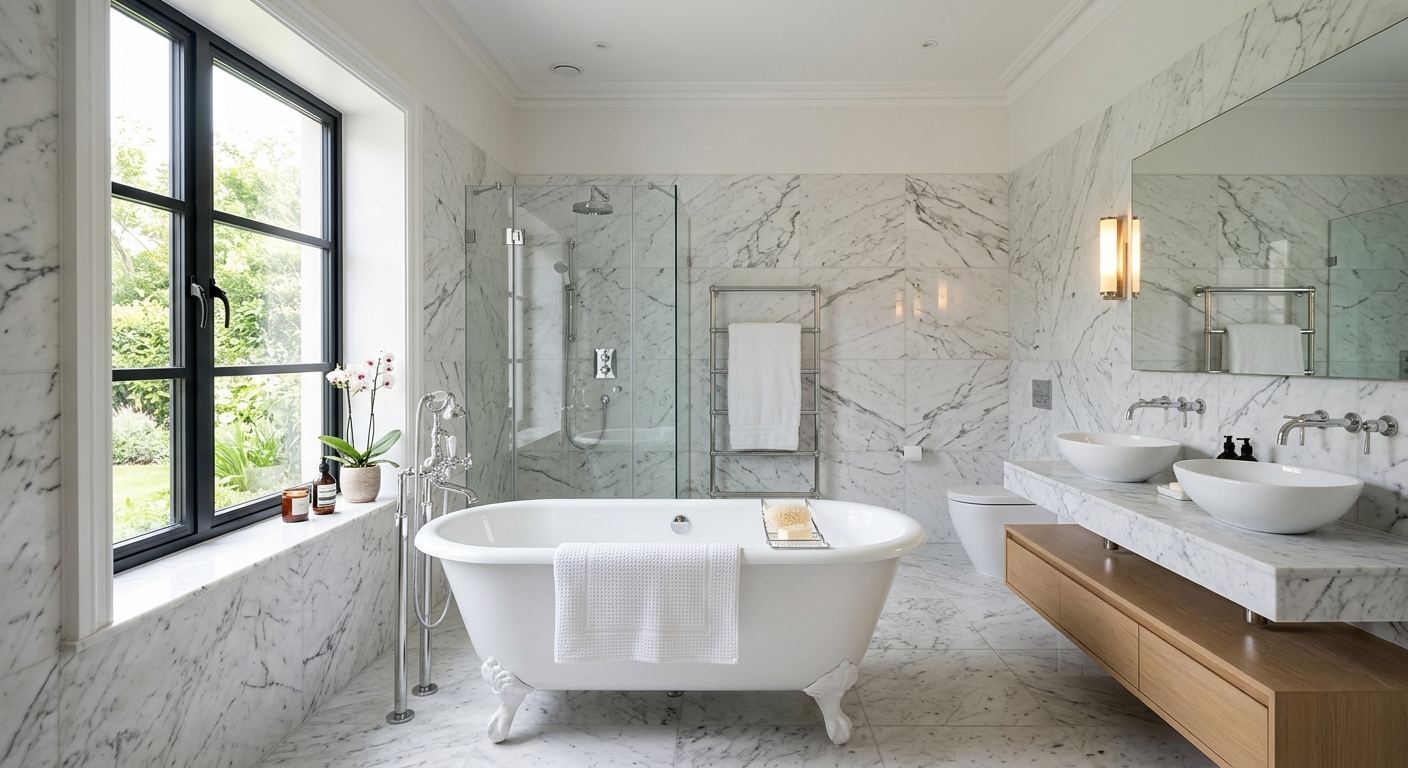
Bathroom renovation options and costs in Elmira
Elmira homeowners have several bathroom-reno routes, and the right choice depends on how much you want to change—and what’s hiding behind the existing walls. With Elmira’s housing base of many post-war and earlier homes that pre-date today’s plumbing layouts, you often see dated drain routing, older shut-offs, and—when floor coverings are disturbed—potential asbestos-containing materials in some floor tile or related compounds (Statistics Canada, 2021 Census). In the Toronto economic region, renovation pricing is shaped far more by labour intensity and contractor availability than by climate alone. Skilled trades in the GTA typically command a premium hourly rate, so even “simple” work like retiling can land higher than national averages.
That labour premium matters most in Elmira for tiling, custom showers, and any plumbing/venting correction needed to match current Ontario code. We also see demand rising where older neighbourhood homes have tightly built-in bathrooms and fewer service clearances—such as in the older core areas and mature subdivisions around Elmira’s residential pockets—because contractors can’t avoid opening walls and subfloors to do it properly. Once walls and floors are opened, surprises can change the scope quickly, like cast-iron or undersized drain sections that need reconfiguration, galvanized supply lines that need replacement, or additional electrical for modern exhaust fans.
Below is a practical way to compare common renovation options and their realistic budget ranges. Use it to start your conversation with contractors before you lock in fixtures and finishes.
| Renovation Scope |
What's Included |
Typical Duration |
Price Range |
| Cosmetic refresh (paint, fixtures, accessories only) |
New paint, vanity surface refresh or vanity replacement (no moving plumbing), toilet/vanity top swap, tap/handle replacement, accessories (towel bar, mirror), deep clean and caulking touch-ups |
3–6 days |
$3,000–$7,000 |
| Mid-range full renovation (new tile, vanity, tub/shower, electrical) |
Demo, new wall and floor tile, vanity and mirror, tub-to-shower updates, new or refreshed waterproofing, exhaust fan upgrade, basic electrical updates (GFCI as needed), plumbing fixture replacement with tie-ins as-is where possible |
2–3 weeks |
$12,000–$20,000 |
| High-end full renovation (custom tile, steam shower, heated floors) |
Custom waterproofed shower with upgraded layout, premium tile installation (including niche/bench as required), steam-ready electrical plan, heated floors where feasible, high-end fixtures, refined trim, more complex plumbing and venting adjustments if needed |
3–5 weeks |
$20,000–$30,000 |
| Shower-only installation (convert tub to walk-in shower) |
Remove tub, install walk-in shower pan or waterproofed base, new tile walls, glass enclosure (if selected), plumbing tie-ins for new shower valve/drain, exhaust fan check/upgrade as needed |
1.5–3 weeks |
$10,000–$16,000 |
| Bathtub replacement or tub-liner install |
Tub replacement (or tub-liner system), surface prep, trim, recaulk and test for leaks, basic plumbing connection work, minor tile touch-up where required |
5–10 days |
$1,200–$3,500 |
| Tile-only installation (floor + surround, existing layout kept) |
Tile removal and reinstallation of floor and/or shower surround, waterproofing (as required), grout/caulking, sealing where applicable, limited drywall repair |
1–2 weeks |
$3,000–$10,000 |
Prices are estimates only and vary by project scope, site access and material selection.
What affects the price of bathroom renovation in Elmira
In Elmira and across the Toronto economic region, two quotes for “the same bathroom” can differ by 30–50% because bathroom work is labour-intensive and highly dependent on what’s discovered once we open walls and floors. Climate plays a smaller role here than in places with extreme freeze-thaw patterns; in Ontario, the bigger cost drivers are the GTA’s skilled-trade labour rates, the complexity of tiling and waterproofing, and the age of the housing stock. Many older homes in the Toronto region are built with plumbing and venting details that don’t align neatly with today’s expectations, so drain reconfiguration, vent corrections, and new shut-offs can add several thousand dollars before you even choose your tile.
Older homes can also hide labour-impacting materials. If asbestos-containing materials are identified during demolition—particularly in pre-1985 floor coverings—you may need licensed abatement, which commonly adds $1,500–$5,000+ depending on extent. Another example: if galvanized supply lines are present, replacing portions to prevent future leaks can expand scope even if fixtures themselves are “mid-range.”
Two concrete Elmira scenarios I see often: (1) keeping the existing layout but replacing tile floors and a tub/shower valve can land in the tile installation and fixture band (for instance, tile-only at $3,000–$10,000 and a bathroom refresh around $12,000–$20,000 once electrical is corrected); (2) a layout change—moving drains or adding a new exhaust fan with ducting and electrical—pushes labour and permit complexity, nudging many projects toward the higher full-reno range of $20,000–$30,000. The cost impact is usually larger than swapping one type of tile for another because workmanship and rework risk dominate in the GTA.
| Price Factor |
Why It Matters |
Cost Impact |
| Layout change — moving drain or supply lines requires rough-in work |
Re-routing plumbing means additional demolition, inspection coordination, and new drain/vent tie-ins |
Often +$3,000 to +$10,000+ depending on how far lines move |
| Tile selection — large-format porcelain vs. mosaic vs. ceramic |
Harder materials and larger panels require more precision cuts, more setbacks, and longer install time |
Typically +$1,000 to +$6,000 |
| Fixture tier — builder-grade vs. mid-range vs. designer brands |
Higher tiers cost more and sometimes require different trims, valves, and installation accessories |
Typically +$500 to +$4,000 |
| Subfloor condition — rot or unlevel concrete adds scope |
Weak or uneven substrate increases prep time and may require replacement underlayment or framing |
Typically +$800 to +$5,000 |
| Electrical — adding GFCI outlets, exhaust fan, heated floor circuit |
Modern bathrooms need safe circuits and properly controlled ventilation; heated floors add dedicated wiring |
Typically +$1,200 to +$6,000 |
| Waterproofing method — membrane type and extent |
Correct waterproofing prevents mould and failed grout joints; better systems can cost more but reduce failure risk |
Typically +$500 to +$3,000 |
| Older-home surprises — asbestos tile, cast-iron drains, galvanized pipes |
Discovery triggers abatement and/or plumbing replacement to pass inspections and avoid leaks |
Often +$1,500 to +$12,000+ for extreme cases |
| Bathroom size — sq ft drives tile and labour time directly |
More surface area means more tile, more thinset/grout, more backer prep, and longer setting and drying times |
Typically +$2,000 to +$9,000 across common size differences |
Permits & regulations in Ontario
In Ontario, the permit picture depends on how much you change. In general, cosmetic updates—like swapping a vanity, replacing fixtures in the same locations, painting, or retiling without moving plumbing—often do not require permits. However, if you relocate plumbing (moving a drain or changing where supplies connect), add or rework ventilation with new wiring, or make structural changes (like cutting into walls for new framing or openings), you should expect permits and inspections.
Electrical work must meet Ontario code and be performed by a licensed electrician or signed off by one. For bathrooms, that’s commonly relevant when you add a GFCI outlet, replace an exhaust fan that needs new circuit work, or install heated-floor wiring. Plumbing rough-ins that change routes, drains, or venting typically require permits and inspections before walls are closed.
Step-by-step for Elmira homeowners:
- Ask for the contractor’s Ontario trade licence number and verify it using the provincial online registry for the relevant trade.
- Request a certificate of insurance before you sign—confirm liability coverage is active and ask whether they carry coverage for their subcontractors.
- Ask how they handle WSIB/WCB compliance for their crew; then verify the coverage clearance letter or proof they provide.
- Get a permit plan in writing: which permits are pulled, who pulls them, and what inspections are scheduled (rough-in and final are common).
- Confirm that any electrician and plumber used are properly licensed and listed under the job scope.
Doing this up front protects you from delays, failed inspections, and uncovered work if something goes wrong behind the finished surfaces.
Choosing tile, waterproofing and fixtures for your Elmira bathroom
Your biggest budget swings in an Elmira bathroom renovation usually come from three material decisions: tile choice, waterproofing method, and fixture tier. First, tile: entry-level ceramic can keep material costs down, but it’s the install details that truly matter—proper substrate, layout planning, and water management at transitions. Porcelain is denser and often more consistent for floors and walls; it’s a strong mid-range pick because it resists staining and handles bathroom moisture better. Natural stone (marble, travertine, slate) looks premium, but it needs careful selection and sealing routines, and it can be more time-consuming to cut and fit around niches, corners and glass.
Second, waterproofing: Ontario bathrooms see frequent humidity from showers and everyday use, so the waterproofing system has to be chosen with real expectations in mind. A paint-on membrane can work in some scenarios, but many homeowners are happier long-term with a bonded sheet membrane or a proven shower system approach, especially when you’re building a tiled shower with linear drains, benches, or multiple transitions. The right method reduces mould risk and helps grout lines last.
Third, fixtures: builder-grade units hit the budget-friendly end, while mid-range and designer brands can improve comfort, flow, and resale appeal. Here’s where the dollars make sense: spending the labour to install higher-quality waterproofing and properly tiled surfaces often justifies more than “upgrading” to luxury fixtures while keeping a mediocre installation plan. For example, a shower project that sits in the $4,000–$12,000 shower installation band can be worth it to move from basic tile choices to porcelain plus a robust waterproofing system if it prevents early rework.
| Material / Option |
Pros |
Cons |
Price Range |
| Ceramic tile (floor + walls) |
Good entry-level affordability, many style options, straightforward to source locally |
More prone to staining and can be less durable than porcelain for high-traffic floors |
$3,000–$7,000 |
| Porcelain tile (floor + walls) |
Denser and typically better moisture/stain resistance, fewer issues with colour consistency, ideal for floors |
Can be more expensive and requires careful layout for large-format pieces |
$5,000–$10,000 |
| Natural stone (marble, travertine, slate) |
Premium look and depth, timeless appeal |
More maintenance (sealing), can be higher labour due to fitting and variation |
$8,000–$16,000 |
| Frameless glass shower enclosure |
Modern, bright look; typically easier to clean |
Glass and hardware add cost; requires accurate waterproofing edges and strong wall prep |
$2,500–$6,000 |
| Prefab tub surround (acrylic) |
Quick install, fewer grout joints, good for keeping costs controlled |
Limited design flexibility; may not match custom-tile aesthetics |
$1,200–$3,500 |
| Custom shower pan (tile or linear drain) |
Best long-term performance when built correctly; easier to create low-threshold layouts; linear-drain look |
More labour and waterproofing complexity; needs accurate slope and drain placement |
$4,000–$12,000 |
How to choose a bathroom renovation contractor in Elmira
Choosing the right contractor in Elmira is mostly about verification and clarity. Start by confirming Ontario licensing and coverage. For licensing, ask for the contractor’s Ontario trade licence number and verify it through the provincial online registry for their trade category. Next, request their certificate of liability insurance and confirm it’s current for the project dates. For worker protection, ask for WSIB/WCB compliance—then verify the clearance letter or proof they provide matches the business performing the work.
Then get 2–3 itemised written quotes. You want line items that separate labour, demo, waterproofing, tile setting, electrical, plumbing rough-in/tie-ins, disposal and any permit handling. Avoid quotes that bundle everything into one lump sum without showing what’s included. Read the scope for exclusions: is drywall repair included, is curb/threshold work included, are niche and bench cuts included, is mould remediation excluded, and is permit pulling included in the contractor’s service or added as a separate line?
Warranty matters too. Ask for the length of the workmanship warranty (not just product warranties) and whether it’s transferable to you if you sell your home. For payment schedule, never pay more than about 10–15% upfront; a holdback until key milestones are complete is standard practice for bathroom projects where waterproofing and tile setting quality must be verified. Finally, require a start date and realistic completion estimate in writing, including tile lead times and drying/curing periods.
- Ask for licence numbers and verify them online.
- Request certificate of liability insurance and confirm limits.
- Verify WSIB/WCB clearance letter or proof coverage applies to the job.
- Get 2–3 itemised quotes with labour and materials broken out.
- Confirm whether permits are pulled and who schedules inspections.
- Check what disposal includes (dump fees, drywall/tile haul-away).
- Demand written scope for waterproofing method and coverage area.
- Ask for the warranty on workmanship and how long it lasts.
- Clarify who supplies tile, thinset, membranes, and backer board.
- Confirm whether electrical and plumbing subcontractors are licensed.
- Agree on payment milestones tied to waterproofing, rough-in, and completion.
- Request a timeline that includes cure/dry times before grouting and caulking.
Red flags: contractors who won’t provide licence/insurance documents, quotes that omit waterproofing details, payment schedules asking for large deposits up front, “free” change orders with vague allowances, and failure to provide a written start/completion timeline or inspection plan.
Frequently asked questions — bathroom renovation in Elmira
What's the difference between a cosmetic and a full bathroom renovation?
In Elmira, a cosmetic renovation usually means updating surfaces and visible fixtures without changing plumbing or structural layout. That typically includes repainting, swapping a vanity or mirror, replacing trim/accessories, and sometimes retiling limited areas. A full bathroom renovation goes further: it includes demo down to the rough substrate, replacing tile across floors and walls, updating waterproofing systems, refreshing or rerouting plumbing fixtures, and often improving ventilation and electrical. Full renos in the Toronto economic region commonly sit in the low-to-mid five-figure range—think $12,000–$20,000 for many mid-range projects—because labour and inspection-ready plumbing/electrical coordination are the real drivers. The key difference is scope and risk: full renos expose what’s behind the walls, which is where surprises can affect budget and timeline.
How do I choose the right contractor for my bathroom in Elmira?
Start with verification. Ask for the contractor’s Ontario trade licence and verify it in the provincial online registry. Request a certificate of liability insurance and confirm it covers the work at your Elmira address. Then ask for WSIB/WCB proof (clearance letter or coverage verification) before work begins. After that, get 2–3 itemised quotes—labour and materials separated—so you can compare the waterproofing method, tile installation approach, disposal, and whether permits are included. A contractor worth hiring will explain what’s included in the scope and what’s excluded (for example, whether drywall patching is included after tile or whether electrical for a new exhaust fan is part of the package). For budgeting, ensure your quote aligns with realistic bathroom renovation bands such as $12,000–$30,000 depending on finish level and plumbing complexity in the region.
What's the most common mistake homeowners make in bathroom renovations?
The most common mistake I see in Ontario—especially in older Elmira homes—is focusing on finishes while under-budgeting for the “hidden work” once walls and floors are opened. Homeowners might choose premium tile or fixtures but skip a realistic plan for waterproofing, ventilation, or plumbing corrections. In the Toronto region, older drain stacks, galvanized supply lines, and ventilation gaps can require updates to meet today’s expectations, adding cost even if the layout seems unchanged. Another frequent issue is not specifying the waterproofing system details in the contract, leading to misunderstandings about membrane type, coverage, and how transitions are sealed. Finally, some homeowners agree to incomplete scope for electrical—like assuming an exhaust fan will work without confirming wiring and safe circuit requirements. A professional quote should protect you from these pitfalls by tying waterproofing and rough-in work to a clear, inspectable scope.
How long does tile installation take in a Elmira bathroom?
Tile timing in Elmira depends on bathroom size, tile format (mosaic vs. large-format porcelain), surface condition, and—most importantly—how long waterproofing needs to cure before tiling and grouting. In many mid-range full renos, tile work is typically spread across roughly 5–10 working days, while the overall project is usually 2–3 weeks because demo, prep, waterproofing, and cure times take place around the tile schedule. If you’re doing tile-only work (floor and surround with the layout kept), it may take about 1–2 weeks total depending on substrate repairs. Larger-format or custom shower layouts add cutting and layout time, so production can slow. If your contractor compresses drying/cure periods to “save time,” that’s usually a cost-saving mistake that can show up later as grout cracking or waterproofing failure.
How much does a bathroom renovation cost in Elmira?
For Elmira homeowners, a realistic budget usually falls into Ontario/GTA pricing realities where labour and the age of housing stock drive cost more than climate. A mid-range full renovation commonly lands in the $12,000–$20,000 range, especially when you’re updating tile, a vanity, and fixtures and doing necessary electrical/ventilation corrections. If you choose higher-end finishes (custom showers, heated floors, premium tile, and more complex plumbing/electrical), costs often move into $20,000–$30,000. If you’re focused only on surfaces, cosmetic refresh projects can be much lower, while tile-only work often sits around $3,000–$10,000 depending on how extensive the tile coverage is and whether waterproofing scope is included. The fastest way to get a dependable number is an itemised quote that includes waterproofing, disposal, and any plumbing/electrical tie-in assumptions.
How long does a bathroom renovation take in Elmira?
A typical bathroom renovation in Elmira takes about 2–3 weeks for many mid-range full renovations, assuming materials are available and no major surprises are uncovered during demo. High-end projects with heated floors, steam-ready elements, or a more complex custom shower often run 3–5 weeks because there are more workmanship steps and more drying/curing stages between waterproofing, tile installation, and final sealing. Shower-only conversions (like converting a tub to a walk-in shower) often land around 1.5–3 weeks depending on glass enclosure lead times and drain/plumbing tie-ins. Cosmetic refresh work can be faster—often several days—because there’s less demo, less rough-in, and less curing. In the Toronto region, older-home discoveries (like drain condition or electrical upgrades) can add time, so it’s smart to include buffer when you schedule your reno around your household needs.