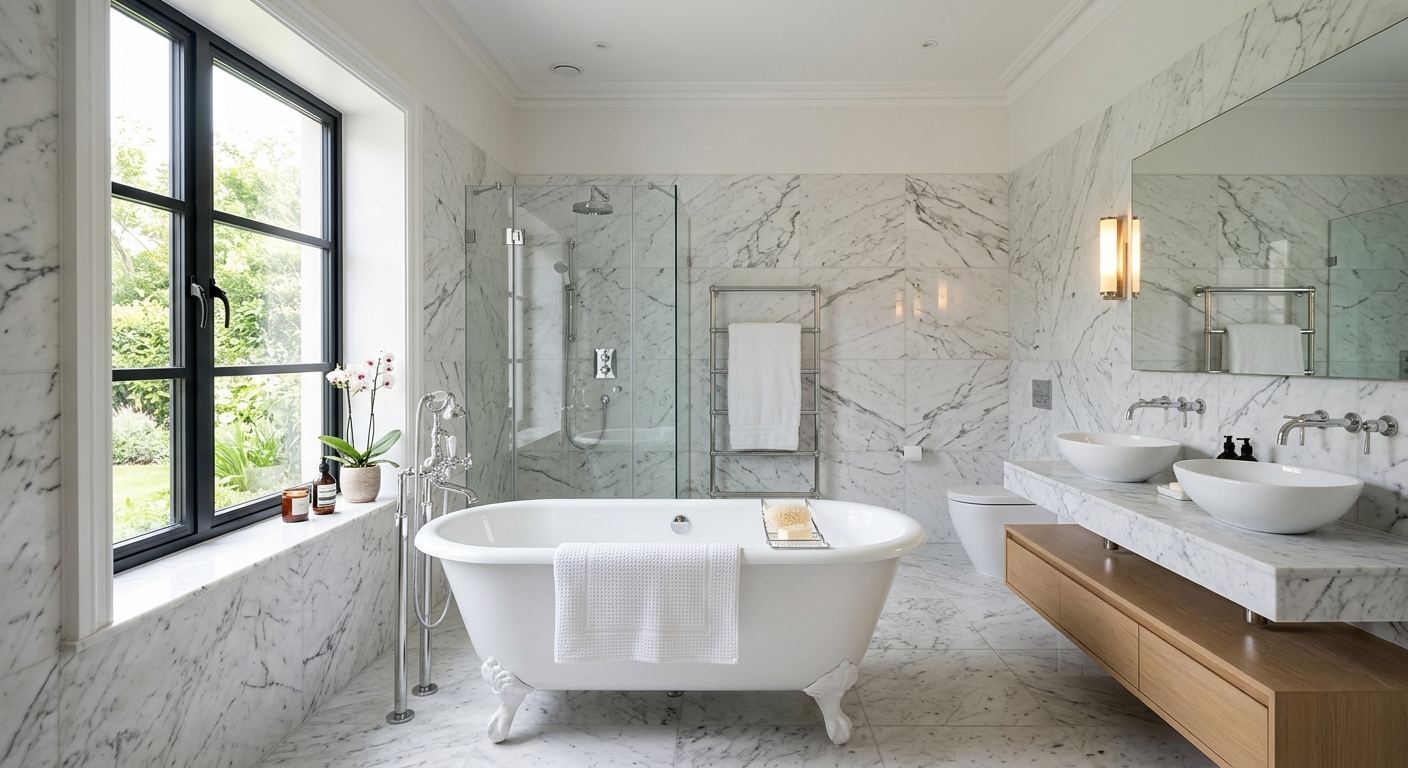
Bathroom renovation options and costs in Peterborough
Bathroom renovations in Peterborough typically start with a clear choice: cosmetic refresh, a mid-range full renovation, or a higher-end build. With 63.7% of homes in the Muskoka–Kawarthas area built before 1981 (Statistics Canada, 2021 Census), many bathrooms aren’t just “dated”—they often have older drain layouts, firmer subfloor tolerances, and venting that may not meet today’s expectations. In older floors and wet-area walls, we sometimes uncover brittle materials and, in some cases, asbestos-containing tile or backing from mid-20th-century installs.
Cost in this region is driven less by extreme climate and more by labour availability and multi-trade coordination. Peterborough trades and contractors generally price slightly under major GTA rates, but the 2026 Ontario labour market still makes plumbing + electrical + tiling coordination the biggest cost driver. If your contractor finds cast-iron or galvanized components during demo, or inadequate exhaust ducting, the scope expands quickly—often shifting a “$15,000 project” into a full renovation level (and sometimes beyond) once re-piping or re-venting is required.
We also see higher demand for bathroom work in areas with a lot of older in-town housing stock and busy rental turnover, including the East City and Downtown core around George Street. From there, the easiest way to compare quotes is to line up the renovation scope, duration, and typical budget ranges—then match your selections to your home’s condition. Use the table below as your budgeting baseline for Peterborough homes.
| Renovation Scope |
What's Included |
Typical Duration |
Price Range |
| Cosmetic refresh (paint, fixtures, accessories only) |
New vanity or faucet (no plumbing relocation), toilet/lighting swap (no circuit changes), paint, accessories, deep clean, caulking renewal where needed |
3–7 days |
$2,500–$6,500 |
| Mid-range full renovation (new tile, vanity, tub/shower, electrical) |
Demo and disposal, updated vanity and toilet, new tub + surround or alcove shower package, tile floor and key walls, new exhaust fan (with wiring where needed), GFCI upgrades, water-resistant backer and waterproofing, basic carpentry trim, prime/paint |
2–3 weeks |
$12,000–$20,000 |
| High-end full renovation (custom tile, steam shower, heated floors) |
Custom shower system (tile/linear drain), premium porcelain or stone, heated floors (proper electric mat/circuit), upgraded waterproofing build-up, designer vanity, upgraded lighting, premium hardware, expanded electrical planning, reinforced framing where required |
3–5 weeks |
$20,000–$28,000 |
| Shower-only installation (convert tub to walk-in shower) |
Remove tub, rough-in adjustments as needed, new walk-in shower base or custom pan, tile walls and floor, grab-bar blocking (if requested), exhaust fan check and rework if required, new valves/trim, waterproofing and sealing |
1.5–3 weeks |
$4,500–$9,000 |
| Bathtub replacement or tub-liner install |
Remove and replace tub (or install liner where appropriate), new trim and caulking, leak test, recaulk and touch-up paint, basic surround refresh, drain/overflow connection checks |
3–7 days |
$800–$2,500 |
| Tile-only installation (floor + surround, existing layout kept) |
Floor tile and selected wall tiling, waterproofing upgrades within tile area, underlayment/cement board where needed, grout/caulk finish, silicone transitions |
1–2.5 weeks |
$1,500–$4,500 |
Prices are estimates only and vary by project scope, site access and material selection.
What affects the price of bathroom renovation in Peterborough
In Peterborough and the wider Muskoka–Kawarthas region, two homeowners can receive quotes that differ by 30–50% for the “same” bathroom—because the real variable isn’t the tile colour, it’s the hidden work that appears once the wall and floor come apart. Regional labour rates and the age of the housing stock are the main drivers. Here, many homes are older (63.7% built before 1981 in the Muskoka–Kawarthas area per Statistics Canada, 2021 Census), which means dated drain stacks, older supply lines, and venting that doesn’t always dry the space the way today’s bathroom fans can.
When we uncover cast-iron or copper drain sections that won’t align with modern fittings, re-piping becomes necessary. Similarly, galvanized supply lines or undersized venting can trigger scope increases: the contractor may need new shutoffs, upgraded drainage routing, and re-venting to support safe discharge. Another common budget swing is asbestos in flooring or old drywall compound on some pre-1985 homes; once identified, abatement protocols can add $1,500–$5,000+ depending on what’s affected and how it’s removed.
Three local examples we see often in Peterborough: (1) a “like-for-like” tub-to-shower swap costs more if the drain needs to be lowered or shifted; (2) a tile-only job becomes more expensive if the subfloor is out of plane and needs prep to avoid cracked grout; and (3) exhaust upgrades can add cost when duct runs are longer than expected or when the fan requires dedicated wiring and a compliant location. Budgeting for a mid-range full renovation (often $12,000–$20,000) or a higher-end build ($20,000–$28,000) is usually the safe range if your home is older and you want new waterproofing and a properly integrated electrical plan.
| Price Factor |
Why It Matters |
Cost Impact |
| Layout change — moving drain or supply lines |
Requires rough-in work, patching and re-waterproofing around new penetrations |
Often +$2,000–$8,000 depending on distance and wall access |
| Tile selection — large-format porcelain vs. mosaic vs. ceramic |
Harder tile needs more precise cutting, extra labour and sometimes more waste |
Typically +$500–$3,500 |
| Fixture tier — builder-grade vs. mid-range vs. designer brands |
Valve/trim quality affects installation time and finish options; premium hardware costs more |
Typically +$300–$4,000 |
| Subfloor condition — rot or unlevel concrete adds scope |
Weak or uneven bases can’t support tile; structural prep and rebuild are required |
Often +$800–$4,500 |
| Electrical — adding GFCI outlets, exhaust fan, heated floor circuit |
Must be code-compliant and properly protected; may need circuit planning |
Typically +$600–$3,500 |
| Waterproofing method — membrane type and extent |
Better systems reduce mould risk and call-backs; more full-coverage prep takes time |
Typically +$700–$3,000 |
| Older-home surprises — asbestos tile, cast-iron drains, galvanized pipes |
Triggers specialized removal, disposal, testing and potentially repipe work |
Often +$1,500–$10,000+ in severe cases |
| Bathroom size — sq ft drives tile and labour time directly |
More area means more substrate, more layout time and more grout/waterproofing |
Typically +$1,000–$6,000 |
Permits & regulations in Ontario
In Ontario, many straightforward updates don’t require a permit—especially when plumbing and electrical locations are left unchanged. Cosmetic work such as replacing a vanity, swapping a toilet, re-caulking, painting, replacing accessories, or retiling with the same fixture locations typically falls under “renovation” rather than a regulated scope that needs municipal approvals. However, permits are usually required when you relocate plumbing (moving a drain or water supply line), add new plumbing fixtures, change structural walls, or make electrical changes that extend beyond simple replacements.
Electrical work also matters: any new circuits, new exhaust fan wiring, or upgrades that require circuit changes must meet Ontario electrical code and be completed (or signed off) by a licensed electrician. Plumbing rough-in adjustments typically require a permit and inspection so the work is verified before walls and floors close up.
For Peterborough homeowners, here’s a practical way to verify a contractor before you start: (1) Ask for their Ontario trade licence number and check it through the appropriate provincial online registry; (2) Request a current certificate of insurance showing liability coverage and, when applicable, confirmation they carry WSIB/WCB coverage for their workers; (3) For plumbing or electrical changes, ask whether they will pull permits, and get the permit numbers and inspection schedule in writing; (4) Verify the wording on their “clearance letter” documentation if they provide proof of coverage; and (5) Confirm warranty terms before payment milestones begin.
Choosing tile, waterproofing and fixtures for your Peterborough bathroom
In Peterborough, your bathroom budget is shaped by three big material decisions: tile, waterproofing, and fixtures. First is tile choice. Entry-level ceramic is usually the most affordable in material costs, but it can be more sensitive to cleaning chemicals and may require more frequent replacement of smaller cracked areas in heavier-use households. Porcelain costs more but handles moisture and temperature swings better, which is valuable in Ontario bathrooms that spend long periods humid. Natural stone (marble, travertine, slate) looks premium, but it’s labour-intensive—additional sealing, careful layout, and specialist finishing often push installation complexity and cost up quickly.
Second is waterproofing. In Ontario’s humidity, the waterproofing system is what prevents mould behind walls—not the grout. Paint-on membranes can be cost-effective in limited applications, but bonded sheet membranes or a properly detailed system (including compatible substrates and seams) generally provide more robust protection. A correct build-up also accounts for corners, niches, and transitions around shower valves and linear drains.
Third is fixture tier. Builder-grade fixtures may fit a tight budget, but premium valves, better showerheads, and higher-quality finishes often reduce maintenance and improve resale appeal in a market where many homes are older. For example, paying the incremental cost for porcelain tile and a higher-quality membrane can be justified if you’re already funding a full renovation; choosing low-end materials on the waterproofing layer usually isn’t, because the labour cost to open everything again is where the real money goes.
To match your budget in Peterborough, align scope with your materials: if your home is older and you expect re-venting and updated waterproofing, a mid-range full renovation foundation ($12,000–$20,000) often supports durable porcelain + proven waterproofing without pushing into full high-end spending ($20,000–$28,000).
| Material / Option |
Pros |
Cons |
Price Range |
| Ceramic tile (floor + walls) |
Lower material cost, wide style selection, good for budget renovations when properly installed |
May chip or wear faster than porcelain; more variation in size can increase layout time |
$1,500–$3,000 |
| Porcelain tile (floor + walls) |
Higher moisture resistance, durable surface for busy households, ideal for modern shower builds |
Costs more per sq ft; larger formats can increase waste if your layout is tight |
$2,500–$4,500 |
| Natural stone (marble, travertine, slate) |
High-end look, unique veining, great for statement bathrooms |
Needs sealing/maintenance; labour and finishing time is higher; can be more expensive overall |
$4,000–$7,500 |
| Frameless glass shower enclosure |
Brightens the space, modern look, easier visual maintenance |
Premium hardware costs; needs careful measuring and proper waterproof detailing |
$1,500–$4,000 |
| Prefab tub surround (acrylic) |
Faster install, often less labour than full tile walls, consistent finish |
Not as customizable as tile; seams and fixtures require correct caulking strategy |
$800–$2,500 |
| Custom shower pan (tile or linear drain) |
Best integration with your layout, cleaner drainage with linear options, top-tier waterproofing potential |
More labour and detailing; higher skill required for proper slope and drain alignment |
$3,500–$9,000 |
How to choose a bathroom renovation contractor in Peterborough
Choosing the right contractor in Peterborough comes down to proof: licensing, coverage, clear scope, and timelines you can hold them to. First verify Ontario licensing. For trade work that affects plumbing and electrical, ask for the contractor’s Ontario trade licences and the licence numbers they’ll work under. Then confirm liability insurance—request a current certificate of insurance and make sure the coverage is active for the project dates. For worker coverage, ask for WSIB/WCB documentation (and a clearance letter when applicable) so you’re not exposed if something goes wrong on site.
Next, get 2–3 itemised written quotes. You want breakdowns by labour and materials, not just a single lump sum. Make sure your quote includes: permit pull responsibility (if required), disposal/hauling, and what’s excluded (subfloor rebuild, waterproofing upgrades, electrical rework, or asbestos testing/abatement if discovered). A good warranty is specific: workmanship warranty length, product/manufacturer warranty details, and whether any warranties are transferable if you sell the home.
Finally, protect your cash flow. Never agree to pay more than 10–15% upfront. Use a schedule that releases the balance as milestones are completed, and keep a holdback until finishing items and punch-list corrections are done. Also insist on a start date and completion estimate in writing—bathrooms often stall when tile deliveries or inspections are delayed, and you should know who controls the schedule.
- Verify Ontario licence numbers and the trades they will actually use
- Confirm active liability insurance before any work begins
- Ask for WSIB/WCB coverage proof for workers (clearance letter when applicable)
- Get at least 2–3 itemised quotes (labour + materials), not lump sums
- Ensure disposal/hauling is included in the quote
- Confirm whether permits are required for your scope and who pulls them
- Check exclusions: subfloor repair, waterproofing upgrades, re-venting, asbestos testing/abatement
- Look for a detailed schedule: demolition, rough-in, waterproofing, tile setting, trim, final inspection
- Confirm warranty terms in writing (workmanship + product)
- Require a payment schedule with a 10–15% max upfront and a holdback
- Ask how they handle change orders and who approves them in writing
- Confirm cleanup standards: daily dust control and end-of-job wipe-down
Red flags in Peterborough that I’ve seen derail bathrooms: vague scopes that omit waterproofing details, quotes that don’t mention permits when plumbing/electrical is moving, refusal to provide insurance/WSIB documentation, “rock-bottom” pricing that appears to exclude disposal or electrical sign-off, and a payment request that asks for most of the money upfront with no holdback for completion.
Frequently asked questions — bathroom renovation in Peterborough
Is it worth renovating a bathroom before selling in Peterborough?
Often, yes—if you’re updating the parts buyers notice and can value immediately. In Peterborough, many homes are older (63.7% built before 1981 in the Muskoka–Kawarthas area per Statistics Canada, 2021 Census), so bathrooms that feel dated or have visible moisture/poor ventilation can become a negotiation issue. If your layout is functional, a mid-range renovation (commonly $12,000–$20,000) that includes new tile, a fresh vanity, and properly integrated exhaust and waterproofing typically offers better buyer confidence than a cosmetic-only refresh.
If you’re short on funds, focus on the highest-impact reliability upgrades: lighting, ventilation, and replacing worn fixtures. However, avoid “cheap shortcuts” around waterproofing—buyers and home inspectors care about signs of failure, and a rework is expensive after closing.
How do I plan a bathroom renovation on a tight budget in Peterborough?
Start by separating “must do” from “nice to do.” In older Peterborough homes, the must-dos usually include ventilation and waterproofing continuity, because inadequate exhaust or weak waterproofing can lead to recurring mould and call-backs. If you keep the layout the same (no moving drain or supply lines), you reduce the labour-heavy rough-in work that can push costs up quickly.
For budgeting, a cosmetic refresh is typically in the low end (often $2,500–$6,500)—paint, fixtures, and accessories—while a mid-range full renovation is commonly $12,000–$20,000 when you’re retiling and updating electrical/venting. On a tight budget, you can still get durability by choosing porcelain where it matters most and keeping the higher-end upgrades to one “statement” area (like a premium vanity or a frameless glass section).
What's the difference between a cosmetic and a full bathroom renovation?
A cosmetic renovation updates the look without changing the plumbing or major building systems. Typical cosmetic work includes painting, swapping fixtures like the vanity, faucet, toilet, lighting, and refreshing caulking and accessories. If the tile is sound, you might only replace surface items or re-grout; no wall and floor demolition is required.
A full bathroom renovation goes deeper: demo and disposal, proper waterproofing on walls and floors, tile installation, and often electrical upgrades like GFCI outlet changes and new or reworked exhaust fan wiring. In many Muskoka–Kawarthas homes built before 1981, opening up the walls can uncover old venting, cast-iron drain sections, or even asbestos-containing materials, which drives the scope and budget. That’s why a full renovation commonly falls around $12,000–$28,000, depending on choices and surprises.
How do I choose the right contractor for my bathroom in Peterborough?
Choose a contractor who can prove coverage and who gives you an itemised, scope-specific quote. In Ontario, confirm Ontario trade licensing where it applies, request a current certificate of liability insurance, and verify WSIB/WCB coverage with documentation (and a clearance letter when applicable). Then ask for 2–3 written quotes that split labour and materials so you can compare apples-to-apples.
Read the scope closely: does it include permit pull (when plumbing/electrical is moved), disposal/hauling, and the specific waterproofing approach? Make sure there’s a workmanship warranty and product/manufacturer warranty details, and that the payment schedule won’t ask for the majority upfront. As a local rule of thumb, if you’re hearing numbers that sound like $2,500–$6,500 for a job that includes electrical rework and full tile waterproofing, ask what’s excluded—because it usually gets expensive later.
What's the most common mistake homeowners make in bathroom renovations?
The most common mistake is treating waterproofing and ventilation as “optional” because they don’t show up in the design photos. Homeowners sometimes budget for new tile and fixtures, then delay or reduce the waterproofing build-up because the wall “looks fine” during demo. In Peterborough’s humid bathroom conditions, that can lead to soft wall sections, grout failure, or mould behind surfaces.
Another frequent issue is underestimating the impact of older housing stock. If your home dates to the pre-1981 era (63.7% in Muskoka–Kawarthas, Statistics Canada, 2021 Census), you may discover cast-iron drain sections, galvanized supply lines, inadequate venting, or—less commonly—materials requiring asbestos abatement protocols. The fix is to plan for discovery: request an itemised quote that includes waterproofing method, and ask how they handle unknowns so your budget doesn’t blow up when walls come open.
How long does tile installation take in a Peterborough bathroom?
Tile timelines depend on bathroom size, tile type/format, and whether substrate and waterproofing prep is straightforward. For a typical Peterborough bath where we’re tiling floors and key wall areas, tile installation often falls within 5–10 working days. The full project timeline is usually longer because waterproofing cures, trim and transitions are detailed, and the area must be kept clean and dry.
In practice, a tile-only scope (keeping the layout and plumbing unchanged) may take about 1–2.5 weeks total for prep, waterproofing, setting, grouting, sealing/cure time, and finish work. If your tile scope is part of a mid-range full renovation ($12,000–$20,000), the tile schedule is typically spread within a 2–3 week overall window once demolition, rough-in, waterproofing, and electrical/vent checks are complete.