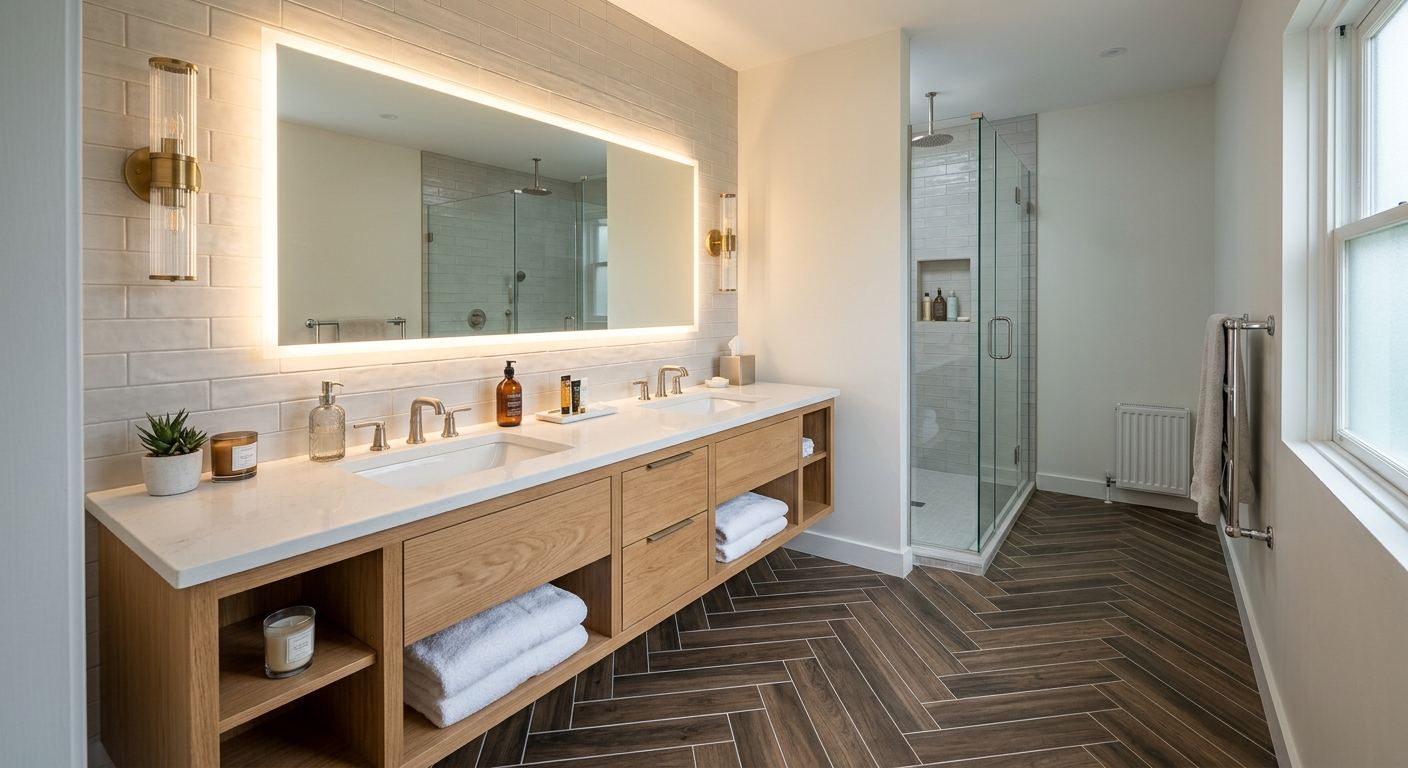
Bathroom renovation options and costs in St. Catharines
Bathroom renovation in St. Catharines typically comes down to what you change behind the walls, not just what you can see. With 71.0% of homes built before 1981, many local bathrooms sit on older plumbing layouts and dated drain/vent configurations. In practice, that age is why renovation scopes in the Hamilton–Niagara Peninsula market often expand after demolition—contractors may need drain-stack upgrades, new shutoffs, or trap corrections to meet code. Also, older floor tile and patching materials can conceal asbestos-containing products, which can add time and cost if abatement is required.
Pricing here is also shaped by labour availability across Hamilton, Burlington, St. Catharines, Brantford, and Niagara Falls. When multiple trades are booked and site conditions are tight, scheduling and re-visits become cost drivers. “Simple” baths can turn into plumbing-and-finishing projects once walls come off, particularly in established neighbourhoods where homes were built with small bathrooms and minimal mechanical ventilation.
In St. Catharines, demand is especially steady in the North End/Valley area and around older housing pockets near downtown—those are the projects where contractors frequently encounter hidden drainage issues and subfloor unevenness. Use the table below as a practical baseline, then we’ll narrow to an accurate range once you confirm fixture locations, tile/waterproofing scope, and any likely behind-the-wall repairs.
| Renovation Scope |
What's Included |
Typical Duration |
Price Range |
| Cosmetic refresh (paint, fixtures, accessories only) |
New vanity/one-piece toilet or similar fixtures (if plumbing stays put), paint, re-grout or light caulking, hardware, mirror/accessories; no wall opening |
3–7 days |
$4,500 – $8,000 |
| Mid-range full renovation (new tile, vanity, tub/shower, electrical) |
Demolition and disposal, waterproofing, new tile floor and surround, vanity, tub and/or shower trim, updated exhaust fan and GFCI outlets, standard hardware, basic plumbing refresh |
2–4 weeks |
$12,000 – $25,000 |
| High-end full renovation (custom tile, steam shower, heated floors) |
Higher-grade tile and layout design, bonded waterproofing system, heated floor circuit, custom shower or steam feature, premium fixtures, improved ventilation, possible behind-wall plumbing upgrades if required |
4–6+ weeks |
$25,000 – $45,000 |
| Shower-only installation (convert tub to walk-in shower) |
Remove tub, prep subfloor, new shower waterproofing and pan/linear drain (optional), new glass enclosure, new plumbing trim, tile for shower only |
2–3 weeks |
$3,000 – $8,000 |
| Bathtub replacement or tub-liner install |
Remove and replace tub OR install tub liner where appropriate, new trim/valves, caulking and sealing, basic wall refinishing (no major layout change) |
4–10 days |
$1,500 – $6,000 |
| Tile-only installation (floor + surround, existing layout kept) |
Tile removal (as needed), substrate prep, new floor and wall tile, grout/sealant, waterproofing to the extent required for tile scope; fixtures remain |
1–3 weeks |
$3,000 – $8,000 |
Prices are estimates only and vary by project scope, site access and material selection.
What affects the price of bathroom renovation in St. Catharines
In St. Catharines, quotes for the “same” bathroom can vary by 30–50% because the work that drives price is often hidden: rough-in plumbing, ventilation upgrades, subfloor prep, and waterproofing details. Even across the Hamilton–Niagara Peninsula, labour rates and how busy the market is at the time of your build can affect the final figure. If two contractors price a bath renovation but one assumes unchanged plumbing and the other allows for behind-wall corrections, the difference quickly lands in the mid-range full renovation band (around $12,000 – $25,000) versus a high-end project (up to $25,000 – $45,000).
The biggest driver here is the age of local housing stock. Because many homes were built before 1981, you may find cast-iron or older drain stacks that need partial replacement, galvanized supply lines that aren’t pressure-ideal, and ventilation that doesn’t meet modern expectations. A properly sized exhaust fan and proper venting can add scope. If discovery occurs—like asbestos in vinyl floor tile or older drywall compounds—abatement protocols can add approximately $1,500–$5,000+ depending on area and containment.
Concrete examples we see in St. Catharines: (1) moving a vanity can require new shutoffs and supply line routing through framing, increasing labour and drywall patching; (2) switching from a smaller ceramic layout to large-format porcelain often raises setting time and waste, particularly where floors aren’t perfectly level; (3) when a shower is rebuilt, the waterproofing method chosen (paint-on vs. membrane system) directly affects labour and material costs. With 37,945 homeowner households (64.4% of all households own), there’s steady demand for quality waterproofing and durable finishes that stand up to Ontario bathroom humidity.
| Price Factor |
Why It Matters |
Cost Impact |
| Layout change — moving drain or supply lines |
Requires rough-in work, patching, and sometimes drain rework/vent tie-ins |
Often adds $2,000 – $8,000+ |
| Tile selection — large-format porcelain vs. mosaic vs. ceramic |
Different cut complexity, substrate tolerance, and labour time |
+$500 – $4,000 depending on materials and installs |
| Fixture tier — builder-grade vs. mid-range vs. designer brands |
Valve trims, drain assemblies, and finish longevity vary |
+$800 – $6,000+ |
| Subfloor condition — rot or unlevel concrete adds scope |
More demo and rebuild needed before tile can be installed properly |
+$1,000 – $7,000+ |
| Electrical — adding GFCI outlets, exhaust fan, heated floor circuit |
Modern code-compliant protection and safe circuit planning |
+$600 – $4,000+ |
| Waterproofing method — membrane type and extent |
Correct system reduces the risk of mould and tile failure |
+$400 – $3,000+ |
| Older-home surprises — asbestos tile, cast-iron drains, galvanized pipes |
Discovery triggers specialized handling and/or replacement |
+$1,500 – $10,000+ |
| Bathroom size — sq ft drives tile and labour time directly |
Tile quantities, waterproofing area, and crew time scale with room size |
Varies widely; often $500 – $5,000 per size tier |
Permits & regulations in Ontario
In Ontario, many bathroom updates are straightforward from a permit standpoint—but “straightforward” doesn’t mean “no rules.” As a rule of thumb in St. Catharines, cosmetic work that doesn’t change plumbing or electrical typically does not require a permit. Examples of work that typically does not need a permit include: swapping a vanity, replacing a mirror, repainting, changing accessories, and retiling with no movement of drains/supplies and no structural wall changes.
Permits and inspections are more likely when you change systems. Work that typically does require a permit includes: relocating plumbing (moving a drain or supply line), adding or modifying wet-area exhaust ventilation with new wiring/circuits, and making structural or wall changes that affect framing or require inspection. Electrical work must meet Ontario electrical code requirements and be performed by a licensed electrician (or signed off by one).
Here’s a homeowner-friendly verification process in St. Catharines: (1) ask the contractor for their Ontario trade licence details/number and confirm it on the appropriate online registry; (2) request a current certificate of insurance showing liability coverage for the renovation period; (3) confirm coverage for workers through WSIB/WCB status (the contractor should provide proof/clearance information); (4) keep copies of all documents with your contract. If a job involves hidden-mechanical access, confirm whether permits are being pulled by the contractor (and whether they include inspection fees in the quote).
Choosing tile, waterproofing and fixtures for your St. Catharines bathroom
In St. Catharines, your bathroom budget is mostly decided by three material choices: (1) tile, (2) waterproofing, and (3) fixture tier. Ontario bathrooms can stay humid for long periods—especially in homes with older ventilation—so waterproofing that’s built correctly is what protects the subfloor and keeps mould from becoming a recurring issue.
Tile choice changes both material cost and installation complexity. Ceramic tile is typically an entry-level option and can be a good fit when your goal is to stay near the cosmetic-to-midrange line. Porcelain tile is denser and less porous, but large-format porcelain demands a flatter substrate and more precise setting. Natural stone (marble, travertine, slate) looks premium but can require sealing and careful selection for moisture performance.
Waterproofing is where the right system pays off. Paint-on membrane can work for some simpler assemblies, but bonded sheet membrane or a well-installed system (including proper corners/edges and cure times) is often a better long-term approach for shower walls and floors. Your contractor should align waterproofing method with the exact tile layout and wet-area details.
Fixtures are the third lever. Builder-grade valves and trims are usually less expensive, while mid-range or designer brands often deliver smoother operation and better finish durability—helpful for resale when 64.4% of households are homeowners and buyers look for “move-in ready” quality.
Where price differences are justified: if your budget can stretch from a basic tile-and-refresh approach toward a mid-range full renovation (around $12,000 – $25,000), spending the extra on proper waterproofing + porcelain can prevent costly redo later. If you’re targeting a narrower scope like tile installation (often $3,000 – $8,000), you can still make a meaningful difference by selecting a waterproofing-ready system and a tile format that fits your floor level.
| Material / Option |
Pros |
Cons |
Price Range |
| Ceramic tile (floor + walls) |
Generally budget-friendly, wide style selection, familiar install method |
More variation in absorption; grout maintenance matters in wet zones |
$3,000 – $6,000 |
| Porcelain tile (floor + walls) |
Low absorption, durable finish, great for busy families and long service life |
Large format needs a flatter substrate; may raise installation labour |
$4,500 – $8,000 |
| Natural stone (marble, travertine, slate) |
High-end look and texture, strong design impact |
Sealing/maintenance, tile selection complexity, installation care and waste |
$6,000 – $12,000 |
| Frameless glass shower enclosure |
Brightens the room, modern “clean lines,” long-lasting hardware options |
More exact measurements; higher cost than framed panels |
$1,500 – $5,000 |
| Prefab tub surround (acrylic) |
Fast install, good waterproofing when fitted correctly, predictable budget |
Less “custom” look; can be limited on design choices |
$900 – $3,000 |
| Custom shower pan (tile or linear drain) |
Modern linear drain look, integrated slope, strong long-term functionality |
More labour and waterproofing coordination; layout is less forgiving |
$3,000 – $10,000 |
How to choose a bathroom renovation contractor in St. Catharines
Choosing the right bathroom renovation contractor in St. Catharines starts with verification. First, confirm Ontario licensing for the trades involved and ask for their licence number and trade class. Next, request liability insurance and ensure the certificate lists your project address or renovation period. For worker protection, ask how WSIB/WCB coverage is handled—your contractor should provide proof/clearance documentation when workers are on site. If you’re planning work that includes electrical or plumbing changes, don’t accept “we’ll get it done”—ask which licensed subcontractors will do the work and provide their documentation.
Then get 2–3 itemised written quotes (not lump sums). A good quote breaks out labour and materials: demolition/disposal, waterproofing, tile setting, electrical (GFCI, exhaust fan), plumbing rough-in/trim, glass, and any permit costs. Read the scope carefully: confirm what’s excluded (e.g., asbestos abatement, subfloor replacement, backer board, extra tile cuts, moving fixtures), whether permit pulling is included, and if disposal and protection of floors/vanities are part of the price.
Warranty should be clear in writing: workmanship warranty length, whether it covers labour for tile/waterproofing failures, and how product/manufacturer warranties are handled. Also confirm if warranties are transferable when you sell your home.
For payments, keep it safe: never pay more than 10–15% upfront, and use a holdback until the job is complete and any punch list items are finished. Finally, insist on a start date and a completion estimate in writing, including dependencies like product lead times.
- Request Ontario licence numbers for all applicable trades and confirm in the correct online registry.
- Collect certificate of liability insurance and verify coverage dates and limits.
- Ask for proof of WSIB/WCB coverage or clearance for workers on site.
- Get 2–3 itemised quotes with labour and materials separated.
- Confirm permit pulling responsibility and inspection fees—include it in writing.
- Check inclusions: disposal, site protection, dust control, and caulking/grout details.
- Clarify exclusions: asbestos/older-home surprises, subfloor rebuild, and extra waterproofing.
- Ensure waterproofing method is specified (not just “waterproofing included”).
- Verify tile scope: substrate prep, backer board, layout, and waste allowance.
- Ask for warranty terms: workmanship duration and what triggers service.
- Use a payment schedule with a holdback until final walkthrough/punch list is done.
- Confirm timeline with key milestones (demo, rough-in, inspections, tile, trim, final).
Red flags in St. Catharines: quotes that are not itemised; contractors who avoid showing licence/insurance/WSIB documentation; “we’ll take care of permits” without stating who pulls them; unusually low pricing that doesn’t mention waterproofing scope; and demanding large upfront payments (more than 10–15%) before any materials are staged.
Frequently asked questions — bathroom renovation in St. Catharines
How do I compare bathroom renovation quotes?
Start by comparing like-for-like scopes. In St. Catharines, one contractor may price a “full” renovation that doesn’t include behind-the-wall plumbing discovery, while another includes allowances for older-home rough-ins—especially relevant in homes built before 1981. Ask each bidder to itemise labour and materials: demolition/disposal, waterproofing method, tile setting, electrical (GFCI and exhaust fan), plumbing rough-in/trim, and glass. Confirm whether permit pulling is included and who pays inspection fees. Finally, compare warranty terms and the payment schedule. If one quote lands in the mid-range band (about $12,000 – $25,000) but the others are much higher with similar inclusions, ask what is actually different (heated floors, custom pan, linear drain, higher-tier fixtures).
Can I live at home during a bathroom renovation in St. Catharines?
Often, yes—depending on how invasive the renovation is. For cosmetic refreshes, you can typically remain in the home with minimal disruption. For a mid-range full renovation, many homeowners choose to stay because crews can work in phases; however, demolition and waterproofing require access to the wet area, and you may lose the only shower for part of the job. If your bathroom is on the main floor and your household relies on it daily, plan for a temporary solution (e.g., a functional second bath, a wash setup in another room, or scheduling the no-shower phase early). For older homes in the Hamilton–Niagara Peninsula region, demolition can uncover drainage or ventilation issues that extend timelines, so build a buffer into your decision. Even then, good contractors coordinate dust control and protect floors and hallways.
What's the best bathtub material for a St. Catharines home?
It depends on whether you’re keeping the layout or replacing the tub entirely. For many St. Catharines homeowners, replacing a tub with a quality acrylic or enamel-on-steel unit is practical because it’s relatively straightforward and works well with modern trim/valves. Acrylic tends to be lighter and can be easier to install, while enamel surfaces can feel harder but may chip if heavy items are dropped. If you’re trying to minimize cost and disruption, a tub-liner or tub-surround approach can be considered, but it’s only appropriate when the existing tub and surfaces are in good condition. If you’re upgrading to a shower-first design, you may not need a tub at all; shower-only installations commonly run in the $3,000 – $8,000 band depending on waterproofing and enclosure.
Is it worth renovating a bathroom before selling in St. Catharines?
Usually, yes—when you target durable, neutral improvements and keep the scope realistic for your home’s age. In a city where many homes were built pre-1981 (71.0%), buyers are often cautious about visible tile wear, grout, and signs of moisture damage behind finishes. A well-executed renovation can make the home feel safer and more “move-in ready,” especially if waterproofing and ventilation are modernised. That said, don’t overspend on niche luxury finishes if your goal is resale. Many sellers focus on upgrading to a mid-range full renovation scope (often $12,000 – $25,000) because it balances cost, timeframe, and broad appeal. If the plumbing behind walls needs work, addressing it before showings is typically worth more than re-surfacing over known issues.
How do I plan a bathroom renovation on a tight budget in St. Catharines?
Work backwards from your must-haves: waterproofing quality, safe electrical/GFCI protection, and good ventilation. Then trim the “nice-to-haves.” If your layout doesn’t need changes, you can keep costs closer to a cosmetic refresh or tile-only scope while still improving function—tile installation often sits around $3,000 – $8,000. Choose a practical tile format (porcelain for longevity when the substrate is stable, ceramic when you want to stay entry-level) and consider refinishing or keeping fixtures where they’re still solid. In older St. Catharines homes, set aside an allowance for behind-wall discoveries; demolition sometimes reveals drainage and ventilation corrections and can add $2,000 to $8,000+ depending on what’s found. Your best budget plan includes a contingency and a contractor who itemises the quote so you can reduce scope without sacrificing waterproofing.
What's the difference between a cosmetic and a full bathroom renovation?
A cosmetic renovation is about surfaces and fixtures without changing the plumbing or major assemblies. In St. Catharines, that typically means repainting, swapping accessories, replacing a vanity or mirror, and possibly re-grouting or doing light retiling where walls aren’t opened. A cosmetic project often takes days and stays in the lower range (often $4,500 – $8,000 depending on fixture selection). A full renovation generally includes demolition, new waterproofing, replacing tile floors and shower/tub surrounds, and often updating electrical such as exhaust fans and GFCI outlets. Because so many homes locally are older (71.0% built before 1981), “full” renovations are more likely to uncover behind-the-wall scope—like cast-iron drains, galvanized supply lines, or asbestos-containing materials—making the budget difference real.