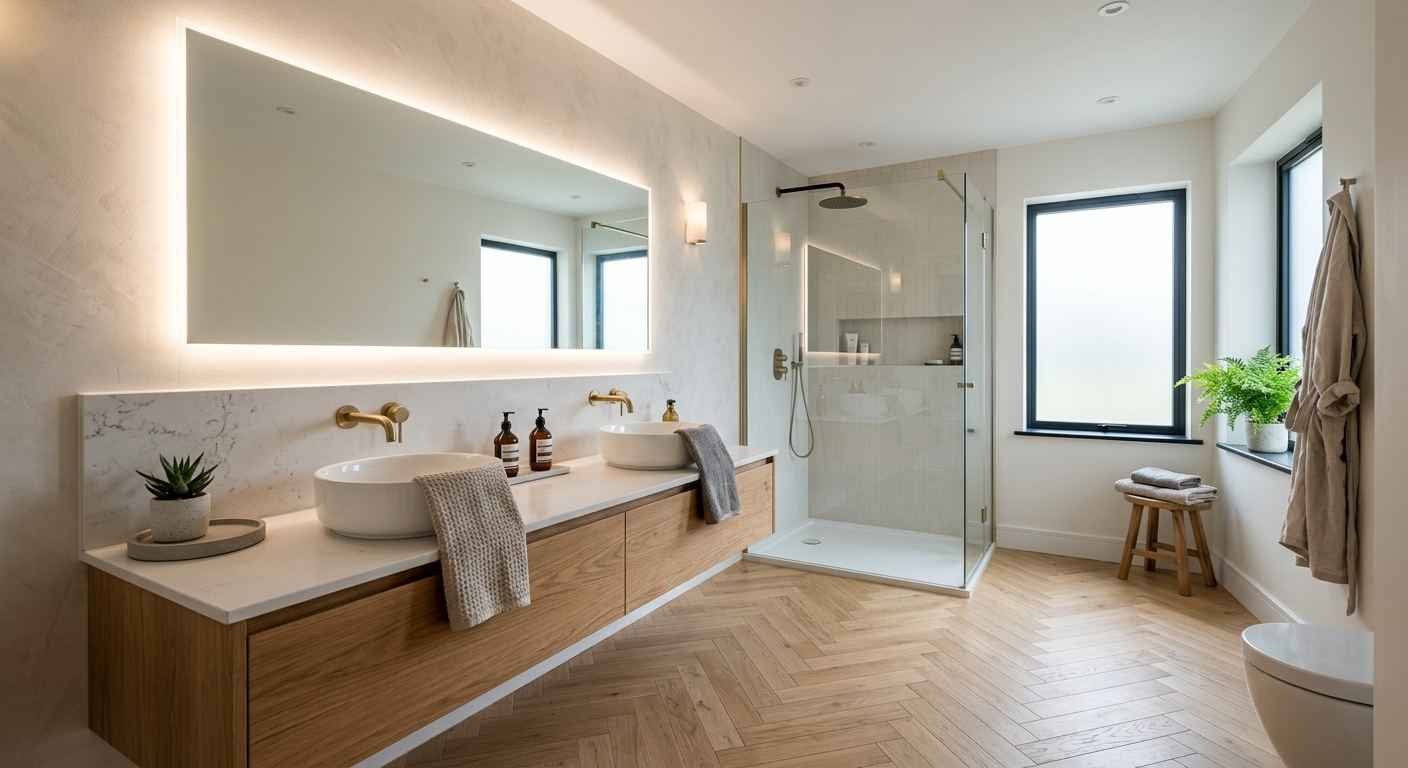
Bathroom renovation options and costs in Fort Saskatchewan
Fort Saskatchewan homeowners typically face the same big fork in the road: do you want a cosmetic refresh, or a true system upgrade that touches plumbing, waterproofing, and electrical. That choice matters because many local homes were built decades ago—about 31.2% of dwellings in the area were built before 1981—so opening walls often reveals older drain piping layouts, dated venting, or wiring that needs to be updated for today’s electrical safety requirements. Add in that Fort Saskatchewan is part of the Edmonton economic region, where skilled trades can be in strong demand, and labour becomes a bigger share of the total budget than people expect when they only price materials. In practice, that means even “mid-range” projects start to look like higher-priced quotes if wall openings uncover surprises.
Edmonton-area conditions also influence scheduling and availability. Because many renovations are happening in nearby communities and satellite suburbs, installers may have lead times for tile setters, glass crews, and waterproofing specialists. That labour pressure is one reason a full bathroom renovation often lands in the $12,000–$35,000 range, while cosmetic-only work stays closer to lower “surface” budgets. Neighbourhoods around Strathcona County-side pockets and the older, established residential areas near the downtown and River Valley-adjacent corridors tend to see steady demand for plumbing and tile—especially where homeowners are modernizing older en-suites and main bathrooms.
To help you compare apples to apples, use the table below as a baseline for Fort Saskatchewan projects and then confirm the exact scope with a written, itemised quote—especially the waterproofing and electrical rough-in.
| Renovation Scope |
What's Included |
Typical Duration |
Price Range |
| Cosmetic refresh (paint, fixtures, accessories only) |
New vanity or faucet, toilet swap if needed, lighting fixtures, paint, re-caulk, replace accessories (towel bars, mirror), clean/reset existing hardware; no wall opening |
3–7 days |
$3,500–$8,000 |
| Mid-range full renovation (new tile, vanity, tub/shower, electrical) |
Demolition, new waterproofing system, tile floor and surround, new vanity, tub or shower package, new exhaust fan (where applicable), GFCI upgrades, modern lighting, updated caulking and trim |
2–3 weeks |
$15,000–$25,000 |
| High-end full renovation (custom tile, steam shower, heated floors) |
Custom layout, upgraded waterproofing, large-format tile, heated floor circuit, frameless glass, higher-end fixtures, additional electrical for controls/lighting, premium trim and details |
3–5 weeks |
$25,000–$45,000 |
| Shower-only installation (convert tub to walk-in shower) |
Remove tub, new shower pan and waterproofing, new tile surround, updated drain connection, new valve trim, new glass (if selected), exhaust fan check/upgrade |
1.5–2.5 weeks |
$10,000–$18,500 |
| Bathtub replacement or tub-liner install |
Swap tub unit or install liner system (as appropriate), new faucet/trim, re-caulk, seal transitions, address any immediate subfloor/waterproofing patching |
5–10 days |
$6,000–$14,000 |
| Tile-only installation (floor + surround, existing layout kept) |
Tile removal and reset or partial demo, waterproofing and membrane install where required by the scope, tile floor and wall surround, new grout/seal, trim and accessories fit |
1.5–3 weeks |
$5,000–$12,000 |
Prices are estimates only and vary by project scope, site access and material selection.
What affects the price of bathroom renovation in Fort Saskatchewan
You can get surprisingly different quotes for the “same” bathroom renovation in the Edmonton economic region—often in the 30–50% range—because contractors price the hidden work differently. In Fort Saskatchewan, the biggest drivers aren’t climate exposure alone (most interior moisture issues are managed through waterproofing), but rather regional labour rates and the age of local housing stock. With about 31.2% of homes built before 1981, many renos uncover cast-iron or older copper drain stacks that need updating, galvanized supply lines that may be corroded, and exhaust ventilation that’s undersized or missing. Those discoveries expand scope fast, which pushes the job upward from “tile budget” into full system replacement territory.
For older properties, asbestos-containing materials can also appear—sometimes in vinyl floor tile or dated drywall compounds—triggering abatement protocols. When that happens, many contractors see budget adds in the $1,500–$5,000+ range depending on quantity, access, and disposal requirements. Electrical scope can also swing: if you’re adding a GFCI-protected outlet, upgrading the exhaust fan with a proper fan circuit, or installing a heated floor, the electrician’s rough-in time becomes part of the baseline.
Here are concrete examples from typical Fort Saskatchewan situations: (1) moving the shower drain can require additional rough-in and patching, which raises cost even if the tile pattern stays the same; (2) switching from ceramic to large-format porcelain increases labour and waste due to layout complexity, especially on older floors that may need flattening; (3) a 5–8 sq ft bathroom with floor-to-ceiling surround can look “small,” but the labour for waterproofing transitions, niche builds, and curbs drives the job toward the mid-range bands of roughly $15,000–$25,000 rather than a cosmetic tier.
| Price Factor |
Why It Matters |
Cost Impact |
| Layout change — moving drain or supply lines requires rough-in work |
Drain relocation impacts framing, subfloor, and venting coordination; supply changes can mean new pipe runs and patching |
Often adds $2,000–$7,000 |
| Tile selection — large-format porcelain vs. mosaic vs. ceramic |
Harder cuts, pattern matching, and higher underlayment needs increase setter time and waste |
Typically adds $1,000–$6,000 |
| Fixture tier — builder-grade vs. mid-range vs. designer brands |
Premium trims, valves, vanities, and specialty shower components cost more and can require more install time |
Often adds $800–$5,500 |
| Subfloor condition — rot or unlevel concrete adds scope |
Dead spots, moisture damage, or uneven surfaces can require floor leveling, replacement, and added waterproofing prep |
Often adds $1,000–$4,000 |
| Electrical — adding GFCI outlets, exhaust fan, heated floor circuit |
New circuits and fan placement require rough-in time and inspection readiness |
Typically adds $1,200–$6,000 |
| Waterproofing method — membrane type and extent |
Good waterproofing is labour-intensive; more coverage and better systems increase reliability and lifespan |
Often adds $800–$3,500 |
| Older-home surprises — asbestos tile, cast-iron drains, galvanized pipes |
Abatement and plumbing upgrades require specialist time and disposal; can change demolition sequence |
Can add $1,500–$12,000+ |
| Bathroom size — sq ft drives tile and labour time directly |
More square footage means more tile, more backer prep, and more time on trims and curing cycles |
Small baths: $5,000–$15,000; larger: can reach $25,000+ |
Permits & regulations in Alberta
In Alberta, what you need to permit for depends on what you change. For most Fort Saskatchewan homeowners, cosmetic updates—like swapping a vanity, replacing faucets, retiling a like-for-like shower surround, or painting—typically do not trigger major permitting. However, the moment you move plumbing, modify the structure, or add new electrical circuits, the work generally crosses into “permit-and-inspection” territory. If you’re adding or relocating a fixture, changing the drain/supply locations, or doing shower waterproofing that requires more than surface replacement because walls are being opened, expect permits and inspection requirements for the plumbing scope. Adding a new exhaust fan (especially with new wiring) also usually requires electrical compliance, and any electrical work must be performed by a licensed electrician or performed by someone authorized under Alberta rules.
Here’s a practical step-by-step way to verify your contractor in Fort Saskatchewan before you sign:
- Ask for their Alberta trade licence details (as applicable to the work they perform).
- Request a current Certificate of Insurance (liability) and confirm the coverage is active for your project dates.
- Confirm workers’ compensation coverage (commonly referenced as WCB). A clearance letter or proof of account is typically provided on request.
- If the quote includes electrical, verify who is doing that portion (name, licence details) rather than assuming the main contractor is the electrician.
- Ask what permits they will pull, and whether permit costs are included or billed separately.
Tip: a professional contractor should clearly list “what requires a permit” in writing and coordinate inspections so you’re not left chasing documentation after the fact.
Choosing tile, waterproofing and fixtures for your Fort Saskatchewan bathroom
To keep a Fort Saskatchewan renovation on budget, treat tile, waterproofing, and fixtures as three separate “budget levers” that influence both cost and long-term performance in the Edmonton-area housing market. First, tile choice: entry-level ceramic tile can be a good option where you want a classic look and lower material cost, but it often demands more careful installation on older, slightly uneven floors. Mid-range porcelain gives you better durability and water resistance, and many homeowners choose it to reduce the risk of cracking or deterioration around wet zones. Natural stone (marble, travertine, slate) looks premium, but it can require more labour for installation and sealing, and it can be less forgiving if your layout is complex.
Second, waterproofing method: in Alberta bathrooms, the risk isn’t outside weather; it’s the interior wet-zone. A paint-on membrane may work for limited areas when used correctly, but bonded sheet membrane systems or a properly designed, modern shower system (with correct overlap and detailing at corners, niches, and seams) generally offers more confidence for longevity. This is especially important in older homes where tile was originally installed over substrates that may not be ideal—your contractor may need additional prep before waterproofing can be applied.
Third, fixture tier: builder-grade fixtures can keep your budget closer to the mid-tier ranges, while mid-range and designer brands often cost more upfront but can improve day-to-day use and reduce leaks/drip call-backs. For example, upgrading from a basic tub surround package toward a system that supports a higher-end valve and more robust waterproofing transitions can be justified when you’re already at the level where a full renovation budget approaches $15,000–$25,000—because the “extra” spending protects the parts you can’t easily fix later. Conversely, don’t overspend on premium stone if your waterproofing scope is minimal; it’s the waterproofing that prevents repeat failures.
| Material / Option |
Pros |
Cons |
Price Range |
| Ceramic tile (floor + walls) |
Lower material cost, wide style selection, good for many typical layouts |
Can be less durable than porcelain in high-impact areas; relies heavily on proper prep and grout |
$2,000–$6,500 |
| Porcelain tile (floor + walls) |
High water resistance, durable, better for modern large-format looks |
Heavier and more sensitive to subfloor flatness; adds labour for layout and cuts |
$4,000–$10,500 |
| Natural stone (marble, travertine, slate) |
Luxury appearance, unique patterns, strong design value |
More expensive materials, more install time, may require sealing and careful grout selection |
$7,000–$18,000 |
| Frameless glass shower enclosure |
Modern look, easy cleaning, can make small bathrooms feel larger |
More hardware and precise installation; may increase electrical/plumbing adjustments if layout shifts |
$2,500–$6,500 |
| Prefab tub surround (acrylic) |
Faster install, consistent fit, typically easier maintenance |
Fewer design options; can look less “custom” than tile; sealing at seams is still critical |
$1,500–$4,500 |
| Custom shower pan (tile or linear drain) |
Better slope and drainage, premium linear-drain look, supports truly watertight systems |
More labour and waterproofing detailing; requires accurate layout and curing |
$4,500–$14,000 |
How to choose a bathroom renovation contractor in Fort Saskatchewan
Choosing the right contractor in Fort Saskatchewan starts with credentials you can verify. Ask for proof of Alberta trade licensing for the work they perform, and request a current liability insurance certificate with project-specific effective dates. For workers’ coverage, confirm they carry WCB/WSIB-equivalent coverage (commonly shown through proof or a clearance letter) so you’re not exposed if a worker is injured. If the contractor is handling demolition and carpentry but hiring subcontractors for electrical or plumbing, the quote should name who’s doing each scope and include their licence/coverage details.
Next, get 2–3 itemised written quotes. A quality bathroom quote breaks out labour and materials separately (tile, membrane, fixtures, glass, electrical allowance, disposal), rather than giving a single lump sum. Carefully read exclusions: is permit pulling included? Who supplies dumpster disposal? Are drywall repairs and repainting included after tile work? Confirm whether the quote assumes “existing plumbing stays” or whether rough-ins are included.
Warranty matters in bathrooms. Look for a workmanship warranty (often covering waterproofing and installation) and confirm manufacturer warranties for fixtures and tile systems. Ask whether the warranty is transferable to you if you sell the home.
Finally, manage cash flow: never pay more than about 10–15% upfront, and hold a portion until completion and final walkthrough. Timeline should be in writing—start date, key milestones, and an estimated completion date—because bathroom projects routinely require curing time and inspection windows.
- Ask for licence and insurance documentation before scheduling.
- Confirm who is doing electrical and plumbing work and that they’re properly licensed.
- Demand itemised labour/materials breakdown, not a lump sum.
- Verify permit responsibility: which permits, who pulls them, and what’s included.
- Confirm waterproofing scope: membrane type, coverage area, and details at corners/niches.
- Check for subfloor prep language (leveling, backer board, moisture checks).
- Review demolition and disposal: dumpster/haul-away included or billed separately?
- Ask about glass enclosure allowances and whether measurements are part of the quote.
- Ensure tile installation includes tile prep, layout, and grout/seal plan.
- Warranty terms in writing: workmanship length and what it covers.
- Payment schedule with a holdback until punch-list items are complete.
- Timeline with curing/inspection buffers stated, not just a start and end date.
Red flags in Fort Saskatchewan include: vague scope wording (especially around waterproofing and electrical), quotes that omit disposal or permit assumptions, contractors pushing large deposits, no written warranty on workmanship, and inconsistent proof of coverage/licensing when you ask for it.
Frequently asked questions — bathroom renovation in Fort Saskatchewan
Do I need waterproofing behind the tile?
In Fort Saskatchewan and the Edmonton area, you should plan on waterproofing in all wet zones (shower walls, tub surrounds, and the floor where applicable). Even if you’re doing “just tile,” moisture will travel through grout lines and at seams if the system isn’t designed correctly, particularly around niches, corners, and the tub-to-wall junction. In most renovation scenarios, contractors use a continuous waterproofing approach (often membrane-based) rather than relying on paint or grout alone. This is especially important in older homes built before 1981, where substrates can be uneven or previously repaired in inconsistent ways, increasing the chance of failure.
Budget-wise, waterproofing is one of the reasons a full renovation typically starts above simple cosmetic pricing guides. If you’re targeting the $12,000–$35,000 full bathroom range, waterproofing scope is usually already included in a mid-range plan, rather than treated as an optional add-on.
How do I compare bathroom renovation quotes?
To compare quotes in Fort Saskatchewan, make sure each price includes the same scope and level of quality. Start by checking whether the quotes specify waterproofing method (membrane type and coverage), not just “tile and labour.” Next compare electrical details: do they include GFCI upgrades and a properly vented exhaust fan circuit? For plumbing, confirm whether the drain and supply lines are staying where they are, or if rough-in changes are included—moving lines can swing costs a lot.
Then look at itemised allowances for fixtures and tile. A quote that looks cheaper at first can be using builder-grade trim or a lower-grade tile and skipping subfloor prep. Finally, verify permit responsibility and disposal. If one contractor includes full system upgrades while another offers a narrow scope, the difference can be 30–50% even when the bathroom looks similar.
Can I live at home during a bathroom renovation in Fort Saskatchewan?
Often, yes—especially if you’re renovating a single bathroom and you plan for a short disruption. Many Fort Saskatchewan homeowners live at home during a shower-only conversion or tub replacement because the “wet zone” work is contained and the rest of the home remains usable. That said, the project typically includes demolition, tile prep, plumbing reconnects, and waterproofing curing time, so your schedule and access to plumbing/finishes can be limited.
Cosmetic refreshes (like replacing fixtures and painting) usually allow the bathroom to stay functional with minimal downtime. But a mid-range full renovation (often priced around $15,000–$25,000) may require temporarily using another sink/shower in the home while walls are open. If you have only one bathroom, expect a longer inconvenience window—plan for a portable option and confirm the contractor’s daily cleanup routine.
What's the best bathtub material for a Fort Saskatchewan home?
For most Fort Saskatchewan homes, the “best” tub material comes down to durability, installation method, and whether you’re replacing the tub only or changing the surround. Acrylic tubs are common because they install efficiently, are lighter than cast iron, and often fit well with standard rough-ins. Cast iron tubs are extremely durable and sound-dampening, but they’re heavy and can complicate subfloor reinforcement and demo logistics.
If you’re considering a tub-liner approach, that can reduce demo work, but it only makes sense if the existing surface is suitable and the seam detailing is done properly. In older homes (pre-1981), the best outcome usually includes confirming the drain condition and ensuring waterproofing is addressed where the tub meets the wall. If your overall budget is targeting the $6,000–$14,000 band for bathtub replacement, ask your contractor how they’ll handle any dated plumbing or ventilation issues found during opening walls.
Is it worth renovating a bathroom before selling in Fort Saskatchewan?
In Fort Saskatchewan, a bathroom renovation can be worth it, but the key is avoiding “over-improving” for the home’s baseline. Because many homes were built earlier (with about 31.2% built before 1981 in the local profile), buyers often expect updated waterproofing, modern lighting, and safer electrical. That’s where a mid-range renovation can help because it replaces the systems buyers worry about—not just the finishes.
If you have dated tile, poor exhaust ventilation, or aging fixtures, upgrading can improve marketability. However, if the renovation is purely cosmetic (paint, accessories) and the underlying waterproofing or plumbing is worn, it may not deliver the confidence buyers want. As a practical guideline, many homeowners lean toward the $12,000–$35,000 full renovation band with durable materials, rather than spending heavily on premium finishes while neglecting ventilation, waterproofing transitions, and code-compliant electrical.
How do I plan a bathroom renovation on a tight budget in Fort Saskatchewan?
On a tight budget in Alberta, focus your spending on what prevents costly failures: waterproofing quality, ventilation, and critical plumbing/electrical upgrades. Start by choosing a scope that matches your needs—if your tub/shower surround is failing, a targeted shower-only conversion may be a better value than a full layout change, since moving drains and supplies usually increases rough-in time and contingency. If your budget can only support tile work, consider keeping the layout and investing in a reliable waterproofing system behind the tile.
For example, if you’re aiming closer to the lower end of the renovation spectrum, a tile-only installation might fit within the $5,000–$12,000 band, while a bathtub replacement often lands around $6,000–$14,000 depending on prep and electrical scope. Also, ask for allowances: choose a mid-range vanity now and upgrade fixtures later, but don’t postpone waterproofing or exhaust fan upgrades. This keeps costs controlled while still delivering an upgrade that feels “complete.”