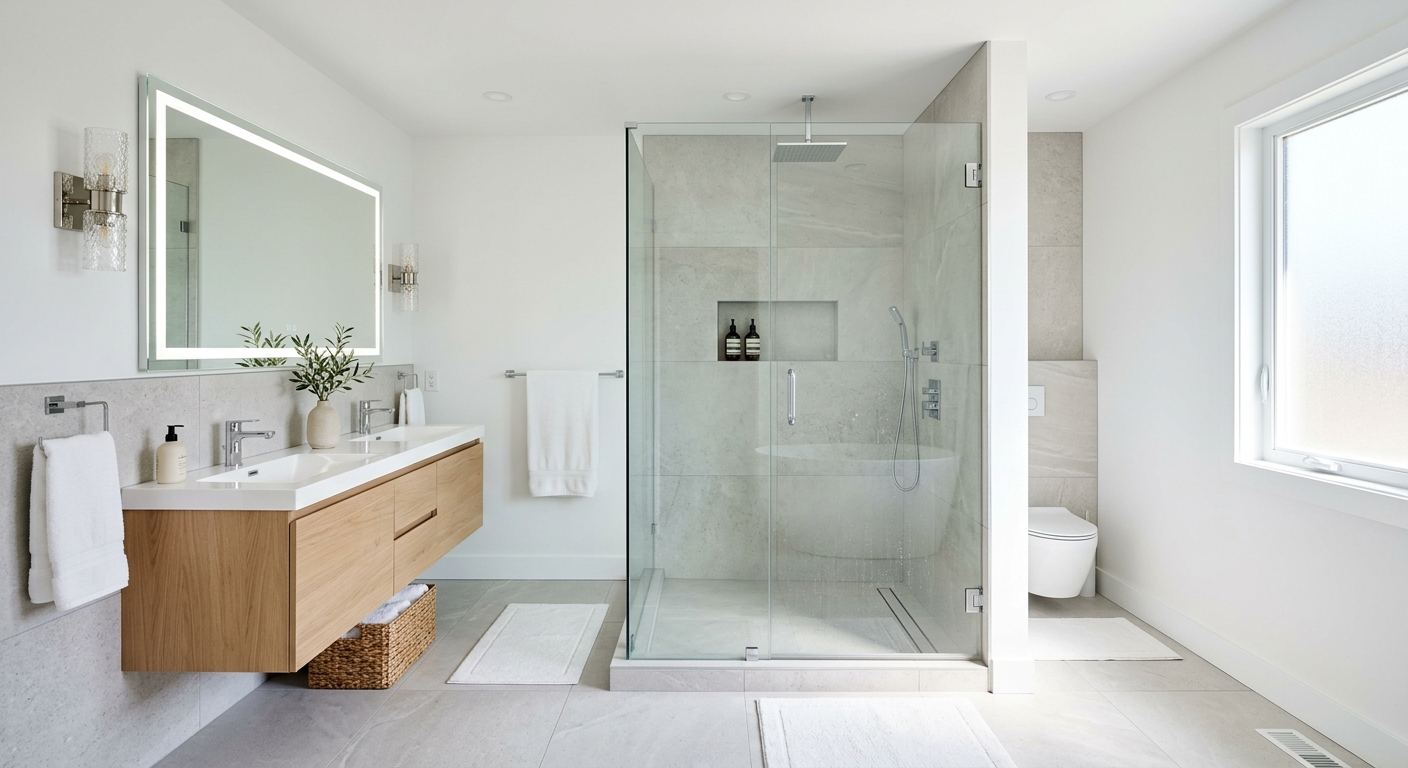
Bathroom renovation options and costs in Bridgeport
Bathroom renovation in Bridgeport often comes down to choosing the right scope early, because the city’s home inventory is frequently older and full of “unknowns.” In Bridgeport, the area’s population is 4,140 (Statistics Canada, 2021 Census), and many properties reflect mid-century build patterns common across the Lower Mainland–Southwest. That matters for budgets: older layouts can hide dated plumbing runs, aging drain materials, and sometimes asbestos-containing materials in older floor tile or drywall compound (particularly in homes built before 1985). Once walls are opened, what looked like a straightforward refresh can expand into venting or drain-stack upgrades, which is a major reason quotes can climb quickly.
In the Lower Mainland–Southwest, labour rates and housing age drive bathroom costs more than the day-to-day climate itself. Because Metro Vancouver area demand is high, skilled plumbers, tilers, and electricians can be booked out—so schedules and labour efficiency affect the final price. If you’re located near active job pockets in Bridgeport—like the areas around the older residential streets closest to commercial corridors—you’ll often see strong trade availability from established crews, but also less flexibility on start dates.
Below are realistic cost bands you can use to compare options before you request itemised pricing. Use them as a budgeting backbone, then plan for contingencies tied to what your inspection reveals.
| Renovation Scope |
What's Included |
Typical Duration |
Price Range |
| Cosmetic refresh (paint, fixtures, accessories only) |
New vanity top (existing box), toilet/trim swaps, painting, re-caulk, accessories, basic drain cleanout if needed; no moving of plumbing or electrical |
2–5 days |
$5,000–$12,000 |
| Mid-range full renovation (new tile, vanity, tub/shower, electrical) |
Demolition, waterproofing, tile floor and shower surround, vanity and toilet, bathtub or upgraded tub/shower valve, exhaust fan (new duct/run as required), electrical for lighting/GFCI, disposal |
2–4 weeks |
$18,000–$32,000 |
| High-end full renovation (custom tile, steam shower, heated floors) |
Premium tile package, custom shower or steam-ready system, heated floor circuit, enhanced waterproofing and drainage design, designer fixtures, upgraded ventilation, upgraded lighting, potential plumbing rework to meet current standards |
4–7 weeks |
$32,000–$45,000 |
| Shower-only installation (convert tub to walk-in shower) |
Tub removal, shower pan and waterproofing, glass or curtain setup, new valve trim, tile surround, possible drain rough-in changes, exhaust fan check/update |
1.5–3 weeks |
$8,000–$25,000 |
| Bathtub replacement or tub-liner install |
Old tub removal and swap (or liner where feasible), new caulking, plumbing hook-ups, surface prep; liner approach depends on substructure condition |
3–8 days |
$1,500–$6,000 |
| Tile-only installation (floor + surround, existing layout kept) |
Tile removal (as needed), prep, waterproofing to code standard for wet areas, floor and/or surround tiling while keeping plumbing positions, grout/seal, caulking |
1–2 weeks |
$2,000–$8,000 |
Prices are estimates only and vary by project scope, site access and material selection.
What affects the price of bathroom renovation in Bridgeport
In Bridgeport and across the Lower Mainland–Southwest, you’ll commonly see bathroom renovation quotes vary by 30–50% for the “same” bathroom. The biggest drivers aren’t the weather day-to-day—they’re labour rates tied to demand and the age of nearby housing stock. In this region, experienced plumbers, tilers, and electricians are booked often, and when crews arrive, the work moves faster, but only if the scope is clearly defined. Older homes also mean there’s a higher chance of encountering cast-iron or galvanized components, copper supply line updates, or older ventilation setups that can’t be reused safely.
Once walls and floors are opened, discovery changes the scope. For example, if an inspection reveals asbestos-containing materials in pre-1985 floor tile or drywall compound, remediation and containment can add about $1,500–$5,000+ to your budget, depending on how much material is affected and where it is located. Likewise, if your shower area requires upgraded waterproofing methods or additional slope/drain corrections, tile-only work can quickly become “full renovation” work.
Two common Bridgeport examples: (1) a mid-century bath with a small drain-line slope can require rough-in corrections once the old surround is removed—this is where tub-to-shower conversions often move toward the upper end of the $8,000–$25,000 shower band; (2) homes with aging subfloors or unlevel concrete may push tile installation toward the higher end of the $2,000–$8,000 tile-only range because prep time increases. A third factor that swings budgets is electrical: adding GFCI protection, a properly sized exhaust fan, or a heated-floor circuit tends to increase material and labour, especially where access is tight behind walls.
| Price Factor |
Why It Matters |
Cost Impact |
| Layout change — moving drain or supply lines requires rough-in work |
New rough-in means opening walls/floors, patching, and inspections; it also increases coordination between trades |
Often adds $3,000–$10,000 depending on complexity |
| Tile selection — large-format porcelain vs. mosaic vs. ceramic |
Larger panels require flatter substrates and more precise setting; mosaics can be labour intensive |
Can shift tile line items by $1,000–$6,000 |
| Fixture tier — builder-grade vs. mid-range vs. designer brands |
Trim valves, toilets, and vanities vary in cost and sometimes require different installation approaches |
Can change total bathroom pricing by $800–$6,000 |
| Subfloor condition — rot or unlevel concrete adds scope |
Prep and structural repairs are not optional for long-term tile performance and waterproofing |
Commonly adds $1,000–$5,500 |
| Electrical — adding GFCI outlets, exhaust fan, heated floor circuit |
Electrical must be to code and performed by qualified trade; drywall openings increase labour |
Often adds $600–$4,500 |
| Waterproofing method — membrane type and extent |
Correct membrane coverage is essential in BC’s damp indoor conditions and wet-area longevity |
Can add $500–$3,500 versus minimal approaches |
| Older-home surprises — asbestos tile, cast-iron drains, galvanized pipes |
Abatement and replacement add trades, time, disposal, and sometimes permit activity |
Can add $1,500–$12,000+ if encountered |
| Bathroom size — sq ft drives tile and labour time directly |
More area means more tile, thinset, membranes, and labour hours; waste also rises |
Typically scales within the overall $18,000–$45,000 full-reno band |
Permits & regulations in British Columbia
In British Columbia, cosmetic updates generally do not require a permit—think swapping fixtures, repainting, replacing a vanity, or retiling where you keep the same plumbing and no structural changes are involved. Where permits and inspections become common is when you change how the bathroom is built: relocating plumbing (moving drains or supply lines), adding or upgrading an exhaust fan with new wiring/circuits, or making structural wall changes. Electrical work must meet provincial code and must be performed by, or signed off by, a licensed electrician.
As a rule of thumb for Bridgeport homeowners: if the scope includes “rough-in” work—new drain piping, new supply lines, or moving a toilet/shower valve—that typically triggers permit activity and inspection steps. Similarly, new ventilation ducting or a new heated floor circuit usually involves electrical permits and inspections.
Step-by-step, here’s how to verify a contractor in Bridgeport: (1) request their British Columbia trade licence details (and confirm the licence is active via the appropriate online registry); (2) ask for a current certificate of insurance showing liability coverage—ensure the certificate includes your renovation company as the named insured; and (3) confirm worker coverage through the applicable system documentation they provide (commonly WCB/WSIB coverage, depending on the employer’s jurisdiction and coverage setup). For additional confidence, ask for a clearance letter or the most current proof they can legally provide. Don’t proceed until you’ve reviewed all three items.
Choosing tile, waterproofing and fixtures for your Bridgeport bathroom
For bathroom renovations in Bridgeport, your material choices are where budgets get won or lost. First: tile selection. Ceramic tile is a solid entry-level option for both floors and walls, but it can be more sensitive to substrate movement and water exposure details if the prep isn’t done right. Porcelain tile is denser and typically better for bathrooms because it handles moisture and wear more consistently. Natural stone (marble, travertine, slate) can look stunning and raise resale appeal, but it often needs more care in sealing and may increase labour due to cutting, layout, and higher material cost.
Second: waterproofing method. In the Lower Mainland–Southwest, the bathroom stays humid even with good ventilation, so prevention is everything. A proper paint-on membrane can work in some cases, but most homeowners get longer-term peace of mind with bonded sheet membranes or a robust system designed for wet areas—especially on shower floors and curbs. Third: fixture tier. Builder-grade fixtures can save money upfront, while mid-range or designer brands can improve user comfort and upgrade the look of the entire room; in practice, the biggest resale value comes from the installation quality more than the brand name.
A good budgeting example: if you’re comparing porcelain versus ceramic, the incremental cost might be $800–$3,000 across a typical full bathroom tile area. Spending that delta is often justified when it reduces the risk of premature wear and improves how the tile performs long-term in a wet zone. But if your waterproofing plan or substrate prep is weak, no premium tile will fix the problem—so prioritise correct waterproofing before “upgrading everything.”
| Material / Option |
Pros |
Cons |
Price Range |
| Ceramic tile (floor + walls) |
Lower material cost, wide style selection, good for dry wall surfaces when installed well |
Can be less durable in high-wear zones; relies heavily on prep and grout choices |
$2,000–$5,000 |
| Porcelain tile (floor + walls) |
Better moisture resistance, more consistent durability, often easier to maintain |
Higher material cost; large-format pieces may increase labour if substrate isn’t perfectly level |
$3,500–$8,000 |
| Natural stone (marble, travertine, slate) |
Premium look, distinctive veining and colour variation, strong design impact |
Requires sealing and careful cleaning; more complex cutting and layout; can cost more to maintain |
$6,000–$15,000 |
| Frameless glass shower enclosure |
Brightens the room, modern appearance, durable when installed with correct anchoring |
More expensive than standard doors; must be planned with waterproofing and proper framing/support |
$2,000–$6,500 |
| Prefab tub surround (acrylic) |
Faster install, fewer tile cuts, good value for straightforward layouts |
Less “architectural” look than tile; seams and detailing must be done carefully |
$1,200–$4,000 |
| Custom shower pan (tile or linear drain) |
Best-in-class look and drainage; can improve accessibility and water management |
More waterproofing detail and labour; linear drains require precise slope and trim coordination |
$3,000–$10,000 |
How to choose a bathroom renovation contractor in Bridgeport
Choosing the right contractor in Bridgeport comes down to verification, clarity, and delivery. Start by confirming British Columbia licensing and insurance. Ask for their trade licence information (and verify it’s active using the public registry), then request a current certificate of insurance that shows liability coverage for renovations. For coverage of workers, ask what proof they can provide for WCB/WCB-equivalent clearance or coverage documentation—your goal is to ensure the company isn’t passing risk to you if an injury occurs on site.
Next, request 2–3 itemised written quotes. “Itemised” means you should see labour and materials broken out (demolition, plumbing/electrical line items, waterproofing, tile labour, disposal, and any permit-related time). A lump sum can hide exclusions.
Read the scope carefully. Specifically ask whether permits are included (and who pulls them), what disposal costs include (dump fees versus full hauling), and whether the quote includes patching, drywall reinstatement, caulking, and final cleaning. Warranty matters: confirm workmanship warranty length, what’s covered (e.g., waterproofing failures, grout release, cracking), and whether product warranties apply directly to you or through the installer. Finally, be strict on payment terms—never pay more than about 10–15% upfront and hold back until the work is complete and deficiencies are addressed. Get a start date and completion estimate in writing, including key milestones like rough-in, waterproofing inspection, and tile setting.
- Ask for BC trade licence details and confirm they’re active
- Request certificate of insurance with the renovation company named
- Verify worker coverage documentation (WCB/WSIB-equivalent clearance)
- Get itemised quotes (labour + materials), not lump sums
- Ensure demolition, disposal/dump fees, and cleaning are spelled out
- Confirm whether permits are included and who coordinates inspections
- Ask what waterproofing system is used and how it’s applied (coverage areas)
- Confirm tile prep steps (leveling, underlayment, moisture checks)
- Ask for product/manufacturer warranty details and transferable terms
- Check workmanship warranty length and exclusions
- Use a conservative payment schedule (10–15% max upfront, holdback to completion)
- Get a written timeline with dates for key stages
In Bridgeport, common red flags include: vague scopes that omit waterproofing details, quotes that don’t state whether plumbing/electrical rough-in and permit time are included, contractors who ask for large upfront payments beyond 10–15%, reluctance to provide licence/insurance proof, and workmanship warranties that are only verbal or extremely short.
Frequently asked questions — bathroom renovation in Bridgeport
How do I choose the right contractor for my bathroom in Bridgeport?
Start with verification: in British Columbia, confirm the contractor’s licence details are active and ask for a current certificate of insurance showing liability coverage. Also request worker coverage documentation (WCB/WSIB-equivalent) so you’re not exposed if something goes wrong on site. Next, get 2–3 written, itemised quotes that separate labour and materials—especially waterproofing, tile prep, electrical for GFCI and exhaust fan work, and disposal/permit time. Because Bridgeport homes are often older, ask how they handle “open-wall surprises” like aging drains or potential asbestos-containing materials in pre-1985 finishes. A good contractor will explain the contingency approach up front and provide a realistic budget within the typical full renovation band of $18,000–$45,000.
What's the most common mistake homeowners make in bathroom renovations?
The most common mistake is planning only for the visible surfaces and underestimating what happens after demolition. Homeowners budget for “tile and a new vanity,” then discover plumbing venting issues, subfloor unevenness, or outdated drain systems that can require rough-in changes. In the Lower Mainland–Southwest, labour costs and trade availability mean delays can be expensive. Another frequent error is skipping clear waterproofing scope—then moisture shows up later through grout lines or at the shower curb. To prevent surprises in Bridgeport, insist on a written waterproofing method, specify whether the exhaust fan will be upgraded, and ask about older-home risks like cast-iron drains or asbestos-containing materials in older floor tile and drywall compound (pre-1985).
How long does tile installation take in a Bridgeport bathroom?
For a typical Bridgeport bath, tile installation often takes about 1–2 weeks once demolition, substrate prep, and waterproofing are complete. The timeframe varies depending on tile type, layout complexity, and whether your contractor needs to level an unlevel floor or correct minor structural movement. Porcelain and large-format tiles can add prep and setting time, while mosaic can increase labour because of more individual pieces. If your project is a tile-only renovation with the layout kept the same, expect quicker scheduling than a full renovation that includes plumbing changes and inspection steps. Budget-wise, tile-only work is commonly within $2,000–$8,000, but duration and cost can shift if the subfloor needs repair.
How much does a bathroom renovation cost in Bridgeport?
For Bridgeport homeowners, a full bathroom renovation typically falls between $18,000–$45,000, with the final number depending on whether you’re keeping the same plumbing layout, how much tile and electrical work you’re doing, and what’s discovered once walls and floors open. Conversions like tub-to-walk-in shower projects often land in the $8,000–$25,000 shower installation range. If you’re only doing bathtub replacement or a tub-liner approach, budgets can be much lower, commonly $1,500–$6,000 depending on access and condition. Because older homes in the Lower Mainland–Southwest can require venting and plumbing upgrades to meet current code, it’s smart to include contingency in your plan before you sign.
How long does a bathroom renovation take in Bridgeport?
Timelines in Bridgeport depend on scope and inspections, not just the number of fixtures. Cosmetic refreshes can be as quick as a few days, while a mid-range full renovation often takes about 2–4 weeks. Higher-end builds with custom shower features, heated floors, and more extensive electrical/plumbing updates frequently run 4–7 weeks. Shower-only conversions typically land around 1.5–3 weeks once demolition and waterproofing steps are complete. In older Lower Mainland–Southwest homes, the schedule can expand if plumbing, venting, or subfloor repairs are needed after opening walls. To keep things predictable, get a start date and completion estimate in writing and confirm how permit inspections fit into the timeline.
Do I need a permit for a bathroom renovation in British Columbia?
In British Columbia, many cosmetic updates don’t require permits—like swapping fixtures, retiling where plumbing positions don’t change, or replacing a vanity with no structural or electrical changes. Permits are typically required when you relocate plumbing (move drain or supply lines), add/upgrade exhaust fans with new wiring or circuits, or make structural wall changes. Electrical work must comply with BC code and be performed by a licensed electrician (or signed off). For Bridgeport homeowners, a practical check is this: if your scope includes rough-in changes—new drain lines, new supply lines, or changing the electrical circuit for ventilation/heated floors—expect permit and inspection steps. Always verify what’s included in the contractor’s quote and ask who will pull permits.