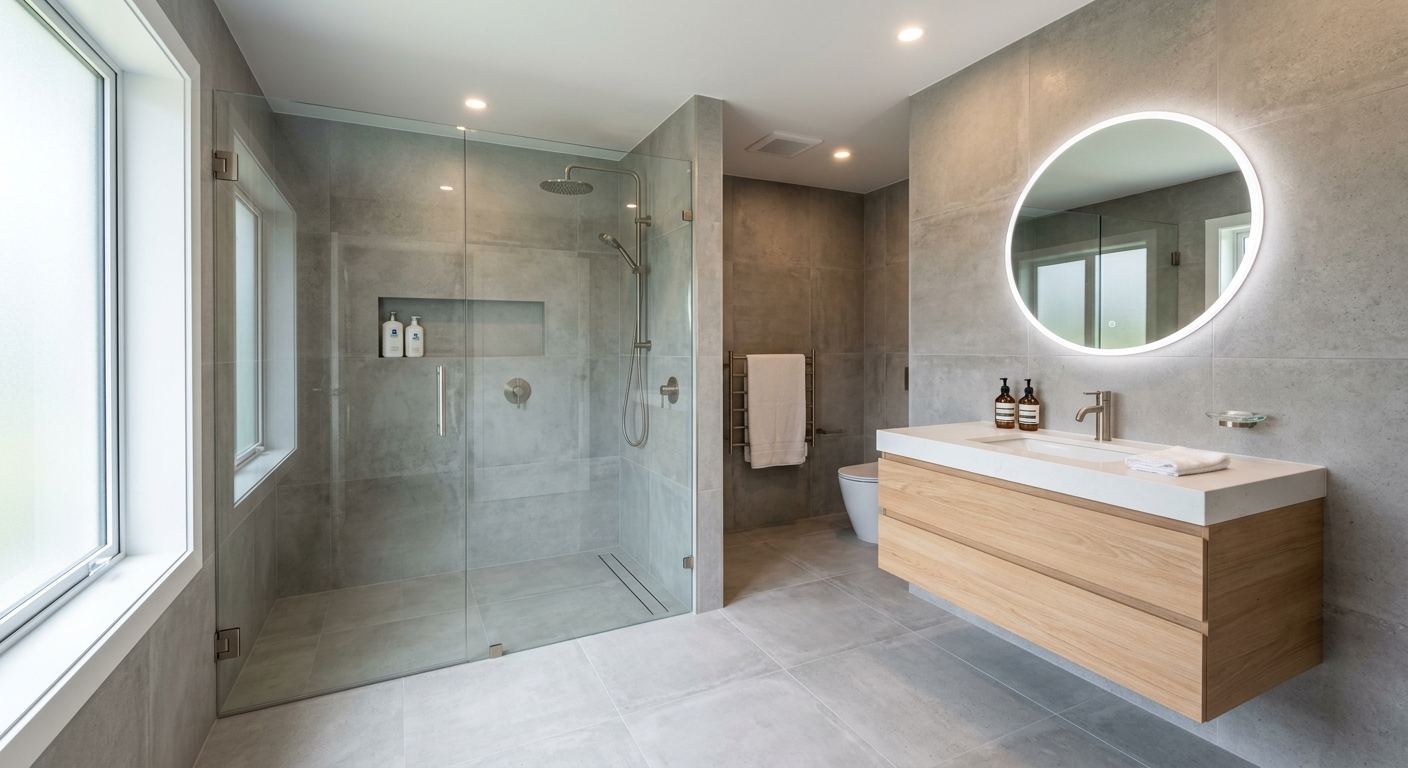
Bathroom renovation options and costs in Hamilton
Bathroom renovations in Hamilton can run the gamut from a quick refresh to a full rebuild, and your cost largely comes down to how much you change. In Hamilton, many homes were built before 1981 (54.6% per the 2021 Census), which often means older drain layouts, dated shut-offs, and finishes that hide surprises once the walls and floors open up. Homeowner households are also common (93.9% of households own), so there’s steady demand for mid-range updates that improve day-to-day comfort and support resale.
In the Muskoka–Kawarthas market, pricing is driven more by labour coordination and housing age than by extreme climate. We still see higher schedule pressure when several trades must line up—plumbing rough-in, electrical, waterproofing, and tile setting—especially in neighbourhoods where there’s active housing turnover and renovation activity, such as Stoney Creek. Contractors in the Peterborough–Kawarthas area often price slightly under major GTA centres, but Hamilton projects still reflect Ontario’s current labour market. When older plumbing is uncovered (cast-iron or copper drain sections, galvanized supply lines) or when ventilation needs upgrading, a “simple” bathroom update can move from cosmetic into a true renovation. That shift is what commonly pushes mid-range projects toward the full-renovation band (typically $12,000 – $28,000) rather than staying closer to fixture-only scopes.
Below is a clear comparison of common options so you can align your expectations before you request itemised quotes.
| Renovation Scope |
What's Included |
Typical Duration |
Price Range |
| Cosmetic refresh (paint, fixtures, accessories only) |
Paint, replace vanity or toilet (if plumbing is already positioned), swap faucets, mirrors, towel bars, caulking updates |
3–6 days |
$3,000 – $7,000 |
| Mid-range full renovation (new tile, vanity, tub/shower, electrical) |
Demo, waterproofing and tile (floor + walls), new vanity/trim, tub-to-tile or tub surround, electrical updates (GFCI + fan wiring), plumbing refresh as needed |
2–3 weeks |
$12,000 – $20,000 |
| High-end full renovation (custom tile, steam shower, heated floors) |
Custom layout refinements, premium tile work, heated floor circuit, higher-tier plumbing trim, steam shower or advanced walk-in shower components, enhanced ventilation |
3–5 weeks |
$20,000 – $28,000 |
| Shower-only installation (convert tub to walk-in shower) |
Demo tub area, new shower base/pan, waterproofing, tile setting, new shower valve trim, drain tie-in, exhaust fan/fan wiring if required |
2–3 weeks |
$4,500 – $9,000 |
| Bathtub replacement or tub-liner install |
Remove and replace bathtub and trim, new caulk/seal system, basic plumbing checks; liner option where appropriate for minimal wall demolition |
5–10 days |
$800 – $2,500 |
| Tile-only installation (floor + surround, existing layout kept) |
Remove existing tile, prep surfaces, install waterproofing and tile (typically floor + shower surround), re-seal and re-grout |
1–2 weeks |
$1,500 – $4,500 |
Prices are estimates only and vary by project scope, site access and material selection.
What affects the price of bathroom renovation in Hamilton
Even when two Hamilton homeowners want the “same” bathroom—new vanity, fresh tile, updated fixtures—quotes can differ by 30–50% across Ontario because bathroom work is labour- and coordination-heavy. In our region (including Muskoka–Kawarthas), contractors may charge slightly less than major GTA cores, but Hamilton projects still run on Ontario’s current multi-trade labour rates. The biggest swing factor isn’t the tile colour; it’s what gets discovered once the walls and floors open.
Regional housing age is a major driver. With 54.6% of homes built before 1981, it’s common to uncover cast-iron or older copper drain sections that require upgrades, plus supply lines that need rework (galvanized or corroded connections). Ventilation is another frequent scope increase: older bathrooms often lack ducted fan wiring to modern standards, which can push you into electrical changes (GFCI and dedicated fan circuit work). If asbestos is discovered in older floor tile or drywall compound (more common in pre-1985 homes), abatement protocols can add $1,500–$5,000+ to the budget.
Concrete examples we see in Hamilton: (1) keeping a tub and re-tile only often fits the $12,000 – $20,000 mid-range band; (2) converting to a walk-in shower can jump because the drain tie-in, waterproofing system, and sometimes fan venting must be corrected to prevent moisture issues; (3) large-format porcelain can lower grout lines visually, but labour increases with extra subfloor prep and tighter tolerances—pushing tile-only work toward the upper end of $1,500 – $4,500.
| Price Factor |
Why It Matters |
Cost Impact |
| Layout change — moving drain or supply lines requires rough-in work |
Draining and water routing often means opening joists/walls and new connections |
+10% to +25% |
| Tile selection — large-format porcelain vs. mosaic vs. ceramic |
Different tile thickness, weights, and cutting/layout complexity affect labour and waste |
+5% to +20% |
| Fixture tier — builder-grade vs. mid-range vs. designer brands |
Trim kits, valves, and faucets vary in price and sometimes require different rough-in parts |
+0% to +30% |
| Subfloor condition — rot or unlevel concrete adds scope |
Uneven or damaged substrates require repairs and additional prep materials |
+5% to +25% |
| Electrical — adding GFCI outlets, exhaust fan, heated floor circuit |
Code-required circuits, fan wiring/ducting and sometimes new breaker work |
+5% to +20% |
| Waterproofing method — membrane type and extent |
Better systems cost more but reduce call-backs from leaks and mouldy substrates |
+5% to +15% |
| Older-home surprises — asbestos tile, cast-iron drains, galvanized pipes |
Testing/abatement and plumbing replacement increase schedule and material costs |
+5% to +40% |
| Bathroom size — sq ft drives tile and labour time directly |
More surface area means more prep, waterproofing, thinset, and setting time |
+0% to +30% |
Permits & regulations in Ontario
In Ontario, many straightforward cosmetic updates in a Hamilton bathroom rarely require permits—for example, swapping a toilet or vanity in the same location (with no plumbing relocation), repainting, replacing trim and accessories, or retiling without changing the layout. Where permits become important is when you change systems, not finishes. Typically, you DO need a permit when you relocate plumbing (moving a drain or supply lines), add or alter electrical circuits for things like a new exhaust fan, install heated floor circuits, or make structural changes that alter framing or wall structure. You usually DO NOT need a permit for fixture swaps that keep existing rough-in connections intact, routine re-caulking and re-grouting, or tile replacement where there’s no electrical/plumbing relocation and no structural modifications.
For electrical work, code compliance and licensed trade involvement matter. A licensed electrician must complete or sign off on the electrical portion (especially any new dedicated fan circuit, GFCI-protected bathroom outlet circuits, or heated floor connections). For plumbing rough-in changes, permits and inspection are commonly required before surfaces close in.
Here’s how a homeowner can verify properly, step-by-step:
- Ask for the contractor’s Ontario trade licence number (as applicable) and confirm it using the relevant provincial/regulated trade registry.
- Request a certificate of insurance for liability (and confirm it includes renovation work).
- Confirm WSIB/WCB clearance (ask for the clearance letter or proof). This protects you if a worker is injured on site.
- Before signing, verify who will pull permits (you should know whether it’s included in the quote).
- Have the scope specify inspections timing—so you know what will be inspected before the tile goes down.
Choosing tile, waterproofing and fixtures for your Hamilton bathroom
In Hamilton, your bathroom budget is shaped by three material decisions: tile, waterproofing, and fixture tier. Start with tile. Entry-level ceramic (often the lowest material and easy to handle) can be a good choice where you keep the layout simple and the substrate is sound. Mid-range porcelain is more durable and better for high-traffic floors, but it usually costs more and demands careful prep for a flatter finish. Natural stone (marble, travertine, slate) looks luxurious, yet it typically brings extra installation complexity—more challenging cutting and higher labour time—plus potential sealing and maintenance considerations.
Next is waterproofing, which is critical in Ontario’s humidity cycle. The right waterproofing system reduces the risk of mould and substrate deterioration behind tile. A paint-on membrane can be economical on small areas, but bonded sheet membranes or a properly detailed schluter-type system (with correct seams/edges) often provide more robust protection in showers where water exposure is intense. If your home is older (common in Hamilton given the pre-1981 stock), waterproofing quality matters even more because older substrates may be less stable.
Finally, fixture tier affects both budget and resale. Builder-grade valves and trim can work fine, but designer brands often include better cartridge/flow performance and finish durability. A practical budget example: you might pay for mid-range porcelain tile and still keep the vanity on the builder-to-mid tier—often a better trade-off than using natural stone everywhere while keeping waterproofing basic.
| Material / Option |
Pros |
Cons |
Price Range |
| Ceramic tile (floor + walls) |
Good affordability; wide style selection; works well for standard wall applications |
Less durable than porcelain for floors; may chip if substrate isn’t well prepped |
$1,500 – $2,800 |
| Porcelain tile (floor + walls) |
Higher durability; lower water absorption; strong choice for shower surrounds and floors |
Can be heavier to handle; large-format porcelain increases layout precision requirements |
$2,500 – $4,500 |
| Natural stone (marble, travertine, slate) |
Premium look; unique veining; strong curb appeal when installed cleanly |
Costlier materials; more demanding installation; sealing/maintenance may be required |
$4,000 – $8,000 |
| Frameless glass shower enclosure |
Brightens the space; modern appearance; typically easier to clean than many framed options |
Premium hardware cost; requires precise framing/plumb alignment |
$1,200 – $3,000 |
| Prefab tub surround (acrylic) |
Fast install; fewer tile-setting variables; good water resistance when installed correctly |
Less “custom” look; may not match high-end tile finishes; limited design variety |
$800 – $2,000 |
| Custom shower pan (tile or linear drain) |
Best performance and aesthetics for walk-in showers; supports linear drainage and clean transitions |
More labour and waterproofing detail; requires accurate slope and drain placement |
$2,000 – $6,500 |
How to choose a bathroom renovation contractor in Hamilton
Choosing the right bathroom renovation contractor in Hamilton means verifying credentials and reading the quote the way an estimator would. Start with licensing and coverage. Ask for the contractor’s Ontario trade licence information where applicable and request proof of liability insurance. Then confirm they carry WSIB/WCB coverage—get the clearance letter or clearance proof. If they can’t provide it, keep looking; it’s a safety and financial protection issue, not a formality.
Next, collect 2–3 itemised written quotes that separate labour and materials (tile, waterproofing membranes, shower valve trim, electrical rough-in, disposal). You’re looking for line items, not one lump sum. Scope clarity prevents the biggest budget overruns: ask what’s excluded (subfloor replacement, permit pulling, asbestos testing/abatement, bathroom fan ducting, plumbing rough-in changes). Also confirm whether disposal and drywall/tile removal are included.
Warranty matters in moisture-heavy bathrooms. Request the workmanship warranty length (for example, tile setting and waterproofing labour), confirm the product/manufacturer warranties for fixtures and membranes, and ask whether those warranties are transferable if you sell your home. Payment schedule should be conservative—avoid paying more than about 10–15% upfront, and use a holdback until completion and punch-list items are finished. Finally, insist on a written timeline with a start date and completion estimate so trade coordination doesn’t drag.
- Verify Ontario trade licence(s) where required and match them to the work being quoted.
- Request proof of liability insurance and confirm coverage limits are reasonable for renovations.
- Ask for WSIB/WCB clearance before work starts; get the clearance letter.
- Use itemised quotes with labour vs materials separated.
- Ensure waterproofing and shower details are written into the scope (membrane type, seams, corners).
- Ask whether permits are included and who will pull them.
- Confirm disposal and demolition debris removal are included.
- Check whether electrical work includes GFCI and the exhaust fan circuit where needed.
- Confirm plumbing rough-in inspection and whether shut-off/isolation changes are included.
- Demand a clear timeline with key milestones (rough-in, inspection, tile prep, tile set, final trim).
- Review warranty terms in writing for workmanship and key waterproofing components.
- Keep a holdback until the job is complete and any leaks/punch-list items are addressed.
Red flags in Hamilton include: quotes that are unusually low without a detailed scope; contractors who won’t provide insurance/WSIB clearance; no written warranty for waterproofing/tile labour; vague allowances (e.g., “fixtures included” without brand/model) that lead to surprises; and requests for large upfront payments (beyond 10–15%) without a signed completion schedule.
Frequently asked questions — bathroom renovation in Hamilton
Should I do a tub-to-shower conversion?
If you’re aiming for easier daily use or planning for future accessibility, a tub-to-shower conversion is often a smart move in Hamilton. A walk-in shower tends to be more practical for regular bathing, and in homes where the tub surrounds are aging, you can combine demo with proper waterproofing and ventilation upgrades. Cost-wise, shower installation is commonly in the $4,500 – $9,000 band for the conversion scope. Whether it’s worth it depends on your plumbing layout—if your drain and supply lines are close to where the new shower will sit, you stay closer to the lower end. If you need moving rough-in or correcting old venting, the full renovation band (often $12,000 – $28,000) becomes more likely.
How do I prevent mold in a Hamilton bathroom?
Mould prevention is mostly about moisture control, not just paint. In Hamilton, bathrooms see repeated humidity from showers, and older homes (many pre-1981) sometimes have ventilation that’s underpowered or not ducted properly. The best approach is to install a properly sized exhaust fan with correct venting, ensure bathroom outlets and fan wiring meet Ontario code requirements, and use a waterproofing system designed for showers (with correct seams and detailing). Also, make sure grout and caulk joints are sealed correctly and that water can’t sit at the edges. If your contractor retiles over a questionable substrate, it can trap moisture. Good renovation scopes include subfloor prep, membrane use, and leak testing before tile is finished.
What adds the most resale value in a bathroom reno?
Resale value usually comes from improvements buyers can see and trust: a clean, modern layout; durable surfaces; and evidence the home is protected from future water damage. In Hamilton’s housing stock (with many older homes built before 1981), premium buyers often appreciate updated waterproofing, ventilation, and an electrical refresh that includes GFCI protection. Tile quality also matters—porcelain flooring and a well-detailed shower surround often read as higher-end than budget finishes. A full renovation typically falls around $12,000 – $28,000, and that’s where you’re most likely to get the “complete package” effect. If you can’t reach full renovation scope, a shower update plus proper fan upgrades can still make a strong impression.
Can I keep my existing plumbing layout to save money?
Yes—keeping the existing plumbing layout is one of the best ways to control costs in Hamilton. When you don’t move drains or supply lines, you reduce rough-in labour, inspection steps, and the risk of opening more walls than necessary. That’s especially important in older homes where drain stacks and pipe materials may be dated, and where surprise remediation can add cost. If your vanity location and tub/shower valve positions are already workable, you can often focus budget on tile, fixtures, and waterproofing rather than on re-piping. In practice, many homeowners see better value when they choose a mid-range full renovation within $12,000 – $20,000 rather than paying for layout changes that push the project toward the upper end.
How much does a walk-in shower cost in Hamilton?
A walk-in shower cost depends on what you’re converting from and how complex the waterproofing details are. For a shower-only conversion (tub-to-shower), typical Hamilton pricing is often in the $4,500 – $9,000 range when the existing plumbing layout can be used and electrical/venting changes are straightforward. If you’re also replacing the floor, doing full tile to the ceiling, adding a linear drain, or upgrading heated surfaces, costs can move upward into full renovation territory (commonly $12,000 – $28,000). Your contractor should explain whether you need drain rework, whether your ventilation must be upgraded, and what shower pan or membrane system they’ll install.
What's the ROI on a bathroom renovation?
Bathroom renovation ROI in Hamilton varies by how much you change and how well the work is done. While buyers value modern bathrooms, the best financial return usually comes from durable, moisture-safe systems—especially in older homes built before 1981 where outdated ventilation and plumbing can cause long-term issues. A full renovation budget often lands in the $12,000 – $28,000 band, and it tends to perform better when it includes waterproofing upgrades, solid tile installation, and electrical safety improvements. If you do a small refresh only, ROI may be more limited if the underlying shower/tile or ventilation issues remain. The strongest ROI typically comes from matching the upgrade to your home’s baseline condition, not necessarily from the most expensive fixtures.