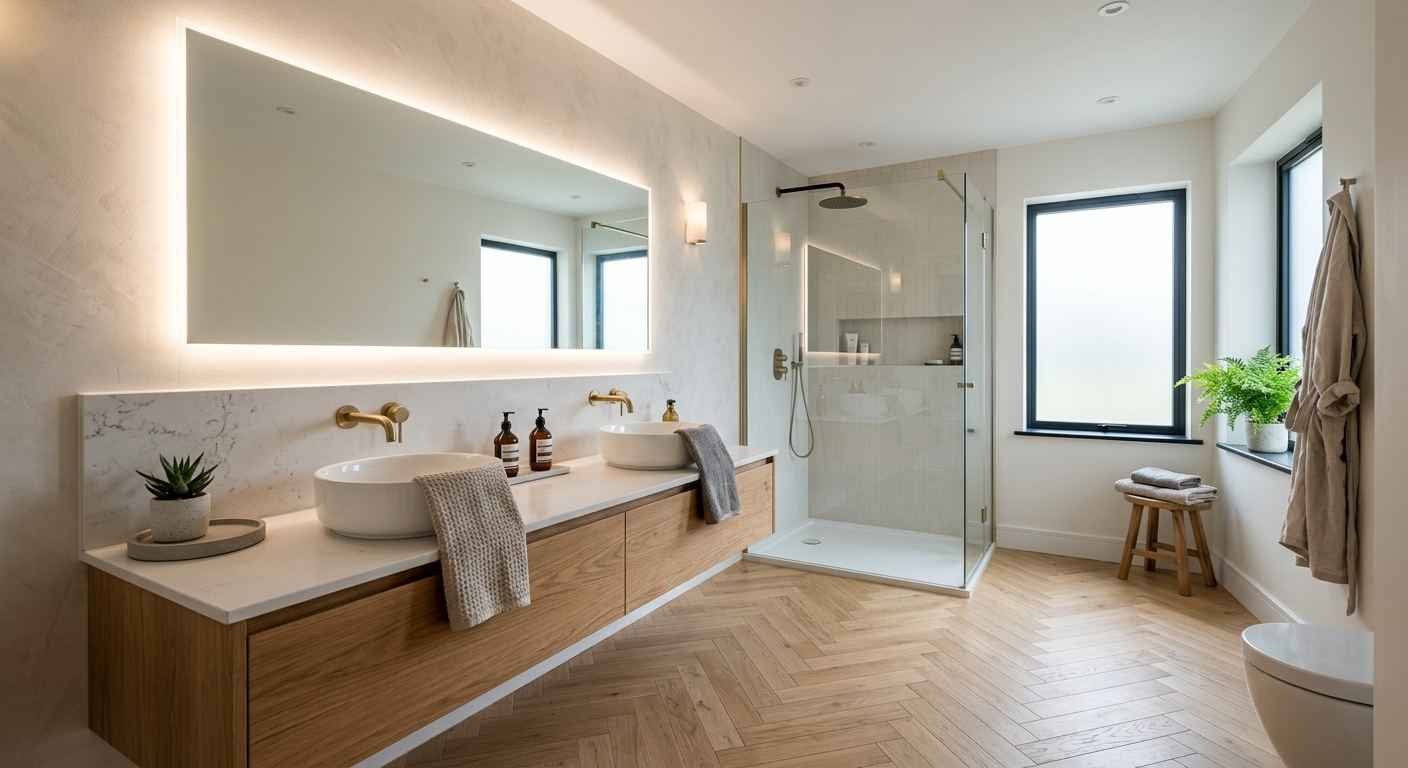
Bathroom renovation options and costs in Downtown Cambridge
Downtown Cambridge bathroom renovations tend to fall into a few repeatable scopes—mostly because many homes in the area share a mid-century or older construction profile. In practice, that means dated plumbing layouts (and sometimes cast-iron or galvanized lines), which can affect everything from how long the demo takes to what’s required to bring drains and supply up to modern expectations. It’s also why surprises like asbestos-containing materials in older finishes can surface during demo; if present, that adds remediation and disposal time. With a small Downtown Cambridge population base of 3,117 residents (Statistics Canada, 2021 Census), the same local trades often book faster during peak renovation months, so timing and availability can shape your schedule even when the design is simple.
In the Kitchener–Waterloo–Barrie corridor, costs are driven less by “weather risk” and more by labour rates and how much you need to upgrade behind the walls. Skilled trades commonly bill around $75–$120 per hour, so project management and rough-in labour can become the main budget variable. Cosmetic refreshes in newer-feeling bathrooms sit closer to the lower end of the regional ranges, while full gut work in older homes—venting upgrades, electrical corrections, and potential remediation—often lands in the mid-five-figure band, consistent with what you’ll see across Cambridge, Waterloo and Barrie.
Below are realistic budget ranges for common Downtown Cambridge options, so you can compare quotes apples-to-apples before you commit.
| Renovation Scope |
What's Included |
Typical Duration |
Price Range |
| Cosmetic refresh (paint, fixtures, accessories only) |
Paint, swap vanity/top or reface, replace toilet/faucet/shower head, new mirror and accessories, basic caulking, deep clean |
3–7 days |
$3,000–$8,000 |
| Mid-range full renovation (new tile, vanity, tub/shower, electrical) |
Demo and rebuild, vanity and toilet replacement, new tub/shower surround or tile surround, select mid-range tile, GFCI where needed, new exhaust fan (if upgrading), waterproofing |
2–4 weeks |
$14,000–$28,000 |
| High-end full renovation (custom tile, steam shower, heated floors) |
Custom layout, premium tile, heated floor system, frameless or custom glass, steam-ready plumbing/electrical coordination, enhanced waterproofing, upgraded ventilation |
4–7 weeks |
$28,000–$40,000 |
| Shower-only installation (convert tub to walk-in shower) |
Remove tub, install walk-in shower pan or waterproofed base, glass door/enclosure, new valve and trim, updated venting as needed, tile floor and surround |
2–3 weeks |
$7,500–$16,000 |
| Bathtub replacement or tub-liner install |
Option A: replace tub, re-plumb to match, new surround/caulking; Option B: tub-liner installation with prep and sealing |
2–5 days (liner) or 1–2 weeks (replacement) |
$1,500–$7,000 |
| Tile-only installation (floor + surround, existing layout kept) |
Tile demo and set, new backer/waterproofing prep, tile floor and wall surround, grout and seal, standard vanity/supply to remain |
1–3 weeks |
$1,500–$7,000 |
Prices are estimates only and vary by project scope, site access and material selection.
What affects the price of bathroom renovation in Downtown Cambridge
In Downtown Cambridge and across the broader Kitchener–Waterloo–Barrie corridor, two quotes for the same-looking bathroom can differ by 30–50% because the cost drivers are mostly behind-the-wall and labour-based. Local skilled trades typically bill around $75–$120 per hour, and when demolition turns up surprises, the “labour hours per finished square foot” can jump quickly. Climate plays a role in material choice (ventilation and waterproofing matter), but in this region the bigger budget swings come from housing age, rough-in upgrades, and project management complexity rather than weather itself.
Older homes in the region often hide cast-iron or copper drain stacks that need upgrading, galvanized supply lines that may require replacement sections, and ventilation that no longer performs well. A bathroom that needs a new exhaust fan (and a properly routed circuit) tends to be more expensive than a cosmetic refresh—especially if duct routing isn’t straightforward. Asbestos can also be present in some older flooring or plaster materials; if discovered during demo, abatement protocols can add about $1,500–$5,000+ to the budget depending on extent and access.
Concrete Downtown Cambridge examples: (1) moving a tub valve or shower drain to improve layout usually means more rough-in work, not just new tile, and that can move a project closer to the mid-range full renovation band (for example, around $14,000–$28,000). (2) Keeping the existing plumbing and using a simpler tile format can help you stay nearer to tile-only budgets (often $1,500–$7,000), even if you upgrade the look. If heated floors or a steam-ready shower is added, labour coordination and electrical scope commonly push costs toward the upper full-reno band ($28,000–$40,000).
| Price Factor |
Why It Matters |
Cost Impact |
| Layout change — moving drain or supply lines |
Requires rough-in demolition, new pipe runs, and potentially new subfloor support |
Often the largest swing factor; can add several thousand dollars |
| Tile selection — large-format porcelain vs. mosaic vs. ceramic |
Harder cuts, more waste, and more labour for complex patterns |
Material + labour can increase total by a noticeable margin |
| Fixture tier — builder-grade vs. mid-range vs. designer brands |
Higher trim/valve quality, better warranty, and sometimes more installation complexity |
Can add hundreds to several thousand dollars depending on selection |
| Subfloor condition — rot or unlevel concrete adds scope |
Needs repair/replacement before waterproofing and tile installation |
Delays and added demolition can raise costs materially |
| Electrical — adding GFCI outlets, exhaust fan, heated floor circuit |
May require licensed electrician work and additional wiring/box work |
Often adds a few thousand dollars when new circuits are needed |
| Waterproofing method — membrane type and extent |
Coverage and system compatibility affect mould risk and long-term performance |
Upfront cost increases, but reduces costly failures later |
| Older-home surprises — asbestos tile, cast-iron drains, galvanized pipes |
Remediation, disposal, and pipe upgrades expand time and labour |
Frequently adds $1,500–$5,000+ when asbestos is found; pipe work can be more |
| Bathroom size — sq ft drives tile and labour time directly |
More floor and wall area means more setting, grout, and drying time |
Larger bathrooms cost more across all scopes |
Permits & regulations in Ontario
In Ontario, many purely cosmetic bathroom updates in Downtown Cambridge typically do not require permits. Swapping fixtures (toilets, faucets, shower heads), replacing a vanity, repainting, and retiling without changing plumbing or structural elements are usually treated as cosmetic work. However, permits are commonly required when you change plumbing locations (moving drains or supply lines), add or modify ventilation with new electrical work, or make structural wall changes that affect load-bearing components.
Electrical is a key dividing line. Any new circuits, significant electrical changes, or work that requires connection to the household system must meet the provincial electrical code and be performed by or signed off by a licensed electrician. Plumbing rough-in changes—especially when you’re altering drain/supply routes—typically require a permit and inspection.
Here’s a practical step-by-step way to verify a contractor before signing in Downtown Cambridge:
- Ask for the contractor’s Ontario trade licence number (and the specific trade that matches the work being done).
- Request a certificate of liability insurance showing the right legal entity and coverage limits.
- Confirm WSIB/WCB coverage for the crews that will be on-site (or the equivalent clearance documentation).
- Get an itemised estimate that clearly labels what requires permits and which party pulls them.
- Request the electrician/plumber names if they are subcontracting and verify their credentials too.
- Ask for proof of insurance renewal dates before the start date.
Doing these checks up front helps you avoid delayed inspections, incomplete work, and cost overruns when hidden plumbing or ventilation issues appear.
Choosing tile, waterproofing and fixtures for your Downtown Cambridge bathroom
In Downtown Cambridge, your bathroom budget usually comes down to three material decisions: tile, waterproofing, and fixtures—and picking the right combination prevents the kind of moisture problems that show up faster in Ontario’s humid bathroom environments. First, tile choice affects both look and installation complexity. Ceramic tile is often the most budget-friendly for entry-level floors and wall work, while porcelain is denser and better suited for heavier traffic and wet-zone durability. Natural stone (marble, travertine, slate) can create a high-end spa feel, but it often requires more careful sealing and more precise installation.
Second is waterproofing method. Ontario bathrooms benefit from a complete waterproofing system, not just paint-on products. Paint-on membranes can work in some cases, but bonded sheet membranes and proven system approaches (including compatible shower systems) generally offer stronger, more predictable protection when detailed correctly—especially around corners, niche edges and changes in plane. This is where correct installation matters as much as the brand.
Third is fixture tier. Builder-grade fixtures can keep costs down, while mid-range or designer brands often improve longevity and resale appeal through better valve performance, finishes, and warranty support. For example, if your core renovation is planned around $14,000–$28,000, you can justify spending more on waterproofing and a durable porcelain tile selection, while keeping fixture trim mid-range. If you instead “overspend” on luxury stone but use a minimal waterproofing approach, you may spend more now and still risk future failures. In a high-end plan near $28,000–$40,000, heated floors and a premium shower system can be worth it—because labour coordination and long-term comfort are part of the payoff.
Matching your budget to these three areas is how you get a bathroom that looks premium, drains cleanly, and stays mould-resistant in real day-to-day use.
| Material / Option |
Pros |
Cons |
Price Range |
| Ceramic tile (floor + walls) |
Entry-friendly cost, good for walls, wide style selection |
More prone to chipping if subfloor is imperfect; may be less ideal for highly wet-floor exposure depending on product |
$1,500–$5,000 |
| Porcelain tile (floor + walls) |
Durable in wet zones, lower water absorption, many modern large-format options |
Heavier tiles can increase handling and labour; large-format layout requires careful planning and flatness |
$2,500–$7,000 |
| Natural stone (marble, travertine, slate) |
Unique character and luxury look; excellent when installed and finished correctly |
Higher material and labour costs; sealing/maintenance requirements; can stain or etch if not managed |
$5,000–$12,000 |
| Frameless glass shower enclosure |
Bright, modern look; easier to keep clean than older curtain setups |
More expensive hardware; requires precise installation and stable waterproofing substrate |
$2,500–$6,500 |
| Prefab tub surround (acrylic) |
Fast install, consistent surfaces, good water management when sealed correctly |
Less design flexibility than tile; repairs may be more limited if damaged |
$1,500–$4,000 |
| Custom shower pan (tile or linear drain) |
Clean, upscale drainage; seamless integration with waterproofing system |
More labour-intensive; requires correct slope and detailing around edges/linear drain |
$3,000–$9,000 |
How to choose a bathroom renovation contractor in Downtown Cambridge
Choosing the right contractor in Downtown Cambridge starts with verifying credentials and then controlling risk through the quote and schedule. First, confirm Ontario licensing for the trades involved and check liability insurance coverage before any work begins. For coverage, ask for documentation in writing: a current certificate of insurance (showing the contractor as named insured) and WSIB/WCB clearance or equivalent proof for the people who will be on-site. If a contractor can’t provide these documents promptly, treat that as a serious gap.
Next, get 2–3 itemised written quotes instead of a single lump sum. A good quote separates labour and materials, lists line items for demo, rough-in (if any), waterproofing system, tile setting, fixtures, and electrical/plumbing allowances. Scope clarity is everything: ask what’s included for permit pulls (if required), disposal, and any patching/painting after tile or waterproofing work. Make sure exclusions are specific (for example, “subfloor replacement if rot is discovered” or “additional electrical if panel upgrades are required”).
Look at warranty details: confirm workmanship warranty length (often separate from product warranties), whether it covers leaks, and whether product/manufacturer warranties transfer to you. Payment scheduling should be conservative—typically no more than 10–15% upfront, with meaningful holdback tied to completion and final walkthrough. Finally, ask for a start date and completion estimate in writing so you can plan around lead times for tile and glass.
- Ask for Ontario trade licence details that match the work being quoted.
- Request liability insurance certificate and verify coverage is active for the project dates.
- Confirm WSIB/WCB clearance for the contractor’s crews (or proof for subcontractors).
- Get a written scope that lists inclusions and exclusions line-by-line.
- Confirm who pulls permits and whether inspections are included in the schedule.
- Ensure disposal and haul-away are explicitly included or itemised.
- Check that waterproofing is specified by method and coverage area, not just “waterproofing”.
- Demand an itemised tile quote showing tile supply and labour separately.
- Ask about grout type, sealing, and any maintenance recommendations.
- Review electrical scope: GFCI, exhaust fan wiring, heated floor circuit (if applicable).
- Ask for warranty terms in writing and whether it covers leaking/remediation.
- Agree on payment schedule with holdback until punch-list completion.
Concrete red flags in Downtown Cambridge: (1) they refuse to itemise labour vs. materials, (2) they can’t show insurance or WSIB/WCB proof, (3) they quote “tile waterproofing” without naming the system or detailing requirements, (4) they ask for large upfront payments beyond 10–15%, and (5) they don’t address older-home risks like venting performance, subfloor flatness, or potential remediation during demo.
Frequently asked questions — bathroom renovation in Downtown Cambridge
How long does tile installation take in a Downtown Cambridge bathroom?
Tile installation time in Downtown Cambridge typically depends on bathroom size, tile format, and whether you’re rebuilding the layout or keeping plumbing where it is. For a straightforward floor + wall surround tile-only project, many jobs land around $1,500–$7,000 and take about 1–3 weeks of working time (not counting ordering delays for specialty tile). Larger-format porcelain, intricate mosaics, or custom niche work can extend that timeline because of layout planning, careful cuts, and longer cure/setting schedules. If the subfloor is unlevel or damaged, extra prep (patching, re-laying underlayment, or repairs) can add several days before any tile goes down.
How much does a bathroom renovation cost in Downtown Cambridge?
In Downtown Cambridge, most full bathroom renovations commonly land within the regional band of $14,000–$40,000, largely because labour rates and rough-in upgrades matter more than climate-driven variables. A cosmetic refresh is typically much lower, while a full gut with upgraded ventilation and electrical tends to sit in the mid-five-figure range. Converting a tub to a walk-in shower can fall into the shower/convert range (often around $7,500–$16,000 depending on plumbing movement and glass). If your home is older, hidden issues discovered during demo—like cast-iron drains, older supply lines, or asbestos-containing materials—can add several thousand dollars to the final budget.
How long does a bathroom renovation take in Downtown Cambridge?
Typical timelines in Downtown Cambridge vary by scope and how much is changed behind the walls. Cosmetic refresh projects (paint and fixture swaps only) are often completed in about 3–7 days. Mid-range full renovations commonly take 2–4 weeks, while higher-end projects with heated floors, custom tile layouts, or steam-ready systems often run 4–7 weeks. The biggest schedule drivers are waiting on tile, glass enclosures, and waterproofing cure time, plus inspection timing if plumbing or electrical changes trigger permits. In older homes, demolition can uncover additional work (subfloor repair, drain upgrades, or remediation), which can extend the schedule even when the visible design stays the same.
Do I need a permit for a bathroom renovation in Ontario?
In Ontario, many cosmetic bathroom updates generally don’t require permits—such as replacing a vanity, swapping fixtures, repainting, or retiling without moving plumbing. However, if you relocate plumbing (moving drains or supply lines), add a new exhaust fan circuit, modify electrical, or change structural elements, you should expect permits and inspections to be required. Electrical work must be done or signed off by a licensed electrician and must meet Ontario electrical code requirements. For a Downtown Cambridge homeowner, the fastest way to confirm is to have your contractor list each change in writing and state whether it triggers a permit. Always verify the contractor’s Ontario trade licence and ask for proof of insurance and WSIB/WCB coverage before permitting starts.
What's the best tile for a bathroom in Downtown Cambridge?
The “best” tile depends on your priorities, but for most Downtown Cambridge bathrooms the practical choice is porcelain for floors and wet zones because of its durability and low water absorption. Ceramic can work well for wall areas and entry-level floors if you pick the right product, but porcelain is more forgiving long-term in high-moisture conditions. Natural stone (like slate or travertine) can look stunning, yet it usually needs careful sealing and more maintenance to prevent staining. Whichever tile you select, the real success factor is the waterproofing system and correct installation details—especially around corners, niches, and where the shower meets the floor.
Should I do a tub-to-shower conversion?
A tub-to-shower conversion is often a smart choice in Downtown Cambridge when you want easier daily use, better accessibility, or you’re updating an older tub area that no longer performs well. It typically costs more than a simple refresh because you’re changing drainage and adding waterproofing and shower components. Budget-wise, many conversions land around $7,500–$16,000, depending on whether plumbing needs major re-routing and whether you add frameless glass and a custom shower pan. If your existing plumbing layout is friendly, the project can be straightforward. If you discover older supply or drain issues behind the wall, it can require additional work to bring everything up to modern standards, and that’s where timelines and budgets can expand.