Bathroom renovation options and costs in Erin
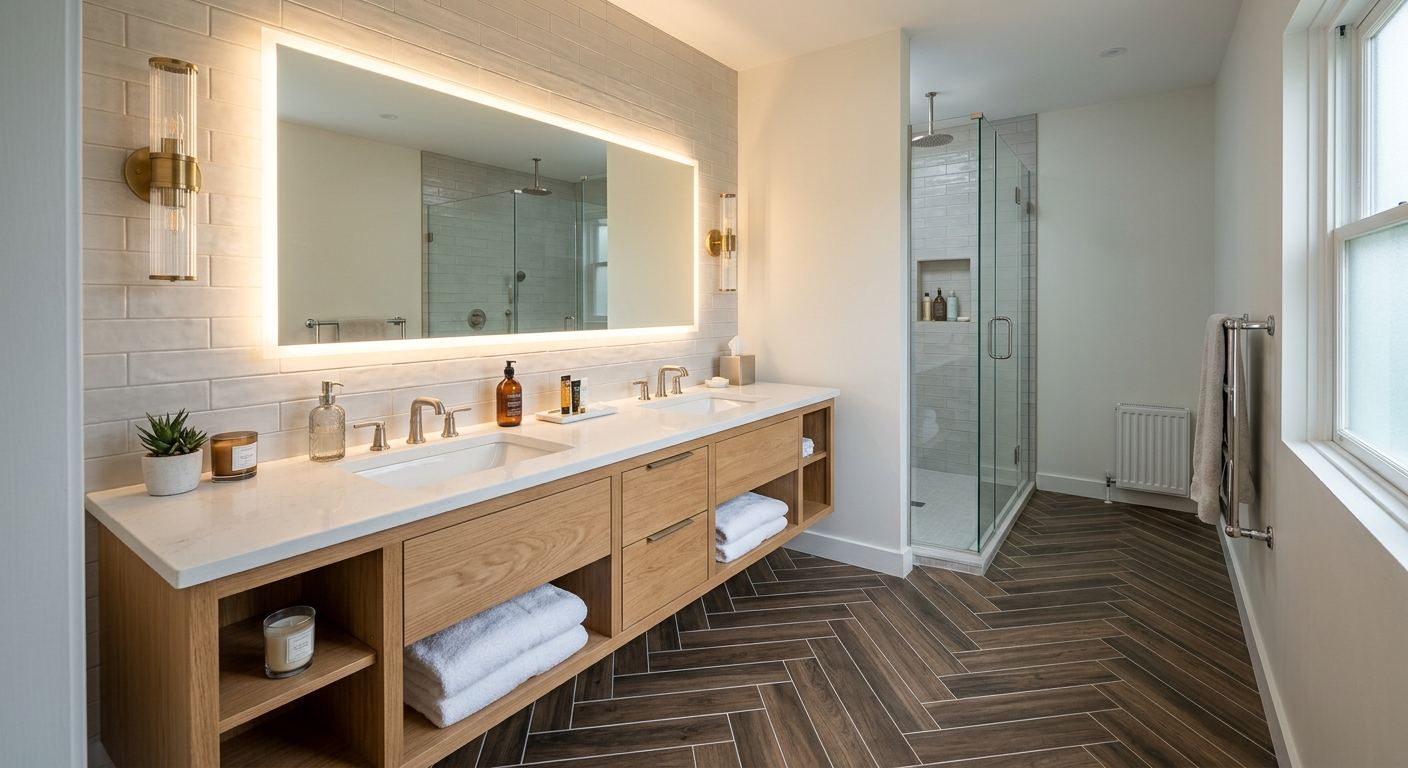
In Erin, Ontario, bathroom renovations range from quick refreshes to full gut projects, and the right option depends on what you want to change and what you discover once walls and floors open up. With 58.2% of homes in the wider profile built before 1981 and 91.5% of dwellings being single-detached, it’s common to run into older plumbing layouts, dated ventilation, and uneven subfloors. In the Kitchener–Waterloo–Barrie corridor, pricing is driven less by climate and more by labour availability and the age of the housing stock—skilled trades typically bill in the $75–$120/hour range, so project management and skilled labour can make up a large share of the total budget. The result is that even “same-looking” bathrooms can land far apart in cost once demolition, rough-ins, and ventilation upgrades are included.
Erin neighbourhoods like Erin Village tend to attract steady renovation demand because homeowners often prefer upgrades that hold up well for resale while improving day-to-day comfort. In older homes, it’s also not unusual to uncover hidden risks—such as worn drain piping, insufficient exhaust ducting, or older materials that must be handled carefully—pushing projects toward the mid-to-upper end of the local ranges. To help you budget realistically, the table below compares common renovation scopes and typical durations for Erin homeowners.
| Renovation Scope |
What's Included |
Typical Duration |
Price Range |
| Cosmetic refresh (paint, fixtures, accessories only) |
Surface prep and paint, replace vanity and mirror, swap toilet/sink/faucet, update accessories (towel bars, lighting fixtures if no wiring changes), caulking and minor silicone work |
2–5 days |
$3,000 – $8,000 |
| Mid-range full renovation (new tile, vanity, tub/shower, electrical) |
Demo to working order, new floor and wall tile, vanity + mirror, tub/shower surround or tile surround, new exhaust fan (often tied to electrical work), updated shutoffs, new GFCI outlet (where needed), plumbing/electrical patching and finishing |
2–3 weeks |
$14,000 – $26,000 |
| High-end full renovation (custom tile, steam shower, heated floors) |
Extensive waterproofing, custom shower system or steam-ready layout, heated floors, high-end tile and fixtures, upgraded ventilation strategy, premium trim, potential drain/vent upgrades, refined lighting plan |
3–5 weeks |
$26,000 – $40,000 |
| Shower-only installation (convert tub to walk-in shower) |
Remove tub, rough-in adjustments for drain slope, waterproofing and shower pan system, new glass enclosure (or wall kit), new valve trim, tile floor and walls around shower, exhaust fan assessment |
1.5–3 weeks |
$7,000 – $15,000 |
| Bathtub replacement or tub-liner install |
Replace tub and re-seal, new faucet trim if required, update surround as needed, plumbing connection work, finishing and caulking; liner installs where layout allows |
3–7 days |
$3,000 – $9,000 |
| Tile-only installation (floor + surround, existing layout kept) |
Tile removal where needed for substrate prep, re-leveling, tile floor and wet-area walls, waterproofing system, grout/seal finish, trim and transitions; fixtures mostly retained if in good shape |
1.5–2.5 weeks |
$5,000 – $14,000 |
Prices are estimates only and vary by project scope, site access and material selection.
What affects the price of bathroom renovation in Erin
Even when two Erin homeowners choose the same “look” for a bathroom, quotes can differ by 30–50% across the Kitchener–Waterloo–Barrie corridor and Ontario because the biggest variable is not aesthetics—it’s what the renovation uncovers and how much skilled labour is required to correct it. Regional labour rates in this corridor commonly land in the $75–$120/hour bracket, and older housing often means more time for skilled demo, rough-in fixes, and careful reassembly.
In this region, 58.2% of homes built before 1981 typically carry plumbing and electrical practices that are outdated. It’s common to find cast-iron or older drain stacks that require upgrading for proper slope, galvanized supply lines nearing end-of-life, and ventilation that doesn’t exhaust moisture effectively. Those “hidden scope” discoveries can move a job from a low-end refresh into the mid-range full renovation band; likewise, asbestos can be an issue in older floor tile or older drywall materials, which triggers abatement protocols and can add $1,500–$5,000+ to the budget depending on how extensive the affected area is.
Concrete examples we see in Erin: (1) If you keep the tub and just update the tile, tile installation typically fits the lower end of the $14,000–$26,000 mid-range range; (2) if you move the vanity or convert a tub to a walk-in shower, drain slope and waterproofing complexity often push the project toward the upper end of the $26,000–$40,000 high-end band; (3) adding a new exhaust fan can be straightforward on a newer bathroom, but in older homes it may require new wiring runs and duct routing, which increases labour. Climate matters less than the building setup, because the real cost driver is moisture control details done to modern standards.
| Price Factor |
Why It Matters |
Cost Impact |
| Layout change — moving drain or supply lines requires rough-in work |
Changing wet-area locations means opening walls/floors, re-routing plumbing, and ensuring correct drain slope and shutoff access |
Often adds $3,000 – $10,000 |
| Tile selection — large-format porcelain vs. mosaic vs. ceramic |
Harder tile can require more specialized cutting, better substrate prep, and longer install time |
Typically $1,500 – $6,000 difference |
| Fixture tier — builder-grade vs. mid-range vs. designer brands |
Premium valves, toilets, and vanities cost more and sometimes require more intricate installation components |
Often $500 – $4,000+ |
| Subfloor condition — rot or unlevel concrete adds scope |
Unlevel or water-damaged subfloor requires repair, re-leveling, and sometimes structural stabilization |
Commonly $1,000 – $5,000 |
| Electrical — adding GFCI outlets, exhaust fan, heated floor circuit |
Electrical tie-ins require licensed work, new circuits, and code-compliant protection |
Often $800 – $4,000 |
| Waterproofing method — membrane type and extent |
Better systems and proper detailing reduce future leaks and failure risk; incorrect method leads to costly rework |
Typically $1,000 – $6,000 depending on shower scope |
| Older-home surprises — asbestos tile, cast-iron drains, galvanized pipes |
Discovery drives demolition, disposal, possible abatement, and plumbing upgrades |
Often $1,500 – $10,000+ |
| Bathroom size — sq ft drives tile and labour time directly |
More surface area means more waterproofing, mortar, grouting, and installation hours |
Usually $1,500 – $8,000 swing |
Permits & regulations in Ontario
In Ontario, many “like-for-like” bathroom updates are treated as cosmetic work and typically do not require permits, such as swapping fixtures (toilet, vanity, sink, faucet) in the same location, repainting, replacing trim, and doing retiling where plumbing connections are unchanged. However, permits and inspections usually are required when you change the wet-area footprint or introduce new electrical scope.
Work that typically DOES require a permit includes: relocating plumbing (moving a drain or supply line), adding or modifying plumbing rough-ins for a new shower valve location, and any structural changes to walls/ceiling that alter framing. Electrical work that involves new circuits, changing panel/circuit capacity, or installing an exhaust fan with new wiring must be performed to provincial code and is generally handled by a licensed electrician. Exhaust fan ducting and fan placement can also require coordination, especially if it affects ceiling/wall spaces.
How to verify your contractor in Erin (step-by-step): First, request their Ontario trade licence details and confirm they match the trade scope on your project. Second, ask for a certificate of insurance showing liability coverage; verify the expiry date and that it matches the job location. Third, confirm WSIB/WCB coverage (or the accepted clearance proof for your contractor’s situation) before work starts. Finally, ensure the permit pull is clearly stated in the written scope (who pulls it, when, and what it covers), and keep copies of licence and insurance documents for your records.
Choosing tile, waterproofing and fixtures for your Erin bathroom
Your Erin bathroom budget usually bends (for better or worse) based on three decisions: tile choice, waterproofing method, and fixture tier. In this part of Ontario, winters and indoor heating can intensify condensation and make small waterproofing failures show up faster—so the “cheapest option” on waterproofing often becomes the most expensive once leaks start. With homeowners here commonly living in homes built pre-1981, substrate conditions and moisture history also affect which materials perform best.
1) Tile choice: Ceramic tile is a good entry option, while porcelain is denser, handles moisture better, and often looks cleaner over time. Natural stone can deliver a luxury look, but it’s more sensitive to maintenance and requires careful sealing and installation practices. 2) Waterproofing: Paint-on membranes can work in simpler layouts, but showers generally benefit from a full system—either bonded sheet membrane or a properly installed system like an approved board/slot approach. The goal is continuity at corners, niches, and around the drain. 3) Fixture tier: Builder-grade fixtures keep initial costs down; mid-range improves longevity and finish quality; designer items can elevate the look but may change installation details.
How to match this to your situation: if you’re staying in the $14,000–$26,000 mid-range band, prioritize porcelain tile and a proven shower waterproofing system, then select mid-range fixtures. If you’re pushing toward $26,000–$40,000, spending on heated floors and premium stone or custom shower elements is where the upgrade feels justified—especially if you’re converting from tub to shower. For example, upgrading from ceramic to porcelain may add roughly $1,500–$4,000 across a full wet-area tiling scope, but it’s often a better long-term choice than trying to cut costs on waterproofing.
| Material / Option |
Pros |
Cons |
Price Range |
| Ceramic tile (floor + walls) |
Lower material cost, wide style selection, good for non-shower walls and moderate shower use when installed correctly |
Typically less dense than porcelain; can chip with impact and may wear differently over time |
$1,500 – $4,500 |
| Porcelain tile (floor + walls) |
More water-resistant, durable finishes, commonly better for high-moisture zones and long-term appearance |
Higher material and sometimes more precise prep/cutting needs |
$3,000 – $7,000 |
| Natural stone (marble, travertine, slate) |
Unique look and premium feel, excellent for statement bathrooms |
Requires sealing/maintenance and careful selection; installation labour often increases |
$6,000 – $14,000 |
| Frameless glass shower enclosure |
Modern appearance, easier to clean than curtain systems, helps visually expand the space |
More expensive and installation depends on tile plane accuracy; may require additional hardware |
$2,500 – $6,500 |
| Prefab tub surround (acrylic) |
Fast install, consistent sealing when installed properly, budget-friendly for tub surrounds |
Limited style options versus tile; can dent with impact and may not match high-end aesthetics |
$1,500 – $3,500 |
| Custom shower pan (tile or linear drain) |
Luxury look, better drainage and slope planning, supports a true no-leak shower system when detailed correctly |
More detailed waterproofing and framing work; higher labour and material costs |
$4,000 – $12,000 |
How to choose a bathroom renovation contractor in Erin
Choosing the right contractor in Erin starts with verifying the basics and then matching their process to how bathroom renovations fail (usually at water containment, ventilation, and rough-in details). First, confirm they carry Ontario trade licensing applicable to their scope and provide liability insurance with a current certificate. Next, request proof of WSIB/WCB coverage (or a clearance letter/acceptable proof where applicable) before any work begins—this matters because demolition, tile removal, and electrical/plumbing changes can’t be treated like “general labour only.”
Second, get 2–3 itemised written quotes with a labour + materials breakdown, not a lump sum. Make sure the proposal clearly states whether a permit is included, what inspections are expected, and whether disposal/dump fees are included. Third, check warranty: confirm the workmanship warranty length (how long they stand behind waterproofing and install quality), the product/manufacturer warranties (what covers fixtures and tile), and whether warranties are transferable if you sell your home.
Fourth, agree on payment timing. Avoid large deposits; a common rule of thumb is never more than 10–15% upfront, and hold back a portion until key closeout items are complete. Finally, require a written start date and realistic completion estimate, since older homes can add time if plumbing vents or subfloor repairs are discovered.
- Ask for the contractor’s Ontario licence details tied to your exact scope.
- Request liability insurance certificate and confirm the job address is covered.
- Confirm WSIB/WCB clearance/proof is current before demolition starts.
- Get at least two itemised quotes (labour, materials, fixtures, tile, waterproofing, electrical, plumbing).
- Ensure the scope includes permit pull, inspection scheduling, and any required upgrades.
- Confirm disposal is included (demolition debris, tile haul-away, old fixtures removal).
- Verify waterproofing scope: method, coverage areas, and how corners and penetrations are detailed.
- Ask how they handle older-home surprises (cast-iron drains, galvanized lines, subfloor repair).
- Review the schedule: demolition day, rough-in inspections, tile/waterproofing cure times, and finish day.
- Confirm who provides and installs the exhaust fan and whether ducting is upgraded if needed.
- Check warranty terms in writing, including workmanship and any exclusions.
- Set a payment schedule and keep a holdback until final caulking, grout sealing (if included), and walkthrough are complete.
Concrete red flags to watch for in Erin: (1) quotes that won’t break out waterproofing and ventilation work; (2) a “permit included” claim with no permit responsibility spelled out; (3) asking for most of the money upfront; (4) vague warranties (no duration or missing workmanship terms); and (5) no proof of insurance or WSIB/WCB coverage before signing.
Frequently asked questions — bathroom renovation in Erin
What's the best bathtub material for a Erin home?
For most Erin, Ontario homeowners, the “best” bathtub material is the one that matches your install method and long-term maintenance plan. If you’re doing a full renovation, a quality acrylic tub is often the practical choice because it’s lighter (easier set-in), and it’s typically installed with reliable sealing and backing support. If you’re staying in a tighter scope like a tub replacement, your budget is often closer to the $3,000–$9,000 band, where acrylic is common. For older Erin homes (many built pre-1981), the real decision driver is whether your plumbing connections and subfloor are in good shape—your contractor should inspect the drain connection and supports before choosing a tub.
Is it worth renovating a bathroom before selling in Erin?
Usually, it can be worth it in Erin, but the value depends on how dated the space is and how much deferred maintenance exists. Cosmetic upgrades can improve appeal quickly, especially if your plumbing is in decent condition—think paint, lighting, vanity refresh, and re-sealing. If your bathroom has hidden issues (poor ventilation, old drain piping, water-damaged subfloor, or outdated electrical near wet areas), a “quick fix” can cost more in the long run. In many older single-detached homes—where 58.2% of the housing stock in the local profile predates 1981—buyers notice bathroom moisture control. A focused mid-range full renovation in the $14,000–$26,000 range often offers the best balance of appearance and reliability.
How do I plan a bathroom renovation on a tight budget in Erin?
To stay on budget in Erin, start by choosing one theme: either upgrade finishes without moving plumbing, or upgrade plumbing/ventilation first and keep the layout. Avoid moving drain/supply lines unless you truly need to—layout changes are usually where projects jump the most. If you’re aiming for a smaller spend, a cosmetic refresh can keep costs closer to the lower band (for example, $3,000–$8,000) while you plan bigger upgrades later. If you need tile, consider porcelain for durability but keep the scope to the wet areas (don’t tile every surface) and align your waterproofing method with the shower size. Also, plan for older-home contingencies: in pre-1981 homes, discovery work can happen, so you’ll want a buffer in your budget.
What's the difference between a cosmetic and a full bathroom renovation?
A cosmetic renovation is mainly surface-level: swapping fixtures and accessories, painting, and updating visible finishes while keeping plumbing and electrical locations the same. A full bathroom renovation typically includes demolition to the working substrate, replacing tile across floors and wet walls, refreshing the vanity and lighting, and often addressing ventilation and electrical safety near the wet zone. In older Erin homes, full renovations frequently include rough-in updates for drains, supply lines, and exhaust improvements, which is why costs land in the mid-five-figure range more often than not. For example, a mid-range full renovation in the $14,000–$26,000 band can include tile, tub/shower updates, and electrical upgrades, while cosmetic work is usually closer to the $3,000–$8,000 range.
How do I choose the right contractor for my bathroom in Erin?
In Erin, start by verifying Ontario trade licensing and asking for a liability insurance certificate before work begins. Next, request proof of WSIB/WCB coverage or a clearance letter—this is essential because bathroom jobs often involve demolition, electrical tie-ins, and plumbing rough-ins. Then get 2–3 itemised written quotes that clearly separate labour and materials and specify whether permits, disposal, and inspections are included. Be cautious of vague scopes. Waterproofing and ventilation should be described specifically: method, coverage, and how penetrations are sealed. Finally, confirm warranty terms for workmanship and ask if the warranty is transferable if you sell your home. A reputable contractor will answer these questions without pushing back.
What's the most common mistake homeowners make in bathroom renovations?
The most common mistake is underestimating hidden scope—especially in older Erin homes where plumbing, ventilation, and substrate conditions aren’t always what they look like behind existing finishes. Homeowners sometimes plan a budget for “new tile” but then get surprised by old drain slope issues, failing ventilation ducting, an unlevel subfloor, or, in some cases, materials that require careful handling. Another common error is choosing a waterproofing plan based on price rather than long-term performance, which can lead to leaks and expensive rework. If you’re targeting either the $14,000–$26,000 mid-range band or moving toward the $26,000–$40,000 high-end range, build a contingency and ensure your contractor’s scope specifically covers waterproofing, exhaust, and any necessary rough-in upgrades.