Bathroom renovation options and costs in Willingdon Heights
Bathroom renovation in Willingdon Heights often comes down to how much you want to change—because the Lower Mainland–Southwest market has both higher trade demand and a high chance of hidden upgrades once walls and floors open. With a population of 12,443 (Statistics Canada, 2021 Census), Willingdon Heights sits in a region where many homes are mid-century, and dated plumbing layouts are common. In older housing, it’s not unusual to find aging cast-iron or galvanized components, and sometimes asbestos-containing materials in older flooring or drywall compound. Those surprises can turn a “simple” refresh into a fuller scope.
In the Lower Mainland–Southwest, the main cost drivers are labour rates and housing age—not day-to-day climate alone. Metro Vancouver and nearby communities like Burnaby and Surrey have relatively high construction labour costs, and trades can be booked out. When contractors open up the bathroom, they frequently discover the need for plumbing and venting upgrades to bring systems up to current British Columbia code. That’s why even modest bathrooms can land in the same price band as larger projects elsewhere.
If you’re renovating near Willingdon Avenue and the surrounding commercial/residential corridors, expect extra scheduling considerations for access and driveway or street parking, which can affect labour productivity. Next, use the comparison table to align your priorities with typical ranges for Willingdon Heights.
| Renovation Scope |
What's Included |
Typical Duration |
Price Range |
| Cosmetic refresh (paint, fixtures, accessories only) |
Paint, replace vanity or toilet only (no plumbing relocation), swap light/fan where existing wiring allows, new towel bars, mirrors, accessories |
3–7 days |
$3,500 – $8,500 |
| Mid-range full renovation (new tile, vanity, tub/shower, electrical) |
Remove finishes, new tub/shower or surround, new vanity and toilet, tile floor + walls, waterproofing, exhaust fan upgrade, GFCI where needed, basic plumbing refresh |
2–4 weeks |
$18,000 – $32,000 |
| High-end full renovation (custom tile, steam shower, heated floors) |
Custom tile work, steam shower or premium walk-in, heated floor circuit, upgraded waterproofing system, designer fixtures, improved venting strategy, niche/specialty storage |
4–7 weeks |
$32,000 – $45,000 |
| Shower-only installation (convert tub to walk-in shower) |
Demo tub, add new shower pan/drain strategy, glass enclosure, tile surround and floor transition, waterproofing, exhaust fan assessment, plumbing rough-in adjustments |
2–3 weeks |
$12,000 – $25,000 |
| Bathtub replacement or tub-liner install |
Replace tub (or liner where suitable), new surround up to tub deck, recaulk/grout, re-connect plumbing, re-tiling as needed at seams, leak test |
5–10 days |
$1,500 – $6,000 |
| Tile-only installation (floor + surround, existing layout kept) |
Tile removal and prep, install waterproofing system, new floor tile and wall surround, replace minor trim, keep existing plumbing locations |
1–2 weeks |
$6,000 – $14,000 |
Prices are estimates only and vary by project scope, site access and material selection.
What affects the price of bathroom renovation in Willingdon Heights
In Willingdon Heights, the same bathroom can come back with quotes that differ by 30–50% because contractors may price different levels of investigation and risk. Two projects that look identical on paper can split in cost once trades start opening walls—particularly in older homes common across the Lower Mainland–Southwest. While climate matters for ventilation and moisture control, it’s labour availability and housing age that most strongly move the needle. In this region, higher construction labour costs mean you pay more for each day of skilled plumber, tiler and electrician time.
Older homes in the Lower Mainland–Southwest frequently hide cast-iron drain stacks or galvanized supply lines that need upgrading once the current configuration is exposed. If the existing venting can’t support modern fixture loads, scope expands to meet current British Columbia expectations. Another major swing factor is asbestos: if asbestos-containing materials are discovered in pre-1985 flooring, drywall compound or insulation, abatement steps can add roughly $1,500–$5,000+ depending on extent and access. That’s one reason a “mid-range” renovation in the $18,000–$32,000 band can creep toward the $32,000–$45,000 end when remediation and extra trades come into play.
Concrete examples from Willingdon Heights: (1) Keeping the plumbing in place can keep you closer to shower-only ranges, while moving a drain or supply line usually requires rough-in work and more labour days. (2) A small bathroom with unlevel subfloor can add more prep than you’d expect; correcting it affects tile install time and waterproofing detail. (3) Upgrading an exhaust fan that’s underperforming—or adding a heated floor circuit—can add electrical scope even when layout stays the same. For predictable budgeting, plan for contingency and confirm what’s behind the walls before finalizing finishes.
| Price Factor |
Why It Matters |
Cost Impact |
| Layout change — moving drain or supply lines requires rough-in work |
Changes plumbing rough-in, framing access, patching and sometimes venting strategy |
Often adds $2,500–$8,000+ |
| Tile selection — large-format porcelain vs. mosaic vs. ceramic |
Higher-end tile can require more precise cuts, higher waste, and more careful substrate prep |
Commonly shifts $1,500–$6,000 |
| Fixture tier — builder-grade vs. mid-range vs. designer brands |
Premium fixtures cost more and may require different rough-in or trim packages |
Typically $500–$3,500 |
| Subfloor condition — rot or unlevel concrete adds scope |
Repairs and re-leveling increase labour and material, and affect waterproofing longevity |
Often $1,000–$7,000 |
| Electrical — adding GFCI outlets, exhaust fan, heated floor circuit |
Requires licensed electrical work, permits/inspections if new circuits added |
Commonly $800–$4,500 |
| Waterproofing method — membrane type and extent |
Better systems reduce mould risk, but require correct installation and overlap detailing |
Often $600–$3,000 |
| Older-home surprises — asbestos tile, cast-iron drains, galvanized pipes |
Triggers remediation and replacement, adds trades and disposal |
Roughly $1,500–$10,000+ |
| Bathroom size — sq ft drives tile and labour time directly |
More area increases labour hours and materials; small bathrooms can still cost high due to complexity |
Varies widely; often the biggest driver after labour |
Permits & regulations in British Columbia
In British Columbia, cosmetic updates—like swapping a vanity, replacing a toilet, repainting, or retiling without moving plumbing—often do not require a permit. However, work that changes plumbing, adds new electrical circuits, or alters structural walls typically does. In practice, bathroom renos in Willingdon Heights usually fall into two categories: “finishes-only” versus “system upgrades.” If you’re relocating a drain or supply line, adding or relocating a tub/shower, or changing venting paths, expect permit and inspection requirements for the plumbing rough-in.
Electrical is the other key area. If you’re adding a new exhaust fan, moving lighting, installing a heated floor circuit, or adding GFCI protection where none exists, electrical work must meet provincial code and be done or signed off by a licensed electrician. Even when the contractor says “it’s straightforward,” permits and inspections are what keep work compliant and insurable.
Step-by-step, here’s how a homeowner can verify a contractor in Willingdon Heights: (1) Ask for the contractor’s British Columbia trade licence number(s) and confirm it using the appropriate online registry for the trade they perform. (2) Request a current certificate of insurance (liability) and ensure the coverage matches the job value. (3) Ask for proof of WSIB/WCB coverage where applicable for the contractor and confirm it’s active for the renovation period. (4) Keep copies of licence and insurance documents in your project file before the first payment.
Choosing tile, waterproofing and fixtures for your Willingdon Heights bathroom
For a bathroom renovation budget in Willingdon Heights, three material decisions usually determine both comfort and cost: tile choice, waterproofing method, and fixture tier. First, tile: ceramic is an entry-level option and can be cost-effective when you want a straightforward look. Porcelain is typically stronger and better suited for higher-moisture areas, but it often has tighter tolerances for flatness and can increase installation time. Natural stone (marble, travertine, slate) looks premium, yet it requires careful sealing and selection because absorbency varies and the wrong prep can cause staining or uneven performance.
Second, waterproofing: in British Columbia’s coastal conditions, a bathroom stays humid—so waterproofing quality directly affects mould risk. Paint-on membranes can work for some systems, but bonded sheet membranes or engineered systems (including well-detailed linear drain setups) often provide more robust protection when installed correctly. Third, fixtures: builder-grade parts lower upfront cost, while mid-range and designer brands can improve longevity and resale appeal, but the real budget impact is installation detail and trim compatibility.
Matching your budget to your situation: if your priority is staying near the $18,000–$32,000 mid-range, choose porcelain tile with a proven waterproofing system and invest in upgrades that reduce long-term risk (like a better exhaust fan and waterproofing coverage). If you’re moving toward the $32,000–$45,000 end, heated floors, custom shower pans, and larger-format tile layouts justify the extra labour and material precision.
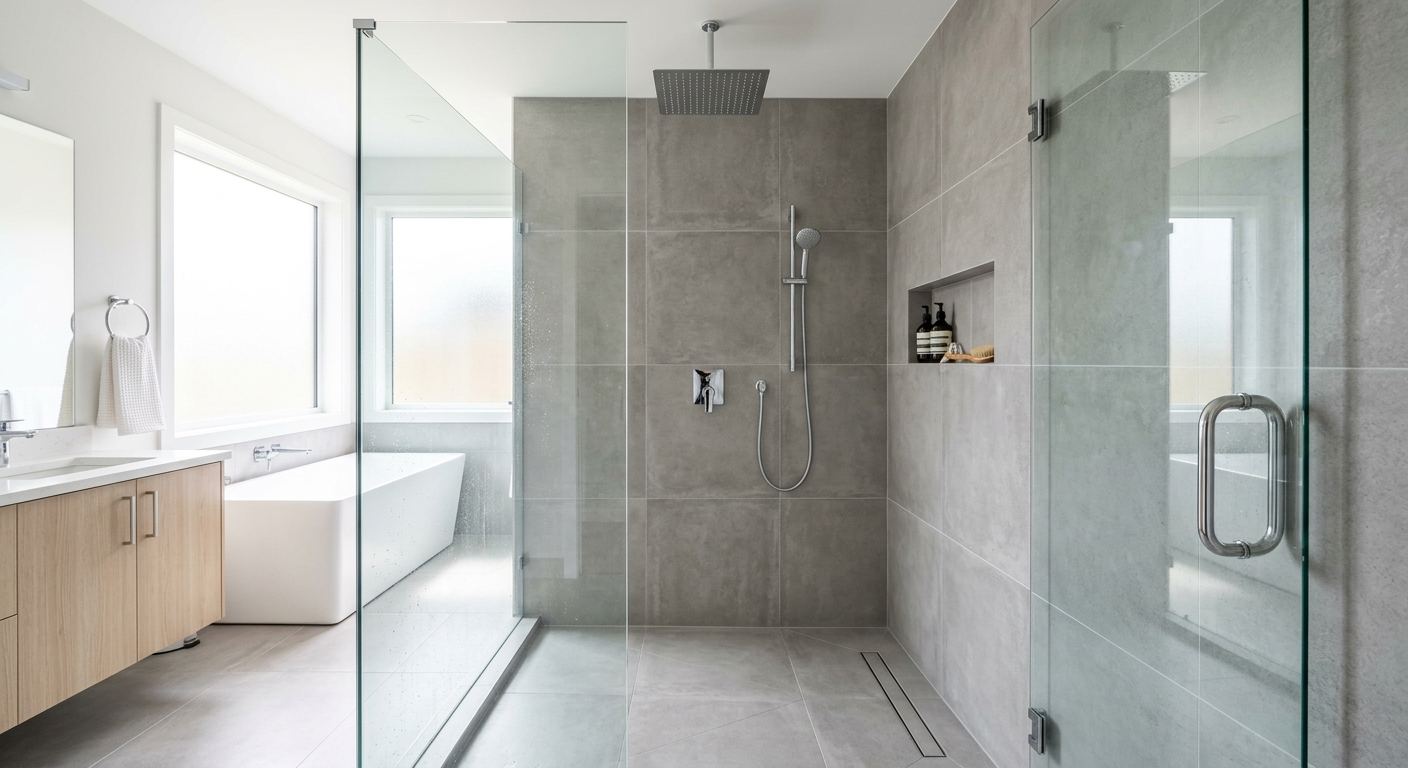
Example: upgrading from a basic tub surround to a custom tile shower with a linear drain typically adds meaningful cost, but it’s justified when you want barrier-free access and a cleaner drainage line. In contrast, swapping decorative faucets without improving the shower waterproofing rarely changes long-term performance—and usually isn’t where homeowners get the best return.
| Material / Option |
Pros |
Cons |
Price Range |
| Ceramic tile (floor + walls) |
Lower material cost, wide style selection, good for basic shower surrounds when properly waterproofed |
More prone to chipping than porcelain if subfloor isn’t well prepped; less strength under heavy use |
$2,000 – $6,000 |
| Porcelain tile (floor + walls) |
Denser, more durable, often better water resistance and stability; supports modern large-format looks |
Requires excellent substrate flatness; premium tile can increase waste/cut complexity |
$4,000 – $9,000 |
| Natural stone (marble, travertine, slate) |
High-end appearance, unique veining and texture |
Needs sealing/maintenance; can cost more to install and to keep consistent in colour and finish |
$7,000 – $14,000 |
| Frameless glass shower enclosure |
Clean, modern look; helps visually open a small bathroom |
Higher cost; requires precise wall/threshold alignment; can be harder to service |
$2,000 – $6,000 |
| Prefab tub surround (acrylic) |
Faster installation, fewer labour hours than full tile in many layouts |
Limited custom look; can be less flexible for niche/custom storage design |
$500 – $3,000 |
| Custom shower pan (tile or linear drain) |
Improved accessibility and drainage line; can create a seamless designer finish |
More labour and detailing; requires top-tier waterproofing workmanship |
$3,500 – $10,000 |
How to choose a bathroom renovation contractor in Willingdon Heights
Choosing a contractor in Willingdon Heights starts with verification. First, confirm British Columbia licensing for the trades they perform—especially the licensed electrician if any circuit work is included. Ask for a current certificate of liability insurance and ensure it’s not expired and shows coverage suitable for your renovation size. For coverage protection, request proof of WSIB/WCB coverage where applicable and keep it on file. A reputable renovation team should provide these documents quickly; if they hesitate, that’s a major warning sign.
Next, get 2–3 itemised written quotes. Don’t accept a single lump sum without breakdowns for labour, demolition/disposal, tile installation, waterproofing, plumbing changes, and electrical items. Itemised quotes help you compare like-for-like and catch exclusions like permit fees, haul-away, and patch-and-paint.
Read the scope carefully: what’s included for permit pulls, inspection scheduling, and disposal? Is there allowance for subfloor repairs if water damage is found? Check warranty terms too—look for a workmanship warranty (how long), manufacturer warranty for products, and whether warranties are transferable to the homeowner when the house sells. Finally, protect your cashflow: avoid paying more than about 10–15% upfront; hold back a portion until the job is complete and deficiencies are corrected. Get a start date and completion estimate in writing, with weather or material delay language if applicable.
- Confirm BC trade licence for relevant scopes and ask for licence numbers.
- Request liability insurance certificate (active dates and coverage amount).
- Ask for WSIB/WCB clearance/coverage documentation where applicable.
- Get 2–3 itemised quotes (labour + materials, not a single total).
- Clarify what’s included for demo, disposal, and site cleanup.
- Verify permit pull responsibility and whether fees are included or extra.
- Ensure waterproofing method and waterproofing warranty are stated.
- Ask how they handle subfloor or drain repairs if discovered late.
- Review timeline assumptions for lead times on tile, glass and vanities.
- Confirm electrical details: GFCI, exhaust fan ducting, and heated floor circuits (if any).
- Ask about jobsite protection (floor protection, dust control, ventilation).
- Confirm warranty terms in writing and who provides manufacturer coverage.
Concrete red flags we often see in bathroom renos across Willingdon Heights: (1) quotes that won’t specify waterproofing products or methods; (2) no mention of permits/inspection responsibility for plumbing or electrical changes; (3) asking for large upfront payments beyond 10–15% without a clear schedule; (4) missing licence/insurance/coverage paperwork when requested; (5) vague “allowances” that change once tiles arrive, without an agreed change order process.
Frequently asked questions — bathroom renovation in Willingdon Heights
What's the best bathtub material for a Willingdon Heights home?
In Willingdon Heights and the Lower Mainland–Southwest, the “best” bathtub material is the one that matches your subfloor condition, installation method, and how you use the space. Acrylic tubs are common because they’re lighter and often cost less to install, which can help if you’re trying to stay nearer the $1,500–$6,000 bathtub replacement/tub-liner band. Fibreglass and acrylic can be great, provided they’re properly supported and not installed over weak framing. Cast-iron is durable and long-lived but heavier and can cost more to replace. For most homeowners, the decision is less about brand preference and more about whether your bathroom floor and drain connections are ready for a smooth install and a watertight seal—especially if you’re also upgrading waterproofing.
Is it worth renovating a bathroom before selling in Willingdon Heights?
Often, yes—but it depends on the condition of what you’re fixing. If your bathroom has dated finishes, worn caulking, or visible moisture staining, a renovation can improve buyer confidence in British Columbia’s humid climate and can prevent a sale from stalling over inspection concerns. If you’re looking at a budget-conscious approach, a cosmetic refresh (paint, fixtures, accessories) can be the right first step, but buyers usually expect waterproofing competence in showers. If plumbing is aging—like older drains or supply lines—consider a scoped upgrade during renovation to avoid costly surprises later. In many Willingdon Heights sales situations, projects in the mid-range full renovation band (for example, $18,000–$32,000) tend to show better value than trying to “patch” problems repeatedly.
How do I plan a bathroom renovation on a tight budget in Willingdon Heights?
Start by protecting your budget with scope control. Keep plumbing locations the same if possible—moving drains or supply lines is where labour and rough-in costs expand quickly in the Lower Mainland–Southwest. Choose durable but not excessive materials: porcelain tile with a reliable waterproofing system, and mid-range fixtures that install cleanly. If you want savings, focus on removal and repair efficiency: get a contractor to check subfloor flatness before ordering tile, and confirm exhaust fan performance so you don’t pay twice. Another budget strategy is staged renovations: do waterproofing and key systems first, then update accessories later. If you’re aiming for a realistic number, many homeowners plan around the $18,000–$32,000 mid-range band for a true full reno, and reserve upgrades like heated floors or custom glass for later unless the layout truly supports the investment.
What's the difference between a cosmetic and a full bathroom renovation?
A cosmetic renovation mainly changes surfaces and visible fixtures without reworking core systems. In British Columbia terms, that usually means paint, replacing a vanity, swapping a toilet, updating mirrors and accessories, and sometimes retiling without moving plumbing. A full renovation goes beyond finishes: it typically involves demolition, new waterproofing, tile floor and wall rebuilds, updated electrical (like GFCI and exhaust fan upgrades), and often plumbing refresh or venting adjustments. The labour reality in Willingdon Heights is that opening walls exposes what’s behind them—age-related issues like cast-iron drains, galvanized supply lines, or outdated wiring can increase scope and cost. That’s why a full bathroom renovation commonly falls in the $18,000–$45,000 band, while cosmetic refreshes are usually much smaller.
How do I choose the right contractor for my bathroom in Willingdon Heights?
Choose a contractor by verifying documentation and comparing scopes. In Willingdon Heights, ask for the contractor’s British Columbia trade licence where relevant, current liability insurance, and proof of WSIB/WCB coverage where applicable. Then get 2–3 itemised written quotes so you can see labour and materials breakdowns—especially waterproofing method, electrical allowances, and disposal. Read exclusions carefully: permit pulls, demolition and haul-away should be clearly stated. Confirm the workmanship warranty length and whether product warranties are provided for the fixtures/tile systems. Finally, protect your payments: avoid more than 10–15% upfront and hold back until work is complete. A contractor should give you a start date and completion estimate in writing. If their quote is vague or their paperwork is slow, it’s usually a risk sign.
What's the most common mistake homeowners make in bathroom renovations?
The most common mistake in Willingdon Heights is under-scoping the “hidden work” until it’s too late—especially around plumbing, waterproofing details, and electrical. Homeowners may select beautiful tile and fixtures, only to discover the subfloor isn’t level or that an older drain line needs replacement when walls are opened. In the Lower Mainland–Southwest, another frequent issue is assuming ventilation is “good enough” and not budgeting for an exhaust fan upgrade, GFCI protection, or proper ducting. If older materials are present, asbestos discovery can trigger remediation steps and add cost. A practical fix is to include a contingency and require clear waterproofing specifications in the quote. If you’re comparing budgets, remember that a true mid-range full reno can be in the $18,000–$32,000 range—so a quote that’s far below that without explaining risk is often missing scope.