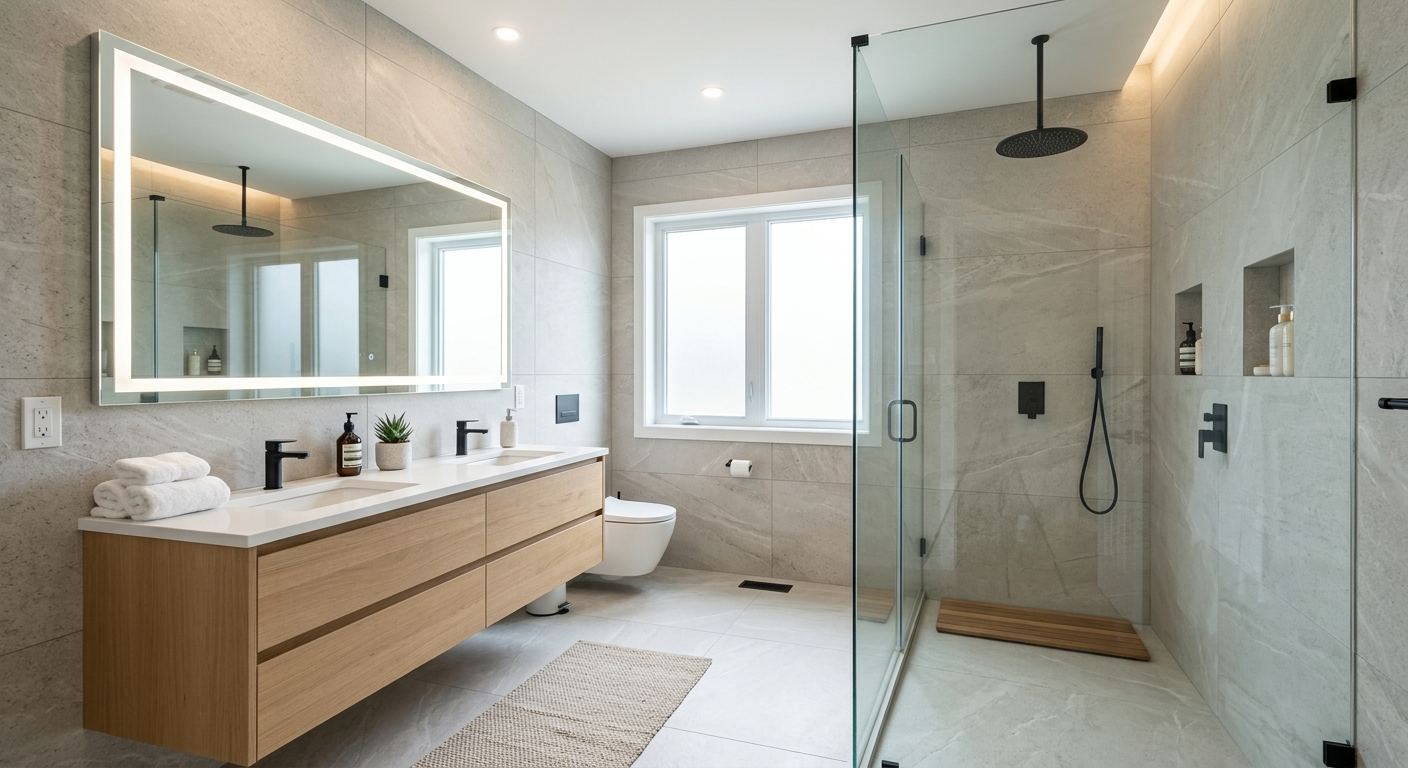
Bathroom renovation options and costs in Lexington
In Lexington, Ontario, bathroom renovations typically fall into a few clear “budget paths,” because the work is labour-heavy and the Toronto-area housing stock is often older. Lexington’s population is 7,330 (Statistics Canada, 2021 Census), and many nearby properties in the Toronto economic region reflect post-war and later eras where original plumbing layouts and ventilation setups can be dated. In homes from the mid-20th century into the 1980s, it’s common to discover surprises behind walls and flooring—think cast-iron or undersized drain piping and, in some cases, asbestos-containing floor materials—so even a straightforward refresh can expand in scope once walls are opened.
Toronto-area pricing is driven less by climate swings than by trade availability and local labour rates, especially for tile work, custom shower builds, and plumbing/venting bring-up-to-code. While Ontario’s overall moisture load doesn’t single-handedly determine cost, it does affect how thoroughly contractors must waterproof and ventilate—otherwise you’ll see premature grout failure and mouldy corners. Skilled trades can also be busier in established residential pockets; in Lexington, contractors are often in higher demand around older neighbourhood clusters where homes were built before modern exhaust-fan standards. With that in mind, the options below show realistic budget ranges so you can compare contractors apples-to-apples before the site visit leads to a final quote.
| Renovation Scope |
What's Included |
Typical Duration |
Price Range |
| Cosmetic refresh (paint, fixtures, accessories only) |
Paint, new vanity top or vanity swap (no plumbing relocation), toilet/bronze-grade fixtures if replacing like-for-like, towel bars, accessories, recaulk, basic deep clean |
3–7 days |
$4,500–$8,000 |
| Mid-range full renovation (new tile, vanity, tub/shower, electrical) |
Demo and disposal, wall and floor tile, new vanity and toilet, bathtub or tub/shower refresh, exhaust fan and GFCI outlet, updated shut-offs where needed, basic waterproofing, electrical trim-out and finishing |
2–3 weeks |
$12,000–$20,000 |
| High-end full renovation (custom tile, steam shower, heated floors) |
Custom shower/tub layout, higher-grade tile (including niche and linear drain options), steam shower components (as applicable), heated floor circuit, premium fixtures/valves, advanced waterproofing system, extended electrical scope, upgraded venting and trim details |
3–5 weeks |
$20,000–$30,000 |
| Shower-only installation (convert tub to walk-in shower) |
Demo tub and surround, new shower pan and waterproofing, tile surround, new valve trim, updated drain connection/venting checks, glass enclosure, exhaust fan check or upgrade if required |
10–16 days |
$8,000–$15,000 |
| Bathtub replacement or tub-liner install |
Replace old tub with new unit (or liner where appropriate), new caulking and sealing, minor tile touch-up, plumbing reconnection, access repairs |
5–10 days |
$1,200–$3,500 |
| Tile-only installation (floor + surround, existing layout kept) |
Remove existing tile/surface as needed, prep and level, install floor tile and shower surround, waterproofing and waterproofing transitions, grout, silicone trim, return to service |
7–14 days |
$3,000–$10,000 |
Prices are estimates only and vary by project scope, site access and material selection.
What affects the price of bathroom renovation in Lexington
Two contractors can quote the “same” bathroom renovation in Lexington and still land 30–50% apart, mainly because labour rates and the age of the local housing stock create uncertainty once walls are opened. In the Toronto economic region, bathroom work often costs more than the national average because skilled trades command premium hourly rates, and bathroom projects are labour-intensive—especially tiling, plumbing tweaks, and venting corrections. If your home is older, even minor finishes like new tile can trigger extra drain work or ventilation upgrades to meet current Ontario code, which can add several thousand dollars in drain reconfiguration, vent corrections, and new shut-offs.
Older-home conditions also change what contractors must manage for safety and durability. Discovery of asbestos-containing materials (often in older floor tile and some drywall compounds) can require licensed abatement, typically adding $1,500–$5,000+ to the budget. For example, a mid-range full renovation around $12,000–$20,000 can move upward when cast-iron drains need replacement sections or when supply lines are galvanized and must be reworked. Conversely, keeping the layout stable can help you stay nearer the lower end of the $12,000–$30,000 band for full renovations.
In Lexington, two concrete cost drivers frequently show up: (1) whether the bathroom fan vents properly (and whether ducting must be corrected), and (2) whether the subfloor is unlevel or shows rot at wet areas, which can add labour for removal and re-labour. A third common driver is electrical—upgrading GFCI protection and ensuring the fan circuit is properly handled can be straightforward in newer homes, but can expand in older wiring conditions.
| Price Factor |
Why It Matters |
Cost Impact |
| Layout change — moving drain or supply lines requires rough-in work |
Rerouting drains and water lines increases demolition, framing, rough plumbing, venting checks, and inspection steps |
Often adds $2,000–$8,000 |
| Tile selection — large-format porcelain vs. mosaic vs. ceramic |
Harder materials may require better substrates, more labour per square foot, and careful cuts for niches and edges |
Typically $1,500–$5,500 swing depending on coverage and complexity |
| Fixture tier — builder-grade vs. mid-range vs. designer brands |
Higher-end valves, trims, and toilets cost more and may require specialized installation parts |
Can add $800–$4,500 |
| Subfloor condition — rot or unlevel concrete adds scope |
Water-damaged framing or uneven floors require repair, additional backer prep, and more labour time |
Often adds $1,000–$6,000 |
| Electrical — adding GFCI outlets, exhaust fan, heated floor circuit |
New circuits and fan/lighting upgrades require licensed electrical work and careful placement |
Usually $600–$3,500 depending on reach and component tier |
| Waterproofing method — membrane type and extent |
Proper waterproofing reduces moisture risk; better systems often add materials and labour, but prevent failures |
Typically $700–$2,500 |
| Older-home surprises — asbestos tile, cast-iron drains, galvanized pipes |
Abatement and additional plumbing repairs increase time, licensing coordination, and disposal |
Can add $1,500–$10,000+ |
| Bathroom size — sq ft drives tile and labour time directly |
More area means more tile, more waterproofing and longer build/finish cycles |
Commonly shifts total by $2,000–$6,000 across similar scopes |
Permits & regulations in Ontario
In Ontario, the permit need depends on what you change, not just that you’re renovating. For a typical Lexington homeowner, cosmetic updates—like swapping fixtures like-for-like, retiling without moving plumbing, replacing a vanity, and painting—generally do not require a permit. However, when you relocate plumbing (moving a drain or supply line), add or reconfigure an exhaust fan that involves new wiring, or make structural changes to walls, doors, or framing, permits and inspections are typically required. Any electrical work must meet Ontario code and be completed by a licensed electrician (or signed off by one).
Plumbing rough-in changes usually require a permit and inspection because the work involves pressure testing, correct venting, drain slope, and proper connections. If your renovation touches the wet area envelope—like shower valve locations or new shower pans—that’s another reason to confirm permit/inspection requirements early with your contractor.
How to verify a contractor in Lexington, step-by-step: first, ask for their Ontario trade licence details (and company name) and confirm it through the appropriate online registry; second, request a certificate of insurance showing liability coverage (and ensure dates and limits are active); third, confirm WSIB/WCB coverage or provide the contractor’s clearance letter, if applicable; and fourth, get everything in writing in your contract—permit responsibility (who pulls it), which inspections are expected, and what happens if hidden conditions are found during demo.
Choosing tile, waterproofing and fixtures for your Lexington bathroom
For a Lexington bathroom, three decisions most strongly influence both budget and long-term performance: tile choice, waterproofing method, and fixture tier. Start with tile. Entry-level ceramic is often the lowest-cost option, but it can be more forgiving for installation and may be better suited to lower-traffic applications. Mid-range porcelain (floor + walls) is denser, handles moisture well, and typically holds up better for areas exposed to daily steam and splash. Natural stone (marble, travertine, slate) looks premium, but it adds installation complexity and maintenance; it also typically costs more and can require careful sealing decisions before grout and silicone details are final.
Second is waterproofing, which matters in Ontario’s humidity and temperature swings. A paint-on membrane can work in simpler scenarios, but many homeowners choose bonded sheet membrane or a engineered system approach because they better manage seams, transitions, and the wet-area edges around niches, corners, and curbless entries. Third is fixtures. Builder-grade fixtures can keep your $12,000–$20,000 mid-range full renovation closer to budget, while designer valves and trims can push you toward the upper end of $20,000–$30,000 when combined with custom tile detailing and higher-end shower components.
Dollar example: upgrading from standard ceramic to porcelain in a typical mid-sized shower/tub surround might add roughly a few thousand dollars in material and labour, and it’s often justified if you’re already investing in waterproofing and retiling. But if you’re only doing a cosmetic refresh, spending heavily on premium stone tile usually doesn’t pay back—focus on finishes only after you decide the scope and waterproofing approach.
| Material / Option |
Pros |
Cons |
Price Range |
| Ceramic tile (floor + walls) |
Good entry price, broad colour choices, acceptable moisture performance when installed with proper backer and waterproofing |
More variation in hardness and strength than porcelain; can show chipping on edges if substrates aren’t well-prepped |
$3,000–$7,000 |
| Porcelain tile (floor + walls) |
Durable, moisture-resistant, consistent sizing for cleaner layouts, often better for floors and wet-area use |
Harder tile means more skilled labour and potential higher material cost, especially for large-format panels |
$5,000–$10,000 |
| Natural stone (marble, travertine, slate) |
High-end appearance, unique character, strong resale appeal when well executed |
Requires extra sealing/maintenance planning; installation tolerance is tighter and repairs are harder if a tile is damaged |
$8,000–$16,000 |
| Frameless glass shower enclosure |
Modern look, easier visual flow in smaller bathrooms, typically less framing clutter |
More expensive hardware, precise measurement needed, may add time for leaks checks and alignment |
$2,500–$6,000 |
| Prefab tub surround (acrylic) |
Fast install, predictable results, good water resistance when seams are sealed correctly |
Less custom appearance, fewer style options, potential for aesthetic mismatch with premium tile goals |
$1,000–$3,000 |
| Custom shower pan (tile or linear drain) |
Seamless, high-end feel; linear drain improves slope design and modern aesthetics |
More labour for waterproofing and slope verification; costs rise if drain placement needs rough-in changes |
$4,500–$12,000 |
How to choose a bathroom renovation contractor in Lexington
Choosing the right contractor in Lexington means verifying licensing, insurance, coverage, and the quality of the plan—not just the lowest number. Start with Ontario licensing: ask for the Ontario trade licence information for the relevant trades (general contractor/renovator, electrician, plumber where applicable). Next, confirm liability insurance by requesting a current certificate of insurance (COI) and checking that coverage is active during your renovation window. For WSIB/WCB coverage, request proof such as a clearance letter or equivalent documentation. If a contractor can’t produce these documents promptly, treat it as a red flag.
Then request 2–3 itemised written quotes, ideally with a breakdown of labour and materials (tile, waterproofing system, fixtures, shower components, electrical and plumbing line items). Review the scope carefully: what’s excluded (e.g., permit fees, disposal, asbestos abatement, drywall replacement, subfloor repairs)? Is permit pulling included in the quote, and which inspections are scheduled? Make sure waterproofing is specifically stated (method and where it’s applied).
Warranty matters in bathrooms. Confirm workmanship warranty length and whether it’s transferable if you sell your home. Also check product/manufacturer warranties for fixtures and shower components. For payment scheduling, avoid paying more than 10–15% upfront—hold back a portion until key milestones are complete and deficiencies are corrected. Finally, lock in a timeline: get the start date and estimated completion in writing, with an allowance for typical supply delays.
- Ask for itemised labour + materials breakdown (not lump sums).
- Confirm permit responsibility in writing (who pulls, who pays, what inspections).
- Verify Ontario trade licence details for each trade involved.
- Request a current certificate of liability insurance.
- Provide WSIB/WCB clearance documentation.
- Ensure disposal and site protection (floor protection, dust control) are included.
- Confirm waterproofing system type, brand or method, and coverage areas.
- Require a timeline with start date, milestone dates, and finish date estimate.
- Check whether electrical upgrades include exhaust fan and GFCI requirements.
- Ask how they handle older-home surprises (asbestos tiles, cast-iron drains, galvanized pipes).
- Review warranty terms for labour and the manufacturer warranty for shower/valves.
- Confirm payment schedule and holdback plan (10–15% max upfront).
Red flags specific to bathroom renovation contractors in Lexington: vague scope language (“we’ll take care of it”), quotes that omit waterproofing details, no proof of Ontario licensing/insurance/WSIB/WCB coverage, refusal to provide itemised breakdowns, and schedules that promise “weekend turnaround” for full tile work without a demolition and cure timeline.
Frequently asked questions — bathroom renovation in Lexington
How much does a bathroom renovation cost in Lexington?
In Lexington and the broader Toronto economic region, bathroom renovation pricing is heavily influenced by labour rates and what’s hidden behind existing walls and floors. For many homeowners, a cosmetic refresh stays on the lower end, while a full mid-range renovation typically lands in the low-to-mid $12,000–$20,000 range, assuming plumbing and venting can remain as-is. If you’re converting a tub to a walk-in shower, many projects quote in the $8,000–$15,000 band once waterproofing, shower pan work, and enclosure are included. High-end builds with heated floors and custom shower details commonly push toward $20,000–$30,000. Budget for surprises in older homes—cast-iron drain sections, vent corrections, galvanized supply lines, or asbestos-containing materials can add several thousand dollars. (Statistics Canada, 2021 Census) data helps frame the local context, but pricing comes down to scope and site conditions.
How long does a bathroom renovation take in Lexington?
Timelines in Ontario usually come down to how much demo, plumbing/venting work, and tile complexity you’re adding—not just finish time. A cosmetic refresh can often be completed in 3–7 days because it avoids rough-in changes. A mid-range full renovation typically takes about 2–3 weeks, while high-end work with custom showers and heated floors is often 3–5 weeks. Shower-only conversions (tub to walk-in) commonly fall around 10–16 days. The biggest schedule risks in older Lexington homes are hidden conditions found after walls are opened—subfloor repairs, drain reconfiguration, or any required abatement. Contractors who provide a written start date and completion estimate, plus a realistic cure schedule for waterproofing and tile grout, are the ones that tend to finish on time.
Do I need a permit for a bathroom renovation in Ontario?
Often, cosmetic work in Ontario doesn’t require permits. For Lexington homeowners, swapping fixtures like-for-like, painting, and retiling without moving plumbing typically falls under “no permit” work. However, permits are usually required when you relocate plumbing (moving drain or supply lines), add new electrical components like exhaust fans with new circuits, or make structural wall changes. Any electrical work must be done or signed off by a licensed electrician, and plumbing rough-in changes typically require permit/inspection to verify venting, drainage, and connections. Before work starts, ask your contractor who is pulling the permits and what inspections are planned. Also confirm the contractor’s Ontario licensing details and liability coverage so the job remains compliant.
What's the best tile for a bathroom in Lexington?
“Best” depends on how you’re using the space, but for Lexington bathrooms, porcelain is usually the safest all-around choice because it’s durable and handles moisture well when installed over the correct substrate with proper waterproofing. Ceramic tile can be a good entry option for walls and some floors, but it’s less forgiving if you’re doing large-format layouts or if the subfloor isn’t perfectly prepped. Natural stone can look spectacular, yet it adds higher installation and maintenance planning (sealing, careful grout choices, and extra protection). If you want a modern look and longevity, porcelain in both wet-area walls and floors often justifies the extra cost—especially if your contractor is already investing in a robust waterproofing system. As a cost reference, tile-only projects often sit around $3,000–$10,000, depending heavily on tile type and layout complexity.
Should I do a tub-to-shower conversion?
A tub-to-shower conversion is usually worth it if you want easier daily access, plan to stay in your home longer, or your tub is outdated and taking maintenance time. Converting to a walk-in shower also reduces the risk of recurring caulk failures around the tub surround—provided the shower pan and waterproofing are done correctly. That said, it’s a scope jump: you often need new shower pan work, updated drain connections, valve/trim changes, and sometimes venting or rough-in corrections in older homes. Budget accordingly: shower-only conversions commonly land in the $8,000–$15,000 range once waterproofing, tile, and glass enclosure are included. If your bathroom is small, plan for the glass opening size and confirm the shower layout won’t restrict door clearance after installation.
How do I prevent mold in a Lexington bathroom?
Mould prevention in Ontario comes from controlling moisture at three points: ventilation, waterproofing, and detailing. First, ensure your exhaust fan is correctly sized and vented—poor ducting is a frequent cause of recurring condensation near ceilings and corners. Second, waterproofing must be continuous and properly integrated at seams, corners, and transitions (especially at niches and around the shower valve). A correct membrane system and proper overlaps reduce failures that can lead to hidden dampness. Third, seal details like silicone joints around the shower glass, baseboards, and tub/shower transitions. In older Lexington homes, additional diligence matters because hidden plumbing/vent issues can keep moisture present behind walls. If you’re redoing tile, don’t cut corners on waterproofing just to hit a lower budget—tile-only work often sits around $3,000–$10,000, and a waterproofing upgrade is usually cheaper than remediation after grout and framing have failed.